


Leonardo da Vinci
Leonardo da Vinci was one of history’s most curious, creative, and versatile individuals. He was a painter, inventor, scientist, engineer, and thinker. For him, learning was an endless adventure.
Childhood and Early Years
Leonardo was born on April 15, 1452, in the small town of Vinci, in the Tuscany region of Italy. His father, Piero, was a notary, and his mother, Caterina, was a woman from the village. As a child, he greatly enjoyed observing nature. He studied the flight of birds, the shapes of leaves, and the flow of water, sketching everything he saw in his notebooks.

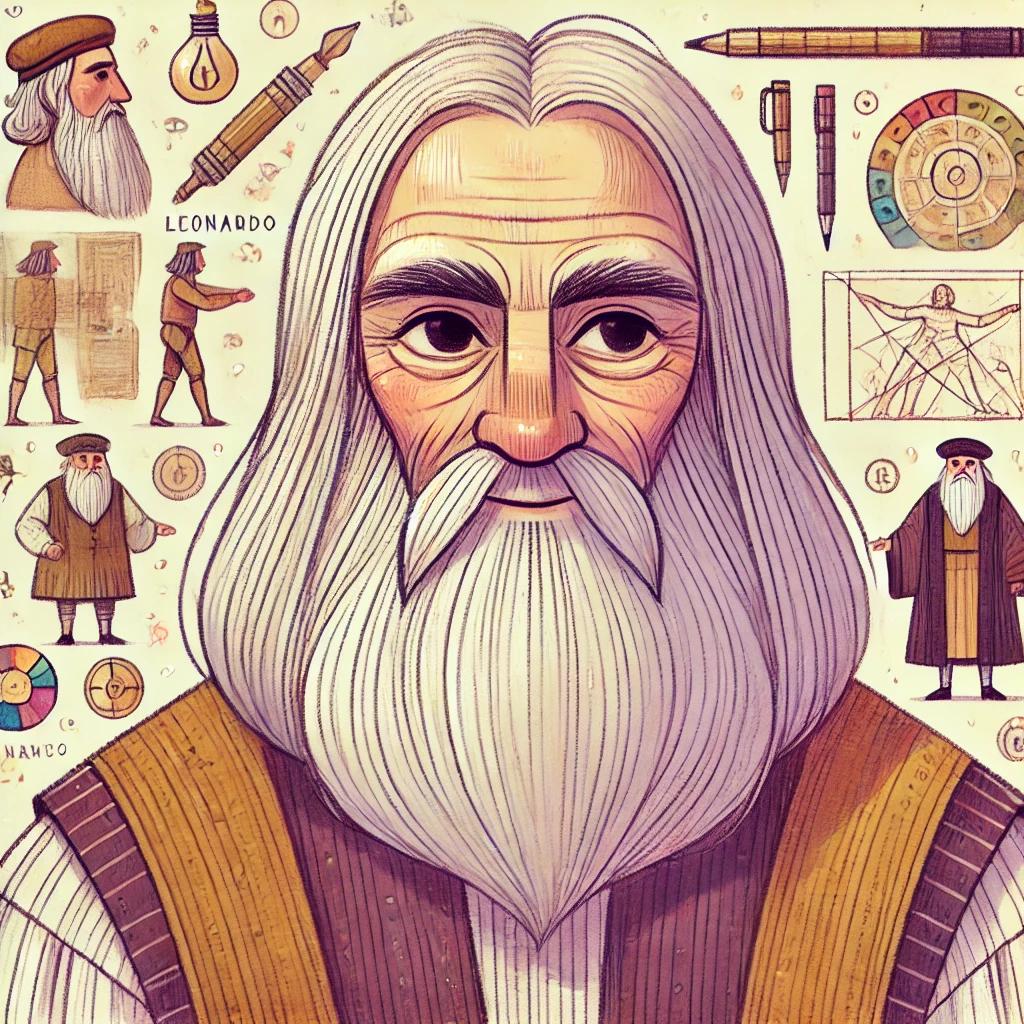
Leonardo da Vinci (generated by artificial intelligence)
Journey into Art
At the age of fourteen, he moved to Florence and began working in the workshop of the renowned artist Andrea del Verrocchio. There, he learned painting, sculpture, metalwork, engineering drawings, and stage design. He quickly gained recognition for his extraordinary talent. His most famous paintings are the Mona Lisa and The Last Supper. The enigmatic smile of the Mona Lisa remains one of the most renowned works of art in the world.

Mona Lisa (generated by artificial intelligence)
Scientific and Engineering Studies
Aside from painting, Leonardo had a deep interest in science. He conducted anatomical studies to understand how the human body functions, creating detailed drawings of skeletons and muscles. By examining the wing movements of birds, he designed flying machines. He performed experiments on rivers to understand the movement of water. He also designed devices similar to helicopters, bridges, and war machines.
A Curious Mind
Leonardo’s notebooks were filled with thousands of drawings and notes. Interestingly, he often wrote his notes from right to left, in mirror script. This allowed him to write quickly while keeping his ideas private. His greatest strength was his unwavering habit of asking, “How does this work?”
Final Years and Legacy
In 1516, at the invitation of King Francis I of France, he settled in Amboise. There, he spent his final years engaged in artistic projects and inventive ideas. He passed away on May 2, 1519. He left behind a legacy that profoundly influenced both the art and science worlds. Even today, his ideas and works continue to serve as a source of inspiration.