



Lüleburgaz Sokollu Mehmet Paşa Kervansarayı
Karavansarays were large buildings where travelers and merchant caravans traveling long distances could safely rest and stay. The Lüleburgaz Sokullu Mehmet Paşa Karavansaray was located on a major travel and trade route extending from Istanbul to the Balkans during the Ottoman Empire. This structure served as a crucial stop for ensuring the safety of both travelers and goods. The karavansaray was not merely a place of lodging but also part of a larger complex known as a külliye, which included multiple buildings such as a mosque school and bathhouse.

Lüleburgaz Sokullu Mehmet Paşa Karavansaray (Culture Portal)
When and Where Was the Külliye Built?
This külliye, a large complex of structures, was commissioned by Sokullu Mehmet Paşa one of the most powerful grand viziers of the Ottoman Empire. Construction of the külliye began approximately 450 years ago in 1569–1570.
The structures were designed by Mimar Sinan the foremost architect of the era. Lüleburgaz lay on a strategically vital route between Istanbul and Edirne both commercially and militarily. Therefore the construction of the karavansaray and külliye here facilitated travel and elevated Lüleburgaz to the status of an important center.

Lüleburgaz Sokullu Mehmet Paşa Karavansaray (Culture Portal)
What Did the Karavansaray Look Like?
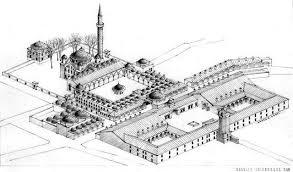
The karavansaray was a key component of the külliye. According to historical sources it was a large inn with a massive gate resembling a fortress an open courtyard and hundreds of lodging rooms.
The courtyard and stables of the karavansaray could accommodate thousands of animals indicating the scale of merchant caravans that traveled with camels horses and donkeys. The karavansaray provided a secure shelter where travelers and merchants could rest safely with their goods.

Lüleburgaz Sokullu Mehmet Paşa Karavansaray (Culture Portal)
A Journey Through Time
The karavansaray remained in use for many centuries after its construction in the 16th century. However over time particularly toward the end of the 19th century it was also used as a kışla (military barracks) for soldiers. Unfortunately much of the karavansaray was demolished in 1935 due to road construction. Today while some parts of the külliye such as the mosque medrese and bathhouse still stand only fragments of the karavansaray remain visible including sections of its walls hearth areas and part of the entrance.
What Else Was in the Külliye?
The karavansaray was only one part of the larger külliye. The külliye also included the following:
- Mosque: For worship.
- Medrese: For education and schooling.
- Sıbyan Mektebi: A primary school for children.
- Arasta (Bazaar): A commercial area with shops.
- Bathhouse: A double bathhouse with separate sections for women and men.
- İmaret: A soup kitchen that provided meals to the poor and travelers.
These buildings collectively provided everything a city needed in a single integrated complex during that period.