




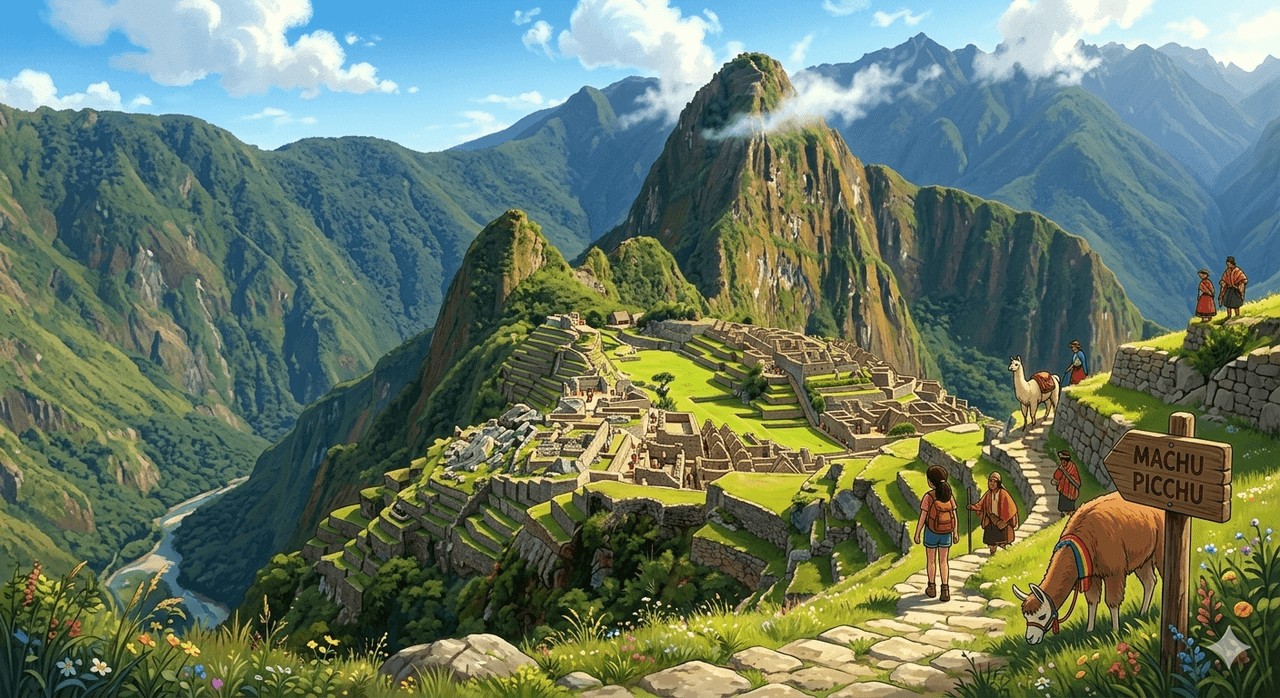
Machu Picchu
Machu Picchu, located high in the Andes Mountains of Peru, is an ancient Inca settlement hidden just beneath the clouds. This enchanting site, chosen in 2007 as one of the New Seven Wonders of the World, captivates visitors from every corner of the globe each year. Have you ever wondered how people living as high as the clouds built their cities?
Who Built This City and Why?
This mysterious city was constructed around 1450 by the powerful Inca Emperor Pachacuti. The Incas used it both for religious ceremonies and as a special royal palace. The city is so elevated that approximately 1,000 people could live simultaneously at its highest point.
When Spanish conquistadors invaded the region, the Incas were forced to abandon this beautiful city. For about 400 years, it remained hidden among dense trees and vegetation, forgotten by the world. However, in 1911 it was rediscovered by the explorer Hiram Bingham, and the entire world came to know this miraculous place.
A Journey Through Time
Exactly 576 years ago, when the Incas built this magnificent city atop the high mountains, they had no electricity or modern machinery. Using ingenious methods such as rope-and-pulley systems, they transported massive stones up the slopes.
A Giant Stone Puzzle
The most astonishing feature of Machu Picchu is how its buildings were constructed from enormous granite stones fitted together with perfect precision. The Incas used no mortar (a mud-like substance used to bind stones) to join them. The stones were cut so accurately that you cannot even slip a sheet of paper between them! For the Incas, stones were not merely lifeless materials but entities deserving reverence. Therefore, when constructing their buildings, they carefully aligned them with the shapes of the surrounding mountains. This unique construction technique also made the city highly resistant to earthquakes, helping it survive to the present day.
A City That Watches the Sky
The Incas held deep reverence for the sky, the Sun, and the stars. At the city’s highest point lies the Intihuatana stone, which functioned like a solar clock. Priests observed its shadow to determine when the seasons changed and when to plant crops. The city also contained temples with special windows designed for observing the heavens. For example, the window of a structure called the Torreon is precisely aligned to capture the first rays of the Sun during the June solstice. Through these observations, the Incas established an unbreakable connection between the heavens and the earth.
Why So High?
Scientists have long investigated why this city was built at an elevation of 2,430 meters. Research has revealed that it was constructed precisely where underground fault lines (massive cracks in the Earth’s crust) intersect. These faults form an “X” shape directly beneath the city. These fault lines actually made the Incas’ work easier, as they naturally provided ready-made stone blocks for construction. Additionally, this geologically active zone allowed heavy rainfall to easily drain underground, creating a natural drainage system that protected the city from floods.