



Mescid-i Nebevi
The Prophet’s Mosque is one of the first major structures built by the Prophet Muhammad after his migration to Medina. It served both as a place of worship and as a center where Muslims gathered, united, and received instruction.
The mosque was constructed in Rabi’ al-Awwal 622 on land acquired from two orphans named Sehl and Süheyl, under the direct supervision of the Prophet Muhammad. The original structure featured a stone foundation, a single row of sun-dried brick walls, and an open roof, covering an area of approximately 1,022 square meters.

Generated by Artificial Intelligence.
Initially, the qibla faced Jerusalem; approximately sixteen to seventeen months after the migration, it was redirected toward the Kaaba. A simple canopy was erected over the spot where the Prophet Muhammad prayed, to mark and protect it.

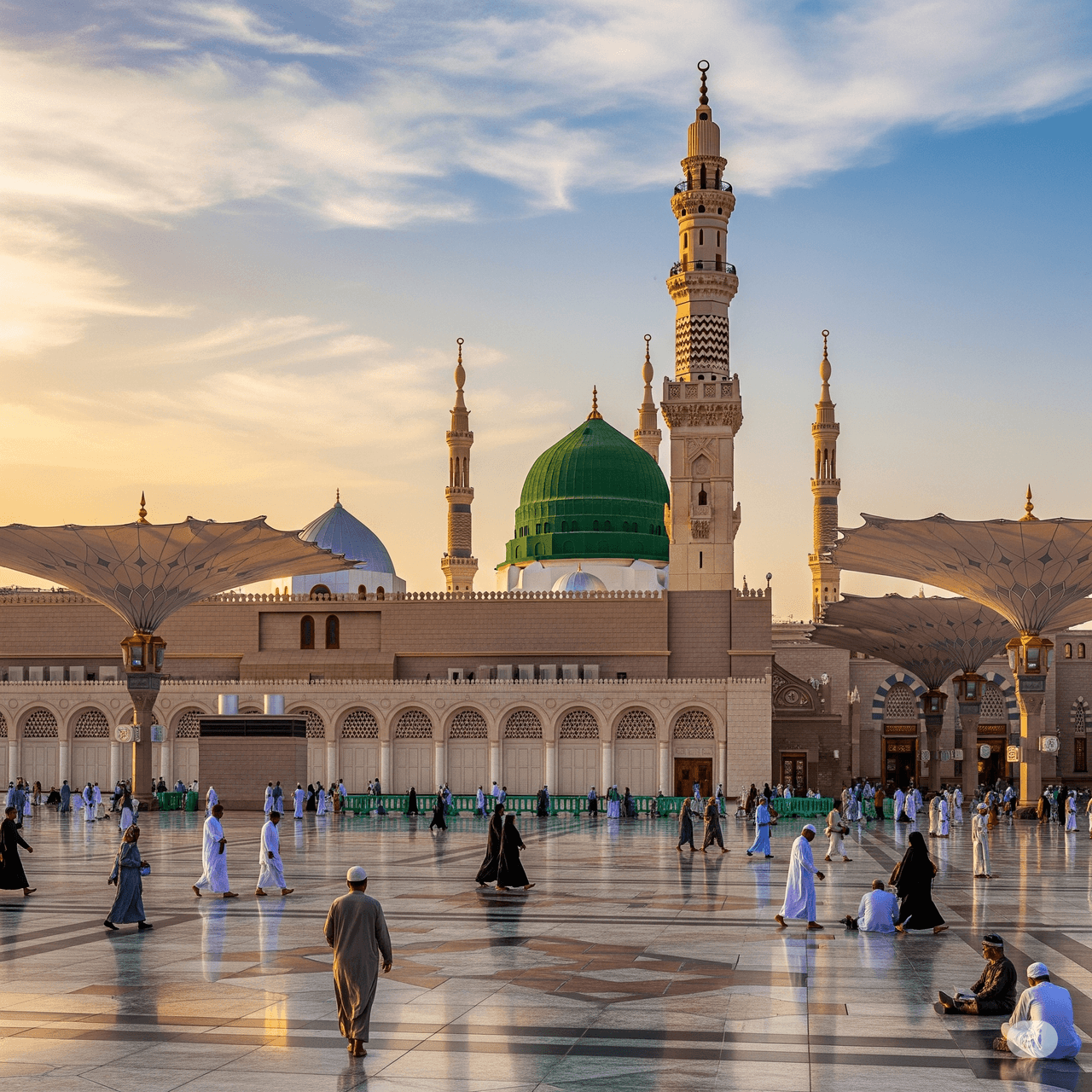
Generated by Artificial Intelligence.
As the Muslim population grew, the mosque was expanded over time. During the caliphate of Umar, several surrounding houses were incorporated into the mosque complex. Uthman, using his own resources, demolished and rebuilt the mosque on a larger scale. During the reign of the Umayyad Caliph Walid, minarets, a mihrab, a pulpit, and the Chamber of Happiness were added to the mosque.
The Prophet’s Mosque is regarded as the second most virtuous mosque in Islamic history after the Sacred Mosque in Mecca and has played a central role for Muslims, both religiously and socially.