




Mirror
Mirror
Have you ever looked into a mirror and wondered how your image is formed? Mirrors, which we use daily to wash our faces, comb our hair, or check our clothing, are indispensable items in our everyday lives. But when did humans begin using mirrors, and how do they work?

(Bu görsel yapay zeka tarafından oluşturulmuştur.)
What Is a Mirror?
A mirror is a shiny surface that reflects light falling on it to display the image of objects in front of it. Light bounces off our faces and surrounding objects, then reaches the mirror. When this reflected light reaches our eyes, we see our own image.
Mirrors used in homes typically have a flat surface. In these mirrors, our image appears close to its actual size. However, our reflection seems to be located behind the mirror. Mirrors with curved surfaces can magnify, reduce, or distort images in different ways.
How Did Humans Make the First Mirrors?
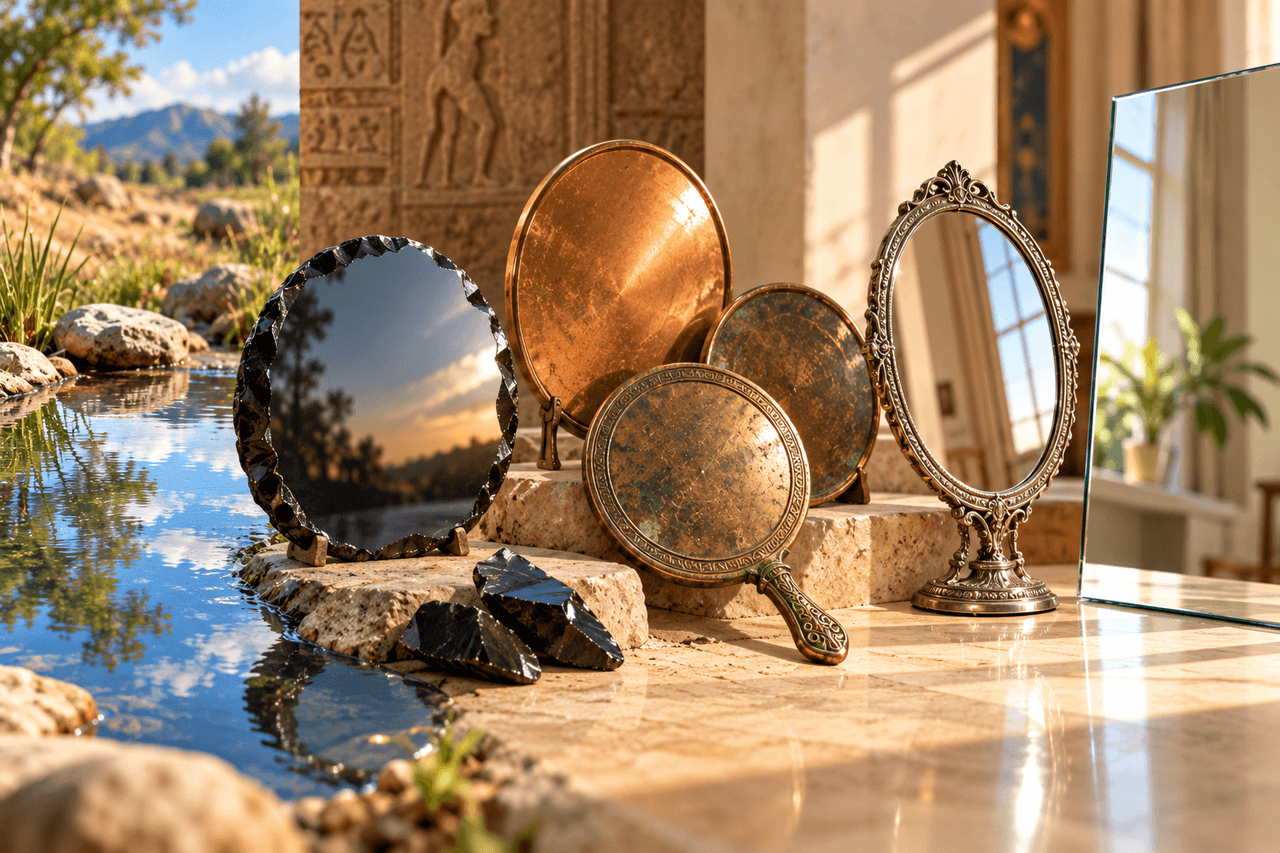
Today, mirrors are mostly made of glass. However, in ancient times, when glass mirrors were not yet common, people used different methods. The surface of still water was one of the first natural mirrors through which humans could see their own reflections.
Later, humans began crafting mirrors from obsidian, a shiny and hard volcanic stone. Obsidian mirrors dating back thousands of years have been discovered at Çatalhöyük in Anatolia. This shows that even in very ancient times, people were able to shape stones to create reflective surfaces.
In later periods, mirrors were made from metals such as copper, bronze, and silver. These mirrors could be used after their surfaces were polished. With the development of glass mirrors, mirrors became more widespread and gradually began to be commonly used in homes.
(Bu görsel yapay zeka tarafından yapılmıştır.)
How Have Mirrors Changed Throughout History?
The production of mirrors evolved as humans developed new materials and manufacturing techniques. Ancient mirrors were mostly small, made of metal, and sometimes had handles. Over time, mirrors were produced with a thin reflective layer applied to the back of glass, resulting in clearer images.
In particular, the island of Murano in Venice was one of the important centers known for glassmaking in the past. High-quality mirrors produced there were sent to different countries. In some European palaces, large mirrors covering entire walls were used. The famous Hall of Mirrors in the Palace of Versailles in France is a striking example of such ornate designs.
During the Ottoman period, mirrors were made from gold, silver, bronze, and other materials. Some mirrors were elaborately decorated and regarded as valuable works of art. Thus, the mirror became not only a practical item for daily life but also a part of art and craftsmanship.
What Are the Types of Mirrors?
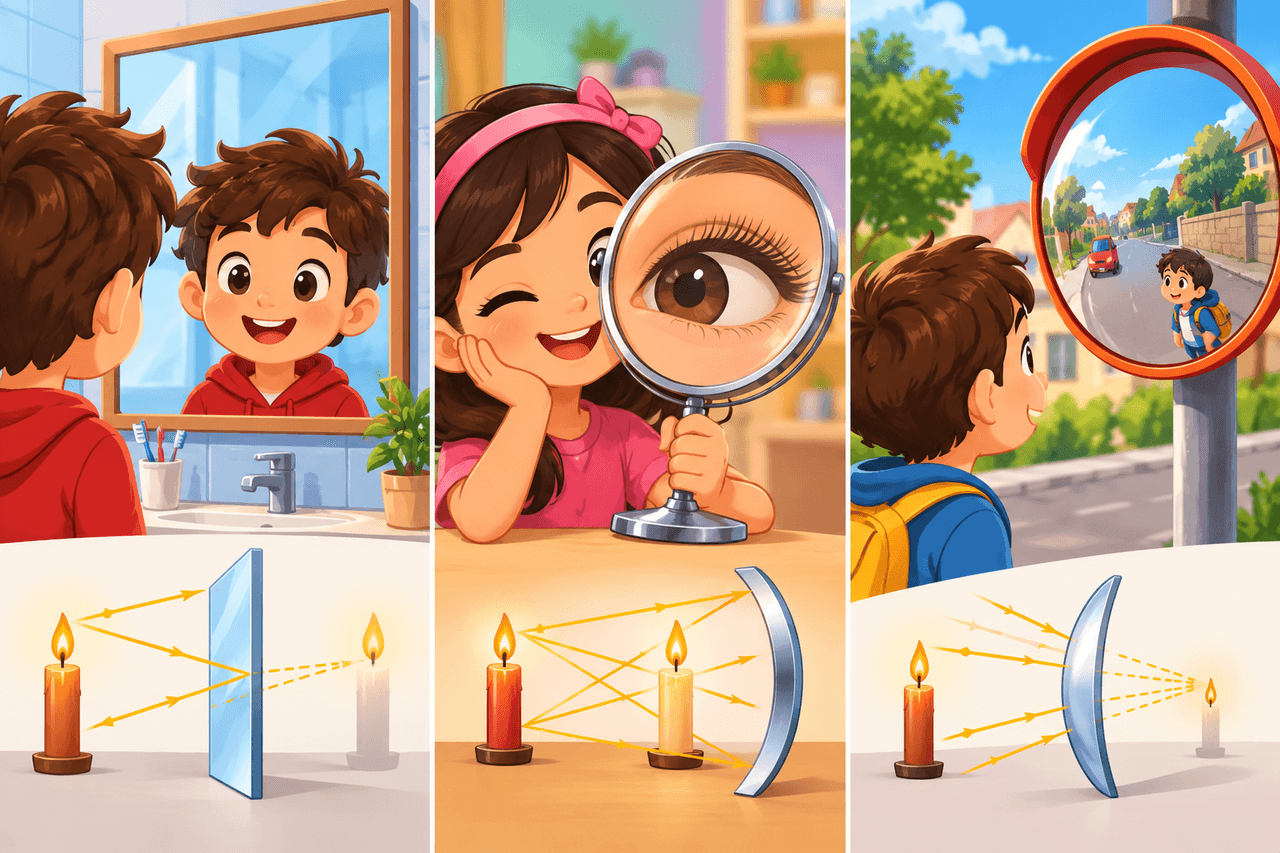
Not all mirrors produce the same image. They can have different properties depending on the shape of their surfaces.
(Bu görsel yapay zeka tarafından oluşturulmuştur.)
- Flat mirror: This is the most common type of mirror seen in homes and bathrooms. It displays an upright image that is typically the same size as the object.
- Concave mirror: It has a surface that curves inward. It can magnify images at certain distances and is used in shaving and makeup mirrors.
- Convex mirror: It has a surface that bulges outward. It shows a wider field of view, which is why it is used in vehicle side mirrors and at certain safety points.
Where Are Mirrors Used?
Mirrors are not only used for viewing ourselves. They help drivers see their surroundings, enable dentists to examine the inside of the mouth, and play a role in the operation of certain scientific instruments.
Special mirrors used in telescopes collect light from space to aid in the study of celestial bodies. Some mirrors are designed to direct light in a specific direction or to provide a broader view of an area.