




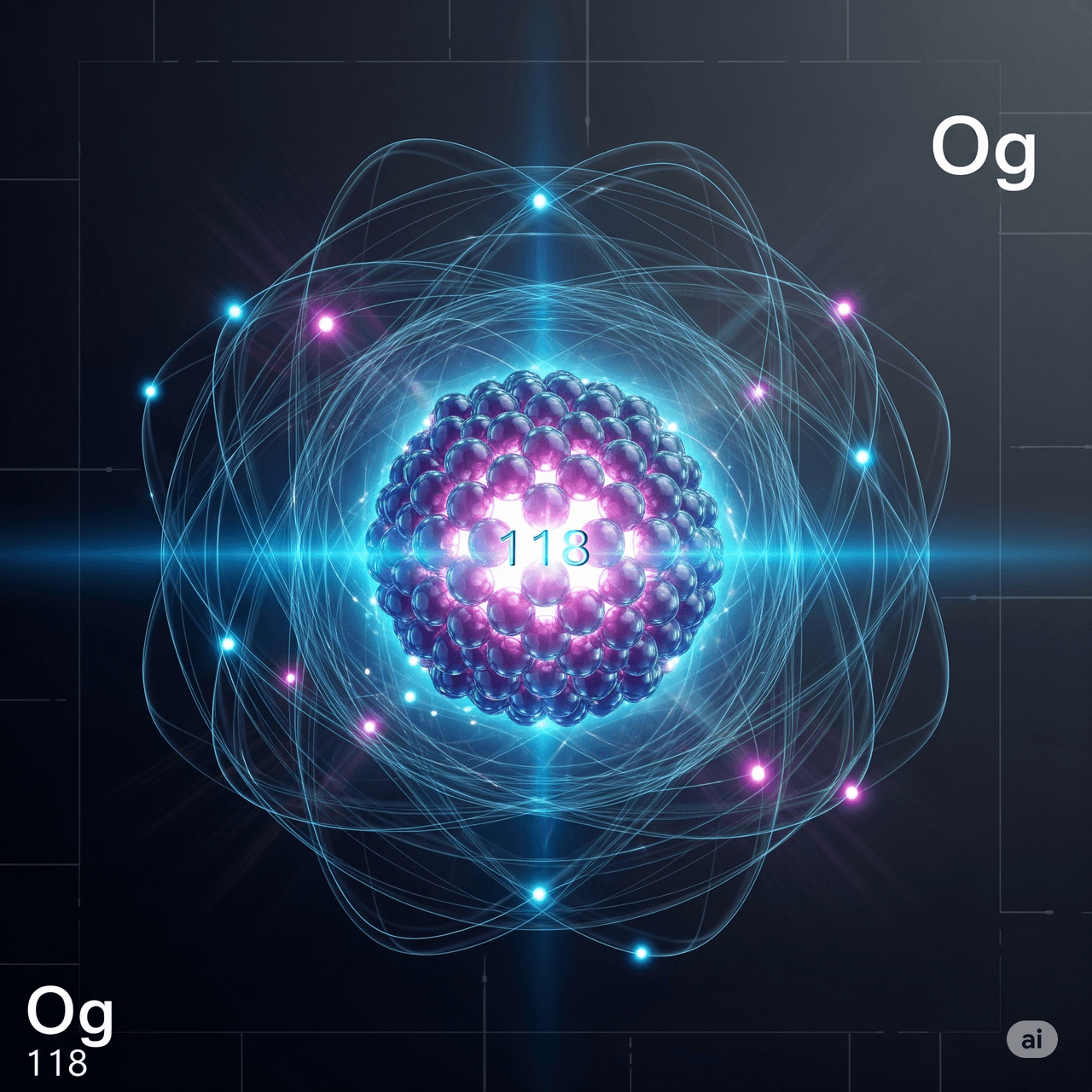
Oganesson Element
Oganesson is element number 118 in the periodic table and belongs to the group of superheavy elements. It is radioactive and does not occur naturally. It can only be synthesized in a laboratory environment. Scientists use specialized equipment to observe it.

(Generated with Artificial Intelligence.)
Classification and Basic Properties
Oganesson is classified in the noble gases group and has the symbol “Og”. Its atoms have an extremely short lifespan, lasting only a few milliseconds. As a result, its chemical properties have not been directly observed; predictions are based on theoretical calculations.
Discovery
Oganesson was synthesized in 2002 by Russian and American scientists at the Joint Institute for Nuclear Research in Dubna. The synthesis involved the use of californium and calcium isotopes. This discovery marked a significant step in the study of superheavy elements.
Origin of the Element’s Name
The element is named in honor of the renowned Russian physicist Yuri Oganessian. This reflects the importance of individual contributions in the scientific community.
Natural Occurrence
Oganesson does not occur naturally and can only be produced in a laboratory. Due to its extremely short half-life, it is difficult to observe and continuously decays.
Physical and Chemical Properties
The physical state of oganesson is not fully known; theoretical calculations suggest it may exhibit properties similar to those of noble gases. Its chemical behavior is based on predictions due to its radioactive and superheavy nature.
Applications
Oganesson has no practical applications; it is produced solely for scientific research. Studies aim to understand the limits of atomic nuclei and the behavior of superheavy elements.
Biological Significance/Effects and Precautions
Oganesson is not used biologically and has no known effects on human health. Due to its radioactivity, all research involving it is conducted in specialized laboratories with strict safety precautions.