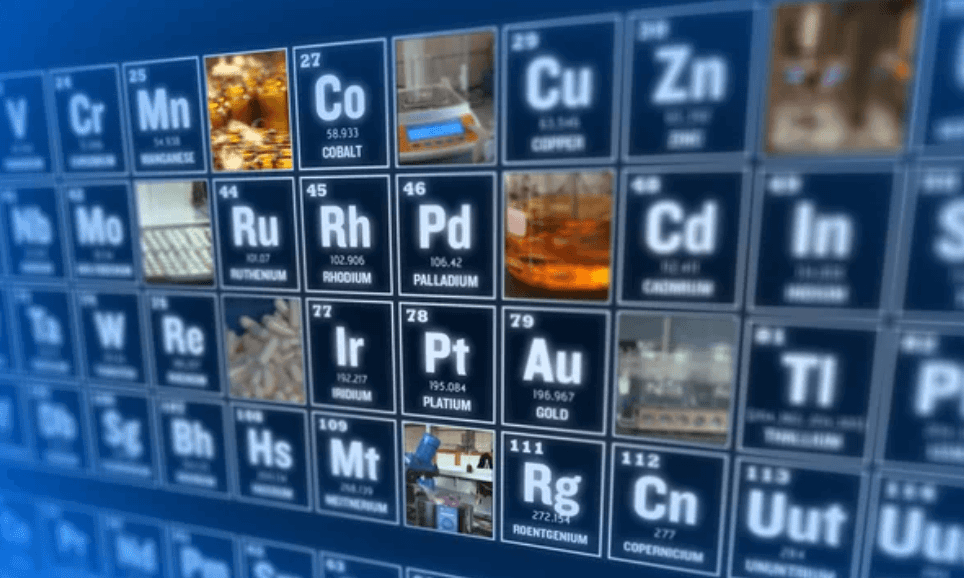




Periodic Table
The periodic table is a specialized chart that organizes all elements found in nature in a systematic manner. To date, 118 elements have been discovered and are listed in this table. However, the periodic table is not merely a list; it also provides valuable information about the properties of elements, their similarities, and how they react with one another.

Periodic Table (Turkish Chemical Society)
What Is an Element?
An element is a pure substance composed of atoms of the same type. Each element has a standardized symbol and a number. For example, hydrogen has the symbol “H” and an atomic number of 1. The atomic number indicates the number of protons in the nucleus of that element. Additionally, the mass number is listed in each element’s box; this represents the total number of protons and neutrons.
How Is the Periodic Table Organized?
The periodic table consists of horizontal and vertical boxes:
Horizontal rows are called periods. Elements in the same period have the same number of electron shells.
Vertical columns are called groups. Elements in the same group have the same number of electrons in their outermost shell and therefore exhibit similar chemical behavior.
The First 20 Elements
The first 20 elements are:
Hydrogen (H), Helium (He), Lithium (Li), Beryllium (Be), Boron (B), Carbon (C), Nitrogen (N), Oxygen (O), Fluorine (F), Neon (Ne), Sodium (Na), Magnesium (Mg), Aluminum (Al), Silicon (Si), Phosphorus (P), Sulfur (S), Chlorine (Cl), Argon (Ar), Potassium (K), Calcium (Ca).
Many of these elements are found in water, air, and even our own bodies!
Some Special Element Groups
🧂 Alkali Metals (Group 1)
Elements in this group are highly reactive. When placed in water, they release gas and fizz. For example, sodium (Na) belongs to this group.
🌱 Alkaline Earth Metals (Group 2)
These elements also react chemically but not as rapidly as alkali metals. Magnesium (Mg) is part of this group.
🌬️ Halogens (Group 17)
Halogens have seven electrons in their outermost shell. They readily combine with other elements to complete their outer shell by gaining one electron. For example, chlorine belongs to this group and plays a key role in the formation of salt.
💨 Noble Gases (Group 18)
Noble gases are stable. Their electron configurations are complete, so they rarely react with other elements. For example, helium and neon belong to this group.

Periodic Table (Depositphotos)
Metals, Nonmetals, and Metalloids
Metals are shiny and conduct heat and electricity well. Examples include copper and gold.
Nonmetals are brittle and typically exist as gases or fragile solids. Examples include oxygen and chlorine.
Metalloids exhibit properties of both metals and nonmetals. The most well-known metalloid is silicon, which is used in computer chips.
Some Scientific Concepts
🧲 Electronegativity: The ability of an atom to attract electrons from another atom.
💥 Ionization Energy: The amount of energy required to remove an electron from an atom.
📏 Atomic Radius: Indicates the size of an atom.
Periodic Table (TÜBİTAK Science Young)