




Proverb
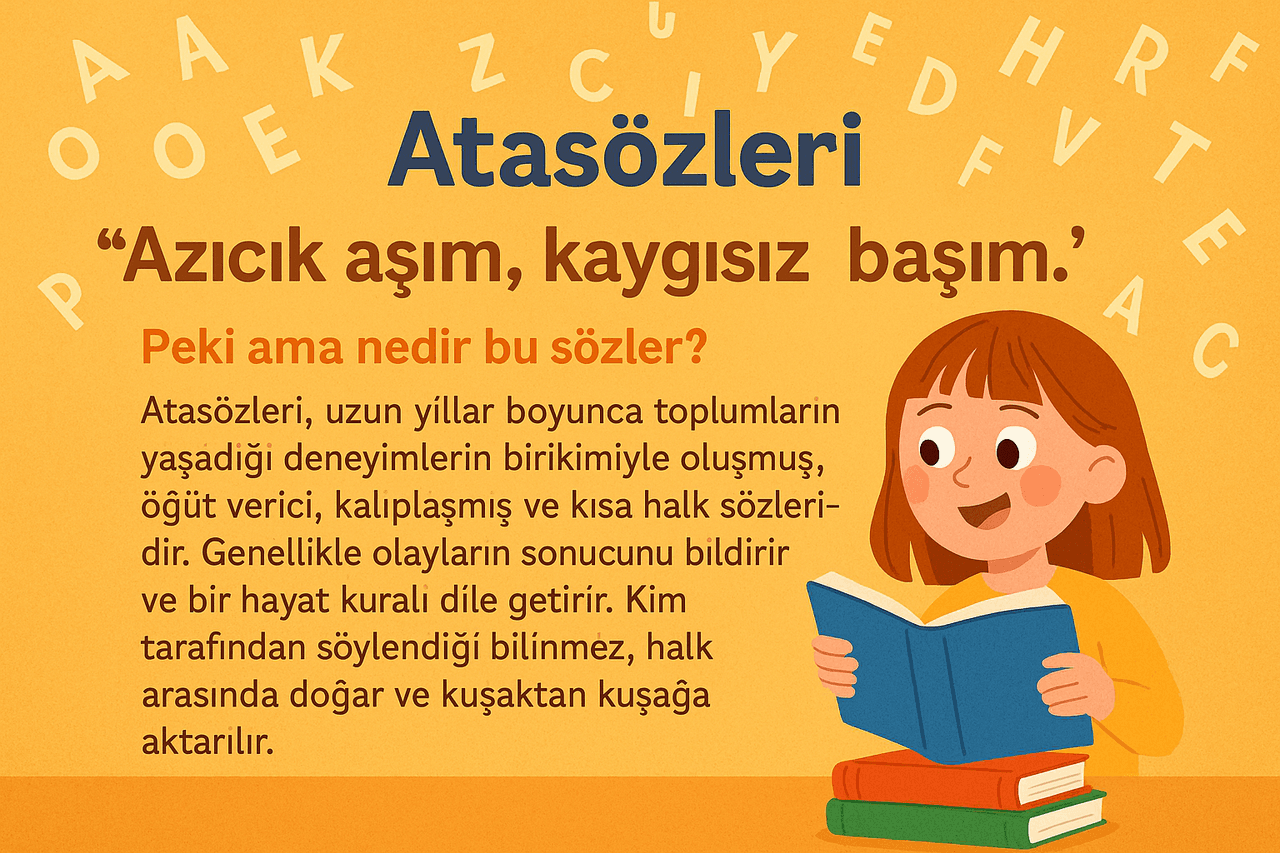
🔍 “A little overeating, carefree head”: But what do these phrases mean?
Proverbs are concise, formulaic folk sayings that have developed over centuries through the accumulated experiences of societies. They offer advice, express life principles, and are often rooted in collective wisdom. Their origin is typically unknown; they emerge from the people and are passed down from generation to generation.
(Generated by artificial intelligence.)
How Long Have Proverbs Existed?
The history of proverbs dates back to the oral culture period, even before the advent of writing. The earliest written examples of Turkish proverbs appear in the 11th-century work Divânü Lügâti’t-Türk by Kaşgarlı Mahmud. This work is both the first dictionary of the Turkish language and the first collection of proverbs. For example:
“A lying shepherd loses his sheep to wolves.” (Divânü Lügâti’t-Türk)
From the 13th to the 15th centuries, written examples of proverbs increased, and from the 16th century onward, they were frequently used by court poets and folk bards. Thus, proverbs established a firm place both in spoken language and in literature.
What Are the Characteristics of Proverbs?
- Short and concise: They convey deep meaning in a single sentence.
- Anonymous: The speaker is unknown; they belong to the people.
- Transmit experience: They are life lessons passed down from past generations.
- Enduring: They have a fixed structure and are used unchanged over time.
- Employ figurative language: They often communicate indirectly rather than literally.
- Reflect societal values: They embody shared values such as morality, honesty, diligence, and mutual aid.
What Is the Structure of Proverbs?
Proverbs can be classified according to their form:
- Conditional proverbs: “As you sow, so shall you reap.”
- Comparative proverbs: “He who does good finds good; he who does evil finds evil.”
- Single-clause proverbs: “A little overeating, carefree head.”
- Cause-and-effect proverbs: “Store your hay, for the time will come.”

(Generated by artificial intelligence.)
Do Proverbs Change?
Although proverbs are fixed in form, as societies change, new proverbs emerge or existing ones acquire updated meanings. For instance, technological advances, new lifestyles, or social transformations may lead to reinterpretations of traditional proverbs in different contexts.
Why Are Proverbs Important for Children?
- They contribute to language development.
- They support abstract thinking skills.
- They teach societal values.
- They aid memory development, as they are easy to memorize.
- They encourage critical thinking.
Are Proverbs Universal?
Yes! Similar proverbs conveying the same message exist in different languages and cultures. For example:
- Turkish: “Ne ekersen, onu biçersin.”
- English: You reap what you sow.
- Arabic: Kema tedîn tüdân. (As you behave, so shall you be treated.)
This demonstrates that humanity’s shared experiences have given rise to common oral expressions across cultures.
References:
- “Most Common Proverbs and Their Meanings”, TRT Children – Parent Academy, https://ebeveynakademisi.trtcocuk.net.tr/makale/en-cok-kullanilan-atasozleri-ve-anlamlari-17799402, Accessed: 10 July 2025.
- Öztürk, R. (2022). “Historical Development of Proverbs”, Süleyman Demirel University Journal of Social Sciences, 47, 134–149. https://dergipark.org.tr/tr/pub/sutad/issue/70255/1130521
- Küçükoğlu, H. (2021). “Changes in Turkish Proverbs Through Historical Processes”, Erciyes University Publication, https://avesis.erciyes.edu.tr/yayin/81c94b57-eea7-4e44-90dc-d21c78994615
- “Proverbs”, Turkish Education Encyclopedia, https://turkmaarifansiklopedisi.org.tr/atasozleri, Accessed: 10 July 2025.
- Gümüş, M. (2021). “Cultural Transmission Through Proverbs”, DergiPark, https://dergipark.org.tr/en/download/article-file/2183390, Accessed: 10 July 2025.