
KURE Kids Header Line
badge icon

This content was originally written in Turkish for children and is automatically translated into English using artificial intelligence.

article-image

Rabbit with Snow Boots

Last Updated: 01.12.2025

The snowshoe hare (Lepus americanus) belongs to the family Leporidae. It is a nimble and cautious animal found in forests and tundra regions. One of its most distinctive features that set it apart from other hares is its broad, fur-covered footpads, which allow it to move easily across snow. Additionally, its long hind legs and powerful muscles enable it to run swiftly and leap over obstacles.


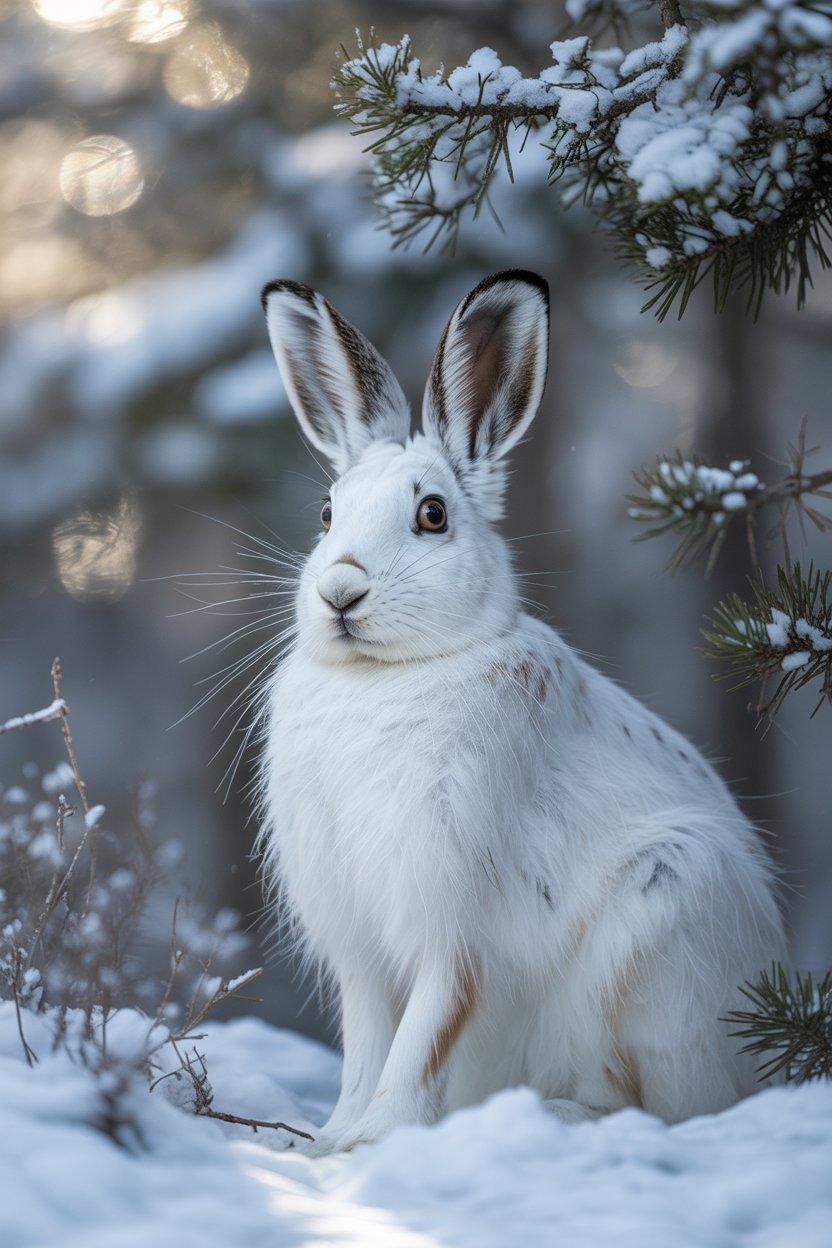
Snowshoe Hare (Unsplash)


What Are Its Colors?

The fur color of snowshoe hares changes with the seasons. During summer, their coats are typically shades of brown, which helps them blend into the forest floor and among shrubs. In winter, their fur turns completely white, allowing them to move undetected across snowy landscapes. The fur on their footpads also thickens in winter, aiding their movement on snow.


How Large Do They Grow?

The body length of snowshoe hares, from head to tail, ranges from approximately 41 to 52 cm. Their weight is around 1.5 kg.


Snowshoe Hare (Freepik)


How Long Do They Live?

In the wild, the average lifespan of snowshoe hares is 2 to 5 years. However, under favorable conditions, some individuals may live up to 8 to 10 years. Predators, harsh winter conditions, and food scarcity are the main factors that shorten their lifespan.


What Do They Eat?

Snowshoe hares feed on leaves, twigs, buds, and bark-bearing plants in the wild. During winter, the primary food sources become the bark, branches, and dried vegetation of shrubs and trees. They particularly favor branches from poplar and willow trees.


Snowshoe Hare (Freepik)


Where Do They Live?

Snowshoe hares inhabit forested and tundra regions of North America. They are especially common in northern Canada and the northern United States. Dense forests, shrublands, and open tundra areas are among the habitats they prefer.


Conservation Status

The snowshoe hare is classified as “Least Concern” by the International Union for Conservation of Nature (IUCN). This indicates that the species’ wild population is currently not at risk.

Don't Forget to Look at These!
Science and Technology
cat img
History and Culture
cat img
Art and Literature
cat img
image
Most Read
Thomas Edison
arrow
image
Last Added
Kişisel Verileri Koruma Günü
arrow
ilham-notu-bg
INSPIRATION NOTE FOR CURIOUS KIDS!

If you were a snowshoe hare, which branch or shrub would you store your food on during winter? Imagine leaping swiftly on your long hind legs, silently moving across the snow, and gnawing on branches with your powerful paws! Perhaps a branch or bud you left behind could, years later, lead to the growth of a new plant in the forest.

Who Wrote?
Kids Writing
AuthorBuse Nur ŞENDecember 1, 2025
bottom-bg-effect-bottom
bottom-bg-effect-top

The snowshoe hare is a nimble mammal native to the forests and tundra regions of North America, recognized by its white fur in winter and brown fur in summer, as well as its large, fur-covered feet. It feeds on leaves, twigs, and tree bark, particularly preferring poplar and willow branches in winter. The species is widespread in northern Canada and the United States and is classified by the IUCN as “Least Concern”.

Bibliographies


Freepik. "lepus americanus JPG." Accessed August 21, 2025. Accessed adresi

Freepik. "lepus americanus JPG." Accessed August 21, 2025. Accessed adresi

Karacık, Burak. "Kar Ayakkabılı Tavşan." *Kutup Bilimleri Ansiklopedisi.* Accessed August 21, 2025. https://ansiklopedi.tubitak.gov.tr/kutup/ansiklopedi/kar-ayakkabili-tavsan

National Geographic. "Snowshoe Hare." nationalgeographic.com. Accessed August 21, 2025. https://www.nationalgeographic.com/animals/mammals/facts/snowshoe-hare

National Wildlife Federation. "Snowshoe Hare." nwf.org. Accessed August 21, 2025. https://www.nwf.org/Educational-Resources/Wildlife-Guide/Mammals/Snowshoe-Hare

NatureServe Explorer. "Lepus americanus." natureserve.org. Accessed August 21, 2025. https://explorer.natureserve.org/Taxon/ELEMENT_GLOBAL.2.104729/Lepus_americanus

Unsplash. "Lepus americanus JPG." Accessed August 21, 2025. https://unsplash.com/photos/white-rabbit-surrounded-by-snow-EBMCAEEuLro

ilham-notu-bg
ilham-notu-bg
ilham-notu-bg
HEYY!
Did You Know?
These?
Lamb
Lamb
Ask to Küre