


Red Crescent Week
Kızılay is a neutral and independent humanitarian aid organization that rushes to the assistance of people in need across the world without regard to religion, language, race, or nationality. It organizes efforts to protect human life, health, and dignity during catastrophic natural disasters such as earthquakes, floods, and fires, as well as extraordinary situations like wars and epidemics.

(Generated by Artificial Intelligence.))
Its fundamental aim is to alleviate human suffering without seeking profit, to promote a culture of selfless kindness within society, and to support individuals in crisis in rebuilding their lives.
When and How Was Kızılay Established?
The idea that aid should be extended to people on battlefields and during major disasters without any distinction first emerged in Switzerland, leading to the gathering of statesmen in Geneva in 1859 and the formation of the international Red Cross movement. Shortly after this humanitarian movement spread globally, action was taken in our country, and in 1868 a substantial aid society was founded under the name "Association for the Assistance of Wounded Soldiers".
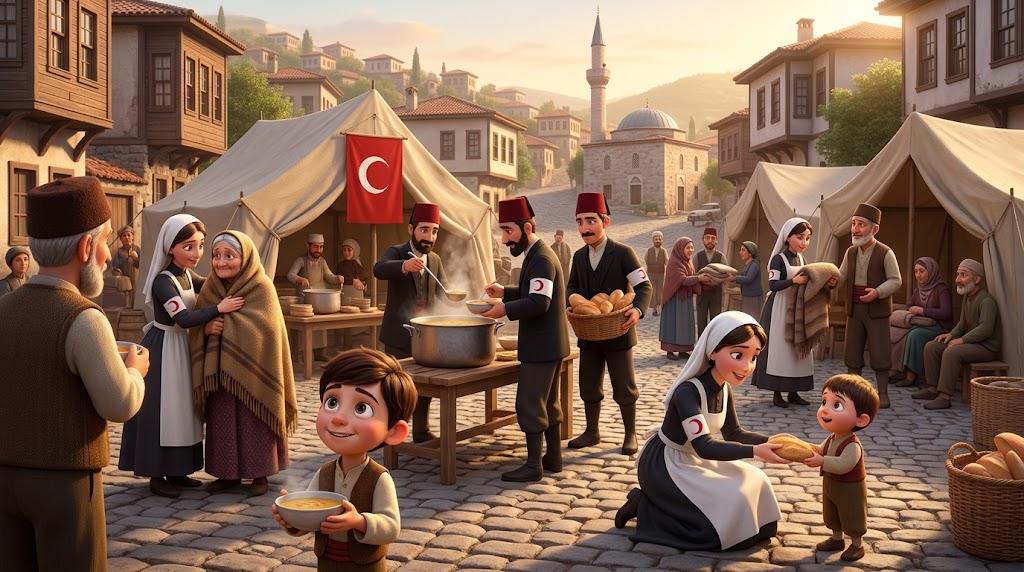
Generated with Artificial Intelligence.
Over time, this association expanded its organization and during the Ottoman Empire adopted the name "Hilal-i Ahmer". In archaic Turkish, "hilal" means crescent and "ahmer" means red. After the proclamation of the Republic, the institution's name was renewed to fully reflect its Turkish equivalent and became the Turkish Red Crescent Society (Turkish Red Crescent). Since its founding, it has continued to extend the compassion and solidarity of the Turkish nation to millions of people in need both domestically and internationally.
What Does the Flag of Kızılay Signify?
The flag of the Turkish Red Crescent Society consists of a red crescent on a white background. This flag is not a randomly chosen symbol but an expression of deep historical heritage and sacrifice.

(Generated by Artificial Intelligence.)
White Background: Represents the white shirts of innocent civilians and wounded soldiers striving to save lives during conflict and disaster; it also symbolizes peace and neutrality.
Red Crescent: Represents the blood of the wounded, compassion, conscience, and mercy without discrimination.
What Does Kızılay Do and How Does It Operate?
The scope of Kızılay's activities is not limited to disaster days but continues uninterrupted throughout the 365 days of the year. It carries out multifaceted assistance programs targeting vulnerable segments of society.
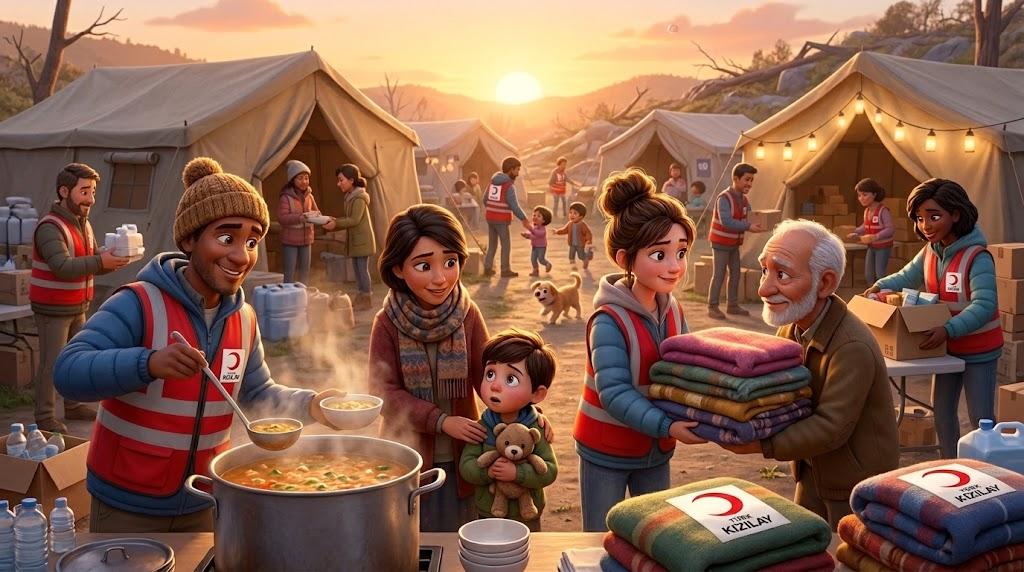
(Generated by Artificial Intelligence.)
Shelter and Nutrition Support
Tents, blankets, clothing, and food supplies prepared in advance are dispatched to affected areas to alleviate the suffering of citizens rendered homeless by earthquakes, floods, or major fires. Hot meals are distributed to meet the basic survival needs of disaster victims.
Soup Kitchens and Social Assistance
Through soup kitchens opened in various parts of the country, daily hot meals are provided to individuals who have lost their ability to work, as well as to the poor, homeless, and those in need of care. In addition, material aid in the form of food and clothing, as well as cash assistance, is provided to families lacking financial means to meet their basic needs.

(Generated by Artificial Intelligence.)
Health Services, Mobile Hospitals, and Blood Banking
Free health care and medication support are provided to individuals without social security. Field hospitals and temporary medical units are established in disaster zones to aid the recovery of the injured. At the same time, Kızılay regularly collects blood donations from volunteer citizens through its blood centers, stores them safely in laboratories, and makes them available to patients awaiting emergency surgery or treatment.

(Generated by Artificial Intelligence.)
Disaster Awareness Education
Comprehensive disaster awareness education programs are organized for the entire population, with priority given to children and students, to ensure societal preparedness for disasters and to minimize losses.
Where Does the Red Crescent Obtain Its Income?
The Red Crescent is a non-profit, fully volunteer-based legal aid organization. To sustain its services, it relies on government support as well as income from member dues, donations from compassionate citizens, and sales of Red Crescent stamps and badges. However, the Red Crescent’s greatest strength lies in its volunteers and donors who work on the ground to uphold human dignity without expecting anything in return.
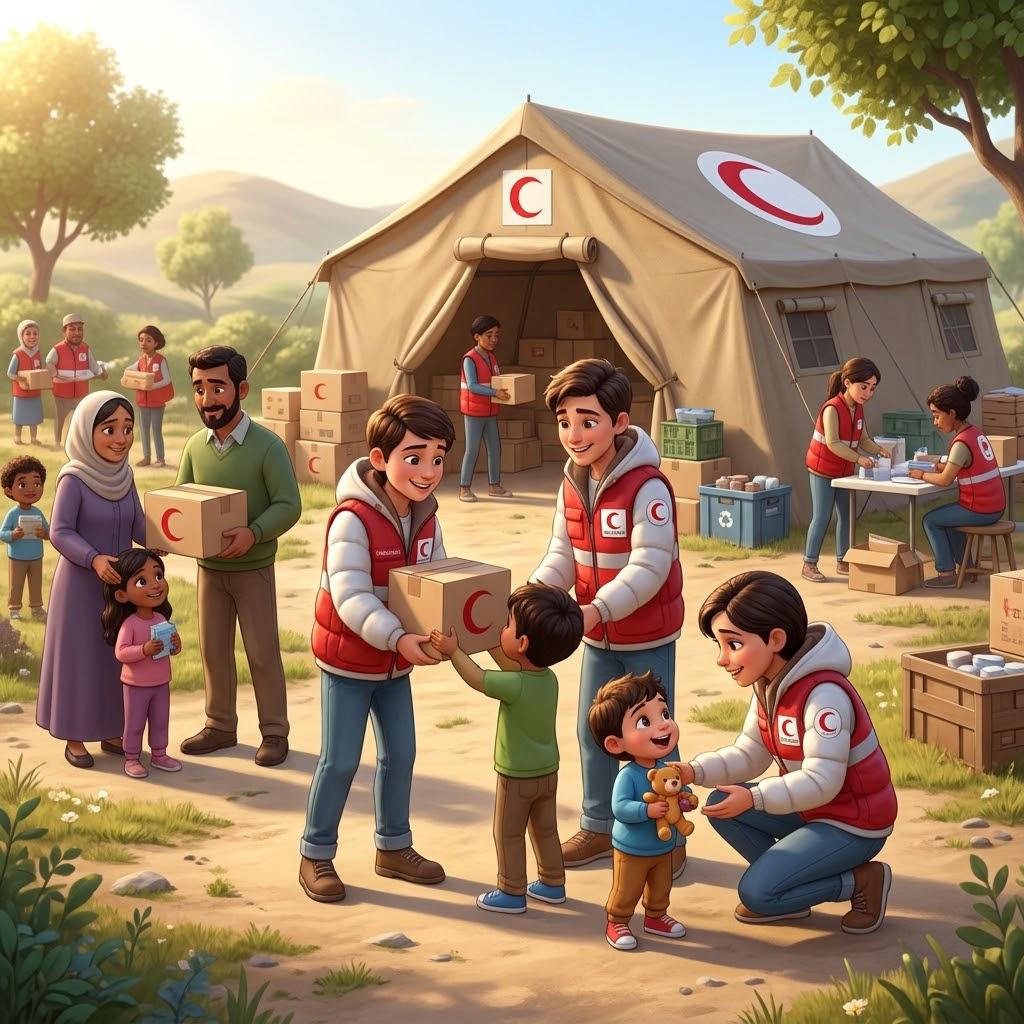
(Generated by Artificial Intelligence.)
Red Crescent Week (October 29 – November 4)
To promote awareness of Red Crescent principles and foster a spirit of mutual aid and solidarity, the period between October 29 and November 4 each year is recognized as Red Crescent Week. During this week, schools hold discussions on the importance of the Red Crescent, create posters and craft exhibitions, and recite poetry to raise public awareness. Red Crescent Week reminds everyone that anyone may need help one day and that holding hands makes the world more livable.
In-Class Awareness Activity: "The Invisible Kindness Bag"

(Generated by Artificial Intelligence.)
Objective: To develop children’s empathy and ability to help others during disasters and emergencies, and to help them understand concretely the Red Crescent’s preparedness processes.
Materials Required: A large cardboard box or bag template, colored paper, crayons, scissors, and glue.
Implementation Steps:
- Students are introduced to the basic supplies the Red Crescent delivers to disaster areas: tents, blankets, hot soup bowls, first aid kits, clean clothing, and children’s toys.
- Each student draws or writes on small cards two essential items that could bring a smile to a peer affected by disaster or meet one of their basic needs.
- On the back of each card, students write a “moral and support note” they would like to include with the item when delivering it.
- Students take turns coming to the front of the class and placing their help cards into the class’s shared “Red Crescent Aid Box,” explaining to their classmates why they chose each item.
Learning Outcome: Children learn through experience that helping others is not merely about sending material goods; compassion, empathy, and moral support are also life-saving forms of solidarity.