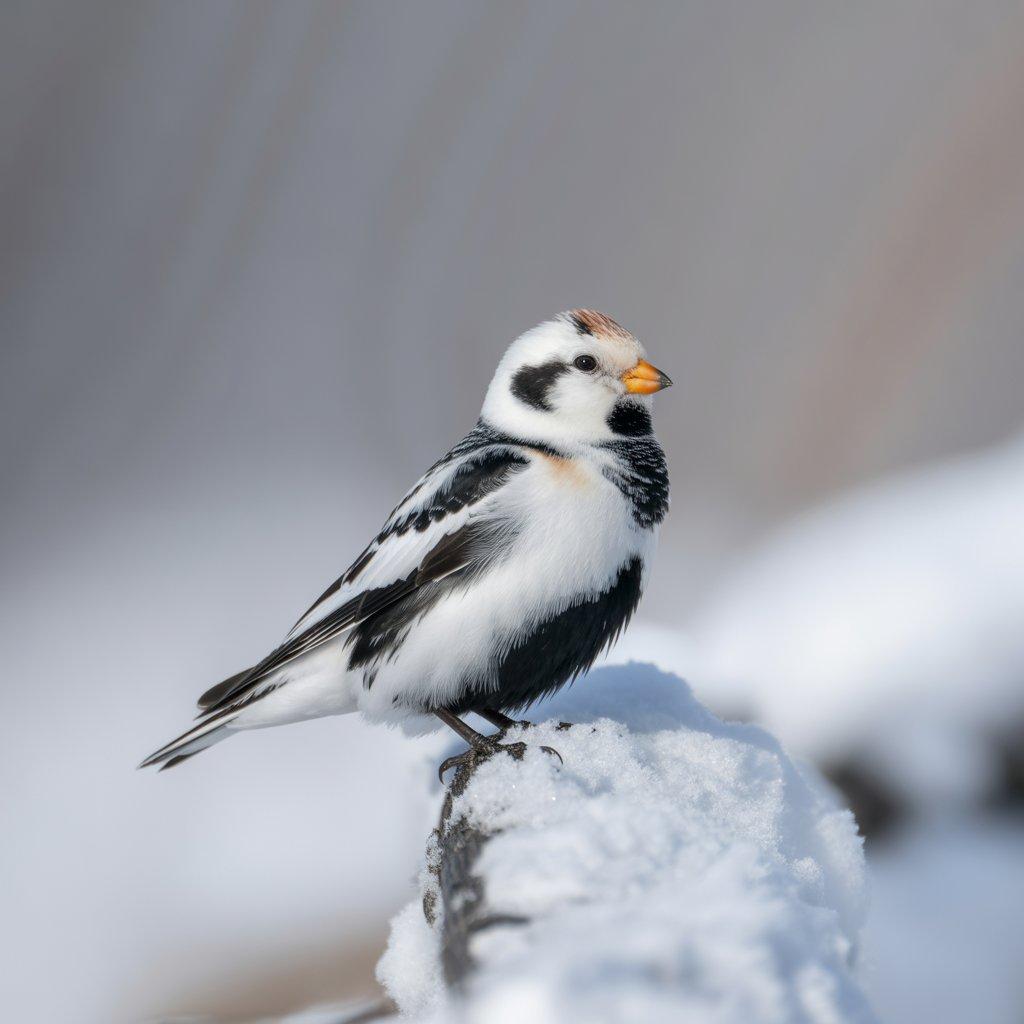




Snow Cherry Bird - Snow Sparrow
The snow bunting, also known as the snow finch (Plectrophenax nivalis), belongs to the family Calcariidae. It is one of the elegant and resilient birds of cold climates. One of its most distinctive features compared to other songbirds is its plumage that changes with the seasons.
They fly in large flocks, performing synchronized movements in the sky that resemble a dance. Even under harsh winter conditions, they travel long distances in search of food.

Snow Bunting (Generated by Artificial Intelligence)
What Are Its Colors?
Its plumage is largely white in winter, providing camouflage against snowy environments. In summer, the feathers darken, revealing distinct patterns of brown, black, and white.
Male summer plumage is striking due to the sharp contrast between black and white, while females have paler brown tones.
In Türkiye, snow buntings observed during winter months typically have bright white bodies and black wing markings. Their underparts are entirely white.

Snow Bunting (Generated by Artificial Intelligence)
How Large Do They Grow?
The body length of snow buntings ranges from 15 to 18 cm from beak to tail. Their weight typically falls between 25 and 40 grams.
How Long Do They Live?
The average lifespan of snow buntings in the wild is 3 to 4 years. However, under favorable conditions, some individuals can live up to 7 to 9 years. Predators, harsh weather conditions, and food scarcity are the main factors that shorten their lifespan.

Snow Bunting (Generated by Artificial Intelligence)
Where Do They Live?
Snow buntings generally inhabit cold regions of the Northern Hemisphere. During summer, they breed in open tundra and arctic areas. In winter, they migrate to milder regions, where they are found in fields, mountain slopes, and coastal areas. In Türkiye, they are commonly observed during winter months, especially in eastern and inland regions.
What Do They Eat?
The diet of snow buntings consists largely of seeds. In summer, they also consume insects, spiders, and other small invertebrates. During winter, they forage in fields and around villages to find food beneath snow-covered ground.

Snow Bunting (Generated by Artificial Intelligence)
What Is Their Conservation Status?
Due to their wide distribution, snow buntings are currently not under significant threat to their population. The International Union for Conservation of Nature (IUCN) classifies them as “Least Concern.” However, climate change and alterations to their habitats may affect their populations in the long term.