


This article was automatically translated from the original Turkish version.
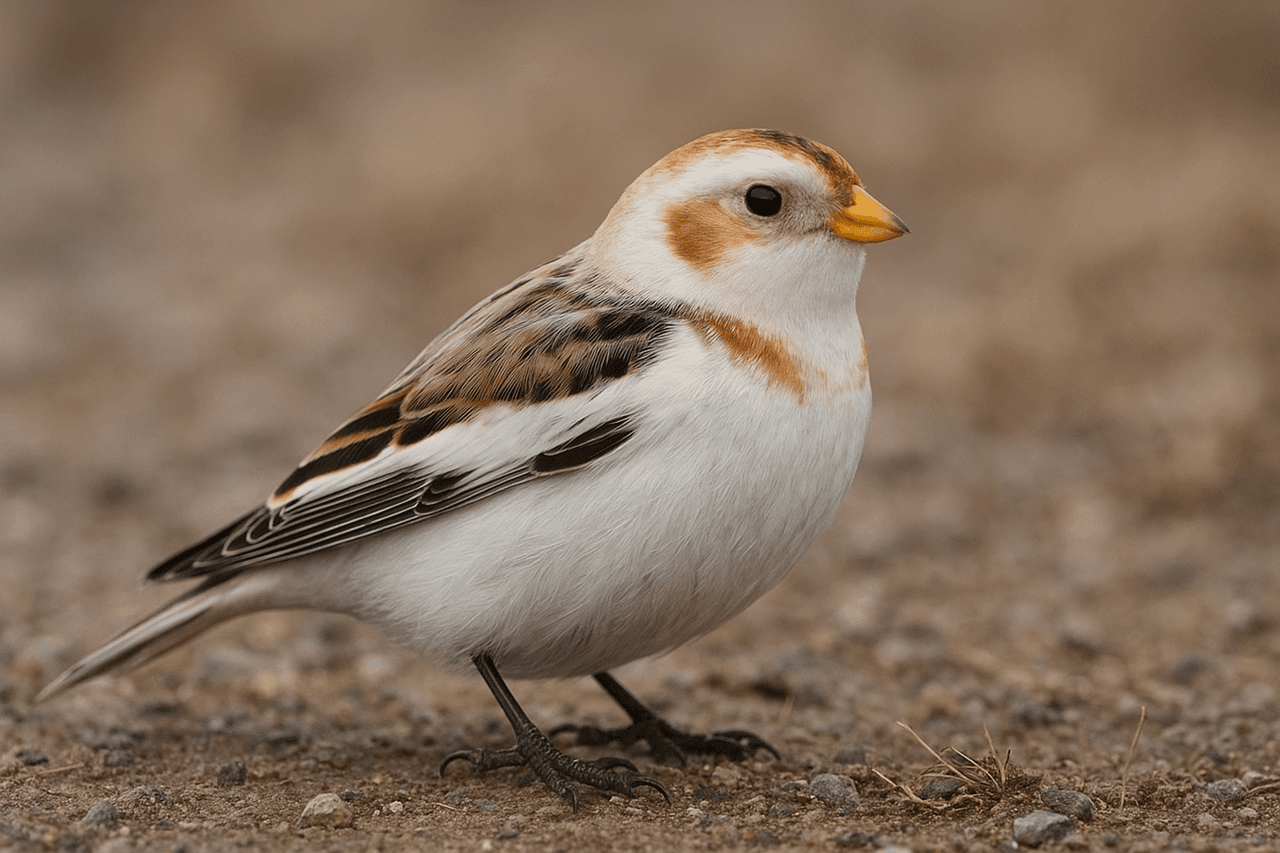
Alaca Çinte (Generated with Artificial Intelligence.)
Team(s) | Passeriformes | ||||||||
|---|---|---|---|---|---|---|---|---|---|
Family | Calcariidae | ||||||||
Genus | Plectrophenax | ||||||||
Specie(s) | Plectrophenax nivalis | ||||||||
Order | Average 15 cm | ||||||||
Wingspan | 32–38 cm | ||||||||
Weight(s) | 30–41 g | ||||||||
Conservation Status | Least Concern (IUCN) | ||||||||
The Snow Bunting (Plectrophenax nivalis) is a songbird species notable for its high-latitude adaptations, breeding in the Arctic tundra zone and migrating to more temperate latitudes during winter months. Due to its ecological functions, behavioral traits, and sensitivity to environmental pollutants, it holds significant importance in both ornithological and environmental scientific research.
The Snow Bunting is a species belonging to the order Passeriformes and the family Calcariidae. This species, classified within the genus Plectrophenax, is one of several songbirds with a distribution across high latitudes of the Northern Hemisphere. It has a stable taxonomic status, though subspecific distinctions remain controversial and are based on regional variations.

Snow Bunting (Plectrophenax nivalis) (Flickr)
Adult individuals measure approximately 15 cm in length and have a wingspan of 32–38 cm. Their weight ranges from 30 to 41 grams. Males exhibit a striking black-and-white color contrast; in winter plumage, the white wing panel and white edges of the tail are distinctive features. These white markings are less pronounced in females. The bill is pale yellowish with a darker tip. Flight is undulating and rhythmic, a characteristic that facilitates easy identification in open habitats.
During the breeding season, the Snow Bunting nests in rock crevices within the Arctic tundra zone. In winter, it migrates to the temperate northern regions of Eurasia and North America. In Türkiye, it is rare but regularly observed, particularly along the Black Sea coast during winter months. Habitat preferences are concentrated around open coastal areas, marshes, and wetlands.
The incubation period lasts approximately 12 days. While the female incubates the eggs, the male is responsible for food provisioning. Early arrival of males at breeding grounds provides advantages in territory acquisition and mate selection. Higher cold tolerance in males is a physiological trait supporting this early migratory behavior.
The diet consists of seeds, buds, and small invertebrates. During migration, small flocks follow coastal strips. Limited feeding areas during the breeding season render this period critically vulnerable to environmental exposure.
Snow Buntings move in small groups during migration. Their flight is undulating and rhythmic. Early migration by males provides advantages in securing breeding territories. In wintering areas, they exhibit more social behavior. Migration routes represent a key adaptive mechanism supporting the species’ broad geographic distribution.
The Snow Bunting is evaluated as a bioindicator for monitoring levels of persistent organic pollutants and perfluorinated compounds in Arctic terrestrial ecosystems. Its dependence on limited feeding areas during breeding allows spatial differentiation of contaminant sources. Concentrations of contaminants detected in egg lipids show significant variation linked to nesting locations and regional pollution sources. This makes the species a high-resolution bioindicator for environmental monitoring studies.
Long-term winter bird surveys in North America have revealed a marked decline in Snow Bunting populations over the past several decades. However, due to its global population of approximately 40 million individuals, the species is currently not considered threatened at the global level. Habitat alteration and contaminant exposure remain key factors requiring consideration in long-term conservation strategies.
Observations of the Snow Bunting in Türkiye are rare but consistently reported. Individuals recorded along the Black Sea coast during winter indicate that the species uses Türkiye as part of its migratory route and makes brief stopovers in suitable habitats. These observations provide complementary data for monitoring regional biodiversity.
Flickr. "Snow Bunting - Plectrophenax nivalis, North Point State Park, Edgemere, Maryland, January JPG." Accessed August 22, 2025. https://flic.kr/p/2pDub24
Montgomerie, Robert and Bruce Lyon. “Snow Bunting - Plectrophenax nivalis.” *Cornell Lab of Ornithology, Birds of the World.* Accessed August 22, 2025. https://birdsoftheworld.org/bow/species/snobun/cur/introduction?lang=es.
Warner, Nicholas A., Kjetil Sagerup, Siv Kristoffersen, Dorte Herzke, Geir W. Gabrielsen, and Bjørn M. Jenssen.
eBird. "Snow Bunting." eBird Türkiye. Accessed August 22, 2025. https://ebird.org/species/snobun?siteLanguage=tr.
Özkan, Korhan. “Alaca Çinte.” TÜBİTAK Kutup Ansiklopedisi. Accessed August 22, 2025. https://ansiklopedi.tubitak.gov.tr/kutup/ansiklopedi/alaca-cinte.
“Snow Buntings (Plectrophenax nivealis) as Bio-Indicators for Exposure Differences to Legacy and Emerging Persistent Organic Pollutants from the Arctic Terrestrial Environment on Svalbard.” Science of the Total Environment 667 (2019): 638–647. Accessed August 22, 2025. ttps://www.sciencedirect.com/science/article/pii/S0048969719308599.

Alaca Çinte (Generated with Artificial Intelligence.)
Team(s) | Passeriformes | ||||||||
|---|---|---|---|---|---|---|---|---|---|
Family | Calcariidae | ||||||||
Genus | Plectrophenax | ||||||||
Specie(s) | Plectrophenax nivalis | ||||||||
Order | Average 15 cm | ||||||||
Wingspan | 32–38 cm | ||||||||
Weight(s) | 30–41 g | ||||||||
Conservation Status | Least Concern (IUCN) | ||||||||
No Discussion Added Yet
Start discussion for "Alaca Çinte (Plectrophenax nivalis)" article
Systematic Position
Morphological Characteristics
Habitat and Geographic Distribution
Reproductive Biology
Feeding Ecology
Behavioral Traits and Migration Dynamics
Contaminant Exposure and Bioindicator Role in the Arctic Environment
Population Status and Conservation
Observation Status in Türkiye