This article was automatically translated from the original Turkish version.
Realm | Animalia | ||||||||
|---|---|---|---|---|---|---|---|---|---|
Branch | Chordata | ||||||||
Class | Aves | ||||||||
Team(s) | Passeriformes | ||||||||
Family | Turdidae | ||||||||
Conservation Status | Least Concern - LC (IUCN) | ||||||||
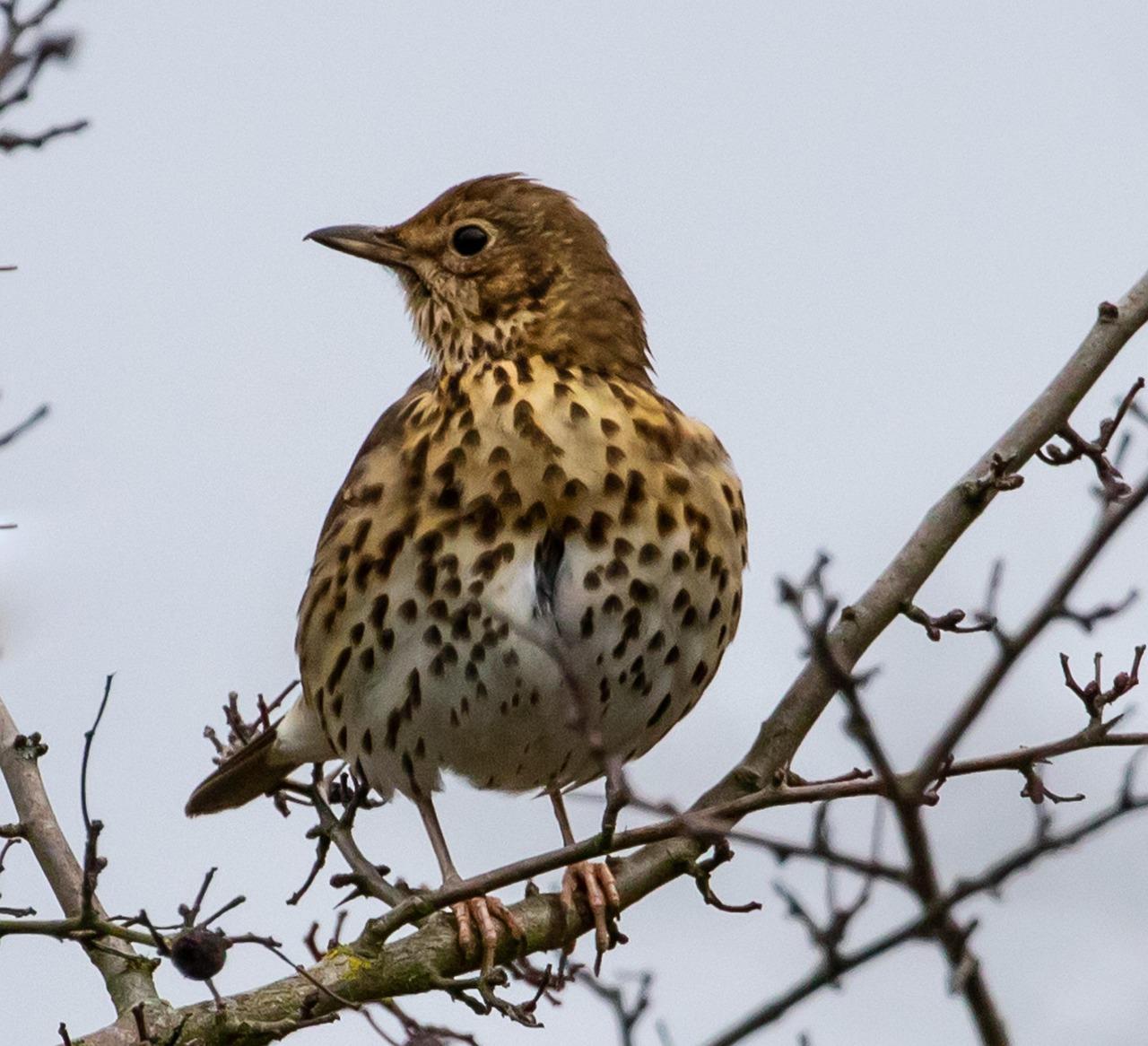
Song Thrush (Turdus philomelos) is a medium-sized songbird species belonging to the family Turdidae. It is smaller in build than the Mistle Thrush and other thrush species and exhibits a more ground-oriented posture. Its back is greenish-brown, while its tail and wing feathers are dark brown. The throat and breast, which have a yellowish-white hue, are marked with clean, regular, arrowhead-shaped or inverted heart-shaped spots. These spots appear more orderly and aligned than those of the Mistle Thrush. A creamy line runs between the eye and the bill, with darker lines behind the eye and along the chin. The bill is yellowish-brown and the legs are pale yellowish. During flight, it can be distinguished by its orange-brown underwing coverts. Females and males have similar plumage; juveniles have a lighter, more spotted back.

Song Thrushpixabay)
It typically inhabits deciduous or mixed moist forests, parks and gardens. It is also found in areas with dense vegetation, and during winter months in wetlands and reedbeds. In Cyprus it is also observed in scrubland areas. It usually builds its nest in trees or shrubs.
In Türkiye it is resident year-round in the Marmara and Black Sea regions and northern Aegean. In western and southern Anatolia it is a winter migrant, and in central Anatolia it is observed as a passage migrant. It is also a passage migrant across much of eastern Anatolia. The population in the Marmara region increases during winter. It is a widespread species throughout Europe; populations in western and central Europe are resident, while those in northern Europe and former Soviet Union countries are migratory. These birds spend the winter in western and southern Europe, the Balkans, northern Africa, southern Türkiye and the eastern Mediterranean coast.
The Song Thrush primarily feeds on invertebrates such as worms, snails, insects and larvae. It also consumes snails, which it crushes by hammering them against rocks. It is known to rely more heavily on snails during frosty periods when it cannot dig into the soil. In autumn and winter it also feeds on fallen fruits and berries, as well as those remaining on trees.
It breeds two to three times per year between March and July. The female builds a cup-shaped nest using grass, fine twigs and mud. The eggs are dull blue and speckled with black spots. Incubation is carried out by the female, and after hatching both parents care for the young. The incubation and fledging period lasts about a month, after which the chicks are fed by their parents for an additional 15 to 20 days.
It moves on the ground by both hopping and running. It detects prey mostly while hidden beneath the soil, using a pause-and-listen behavior. It is most active in the early morning and late evening. It generally prefers habitats close to human settlements and is often seen in flocks during winter. In popular belief, seeing a Song Thrush on a roof is interpreted as a sign that winter has ended and spring has arrived.
The Song Thrush is widespread globally and is listed as Least Concern (LC) on the IUCN Red List. It is estimated that there are 40 to 71 million individuals across Europe. However, population declines have been observed in some regions; in the United Kingdom, numbers have halved and it has been added to the red list. In Türkiye it remains a widespread and common species with a broad distribution.
Izmir Kus Cenneti. "Öter Ardıç." T.C. İzmir Kuş Cennetini Koruma ve Geliştirme Birliği. Accessed August 16, 2025. https://izmirkuscenneti.gov.tr/2022/12/05/oter-ardic/
Ornito. “Öter Ardıç.” Ornito.org. Accessed August 16, 2025. https://ornito.org/Bird/Detail/380
Pixabay. "Mistle thrush, Pamukçuk, Ötücü kuş görseli JPG." Pixabay. Accessed August 16, 2025. https://pixabay.com/tr/photos/mistle-thrush-pamuk%C3%A7uk-%C3%B6t%C3%BCc%C3%BC-ku%C5%9F-4743360/
Pixabay. "Teşvik, Kuş, Şakacı görseli JPG." Pixabay. Accessed August 16, 2025. https://pixabay.com/tr/photos/te%C5%9Fvik-ku%C5%9F-%C5%9Fakac%C4%B1-turdus-pilaris-635500/

Realm | Animalia | ||||||||
|---|---|---|---|---|---|---|---|---|---|
Branch | Chordata | ||||||||
Class | Aves | ||||||||
Team(s) | Passeriformes | ||||||||
Family | Turdidae | ||||||||
Conservation Status | Least Concern - LC (IUCN) | ||||||||
No Discussion Added Yet
Start discussion for "Blackbird (Turdus philomelos)" article
Habitat
Distribution
Diet
Reproduction and Biology
Behavior
Population and Conservation Status