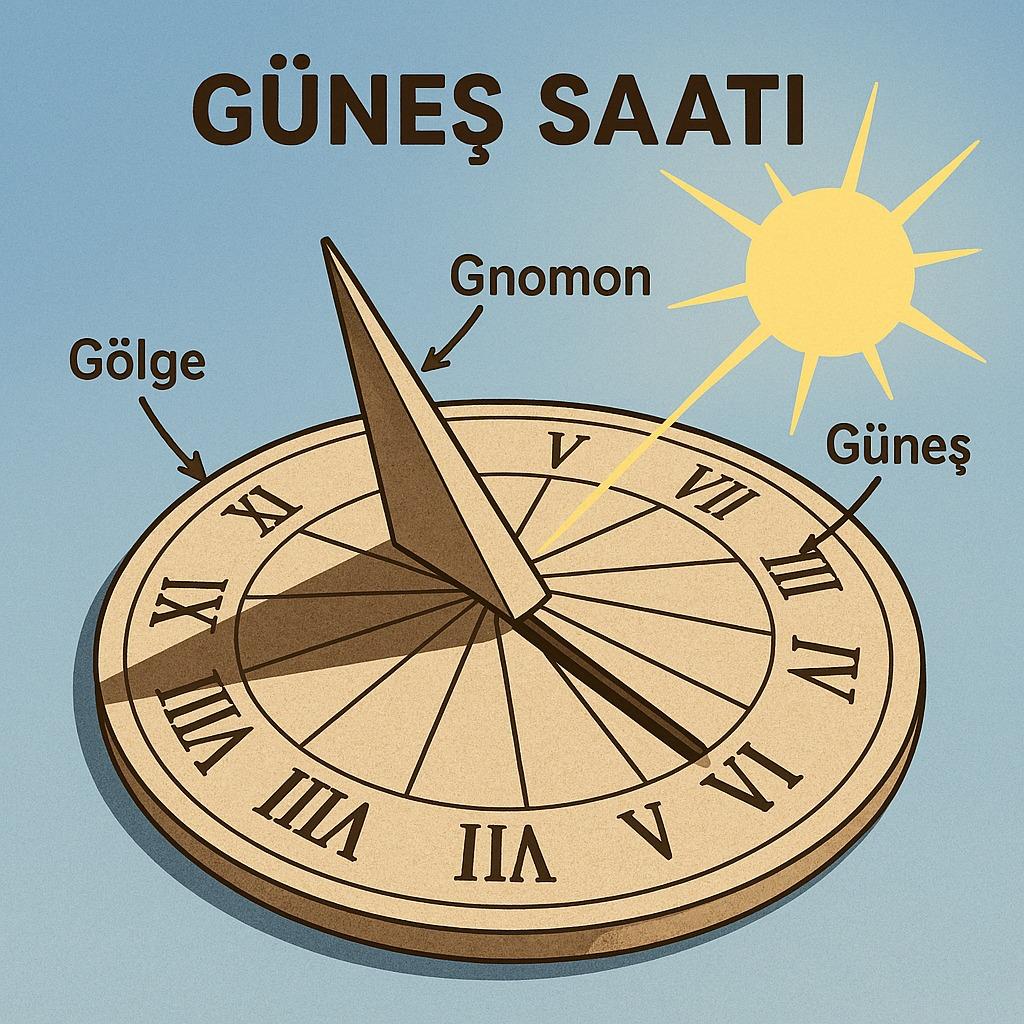




Sundial
A sundial is an ancient instrument that tells time based on the position of the sun in the sky. By observing the movement of its shadow, you can determine the time of day. It was used to measure time before the invention of mechanical clocks.

(Generated by Artificial Intelligence.)
Structure
A sundial consists of a flat dial marked with hour lines and a central rod called a gnomon. The gnomon casts a shadow onto the dial, and the position of this shadow indicates the time. The sundial can be made from stone, metal, or wood. The height and angle of the gnomon are adjusted according to the latitude of its location to ensure accurate timekeeping.
Principle of Operation
The sun rises in the east in the morning and moves westward across the sky. The shadow of the gnomon moves across the dial accordingly. In the morning, the shadow is long and points eastward; at noon, it becomes shortest and points southward. By tracking the movement of the shadow, one can determine the time.
History
The earliest known sundials date back to the ancient Egyptians. An example from around 1500 BCE is still on display at the Berlin Museum. Sundials designed by Berossus in Babylon during the 300s BCE are also recorded in history. Over time, the Greeks and Romans further developed these instruments.
The Middle Ages and Early Modern Period
During the Middle Ages, little progress was made in sundial design in Western Europe. Between 1500 and 1800, however, with the support of aristocrats, sundials became more detailed and practical. During this period, they not only indicated the time but also displayed astronomical information.

(Generated by Artificial Intelligence.)
Sundials in the Islamic World
In the Islamic world, sundials are classified as horizontal, vertical, and cylindrical. Horizontal sundials indicate prayer times. Vertical sundials are mounted on the western walls of buildings and may be circular, rectangular, or triangular in shape. Cylindrical sundials are rare; wooden examples can be found at the Kandilli Observatory.
Scientific Studies
In the 10th century, Ibn al-Adim and Sabit ibn Qurra wrote treatises on the construction of sundials. Around 1281, al-Marrakushi, Shahab al-Din al-Maksi, and Ibn al-Sarraj designed different types of sundials and performed detailed calculations. These studies contributed significantly to the advancement of sundial technology in the Islamic world.
The Ottoman Period
The oldest sundial in Anatolia was constructed in 1409 at the Hacı Hasan Mosque in Konya. Detailed and functional sundials were installed on mosques and other buildings in Istanbul. Even as mechanical clocks became widespread, individuals and scholars in the Ottoman Empire continued to produce sundials. Ahmed Ziya Akbulut was one of the last representatives of this tradition.
How to Make a Simple Sundial
To make your own sundial, cut out the template, fold it according to the instructions, and glue it together. Secure it by attaching it to a piece of cardboard. In this way, you can create a simple sundial model.

(Generated by Artificial Intelligence.)