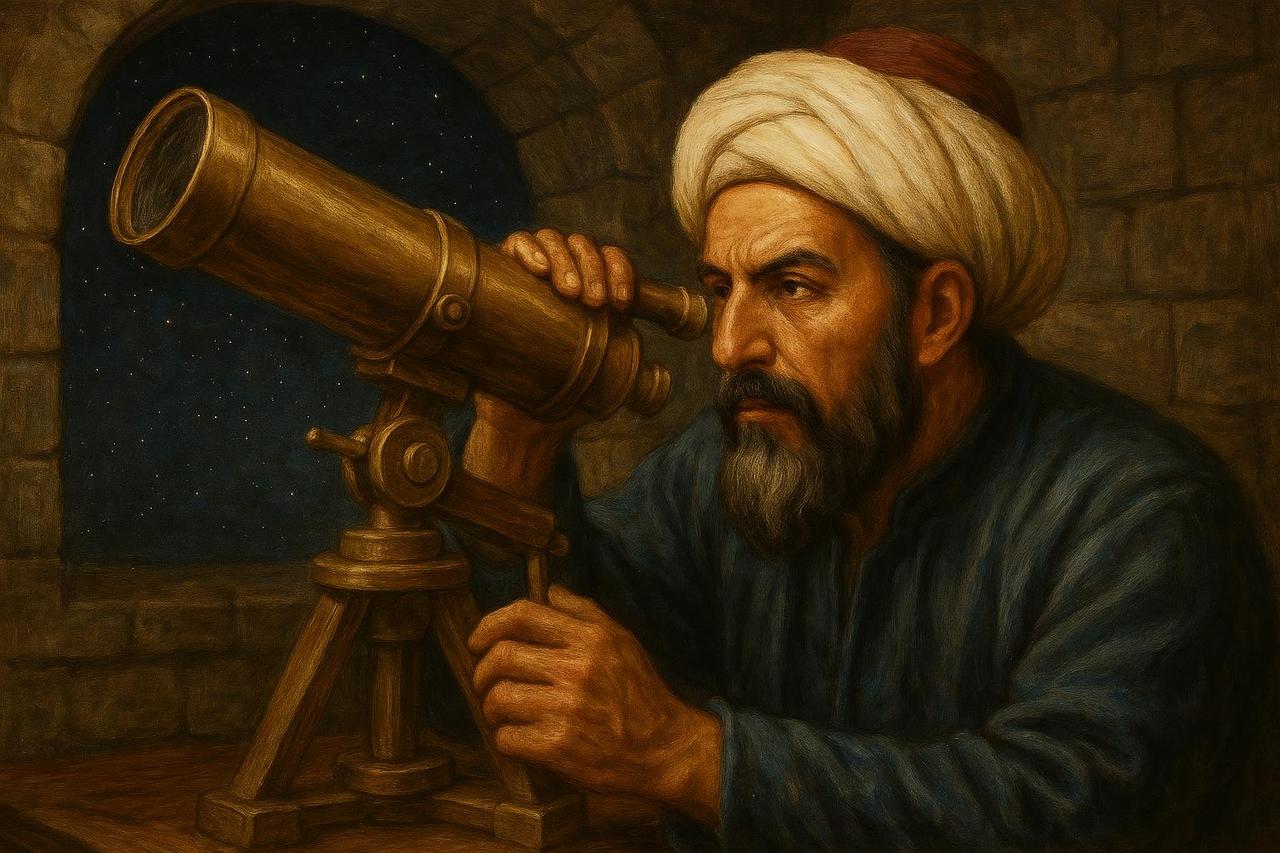




Takiyüddin
Takiyüddin was born in Damascus in 1526. While growing up there, he acquired religious knowledge and developed a keen interest in sciences such as mathematics and astronomy. He later received education in places like Cairo and Samarkand, which were centers of science and learning at the time. Takiyüddin was a highly diligent student and eventually moved to Istanbul.

Takiyüddin (Generated by Artificial Intelligence.)
A Star House in Istanbul: The Rasathane
With the support of Sultan Murad III, Takiyüddin established an rasathane in Istanbul in 1577. The rasathane was a place used to observe stars and planets—a kind of star house! Here, Takiyüddin carefully monitored the sky and recorded the movements of stars and planets. Using this data, he created celestial maps.
But the rasathane was not only for observing stars. Takiyüddin also designed highly specialized instruments there. For example:
- Astrolabe: An instrument used to measure the positions of stars in the sky. Takiyüddin improved its precision, making measurements far more accurate.
- Mechanical Clocks: Takiyüddin built clocks that measured time down to the second. These were crucial for recording the exact timing of celestial movements.
- Telescopes: He conducted experiments with lenses to observe distant stars more clearly. These efforts were among the earliest steps toward the development of the telescope!

Takiyüddin (Generated by Artificial Intelligence.)
What Did Takiyüddin Accomplish?
Takiyüddin did not only observe the stars—he also made significant contributions to mathematics, optics (understanding how light works), and mechanics (building machines). Here are some of his most notable achievements:
Mathematics
Takiyüddin had a remarkable talent for numbers. He made major advances in trigonometry, calculating values such as sine and cosine using decimal fractions. This was a novel approach at the time and greatly simplified the calculation of star positions.
Light and Optics
Takiyüddin conducted experiments to understand how light behaves. He studied reflection, refraction, and the formation of colors in the rainbow. The instruments he developed helped observers see stars more clearly.
Mechanical Clocks
Takiyüddin built clocks powered by springs and weights. These clocks were used to record the precise timing of events in the sky.
Takiyüddin’s Legacy
Takiyüddin taught us to love the sky and science. His mathematical tables, clocks, and optical instruments left a profound mark on the scientific world. He achieved similar results to contemporary European scientists, but in his own distinctive way. His work continues to inspire scientists today.