

Timurids
The Timurids were a great empire founded by a leader named Timur approximately 650 years ago. This empire was established over the territories of many modern-day countries including Uzbekistan, Iran, Afghanistan, and India. Like a tree taking root and growing, the Timurids took root in Central Asia and built a great civilization. We must recognize them not only for their military conquests but also for the value they placed on science and art.
The Timurids were one of the most powerful states of their time. They left a significant mark in history through the cities they founded, the buildings they constructed, and the scientists they supported. Their story tells us how a leader’s vision could transform into a vast empire and how this empire enriched culture.
Time Travel
Let us travel back in time! Approximately 655 years ago, in 1370, a clever and courageous commander named Timur decided to establish his own state. At that time, many small principalities in Central Asia were fighting each other. Timur united these principalities, formed a powerful army, and quickly conquered vast territories.
This empire founded by Timur is known as the Timurid Empire. Its capital was the city of Samarkand, which was transformed into one of the most beautiful cities in the world. After Timur, his sons and grandsons continued to rule the empire. However, over time, internal conflicts and attacks from neighboring states weakened the empire, and after approximately 137 years, it disappeared from history in 1507.
How Was the State Administered?
The Timurid Empire was governed by rulers known as “emperors” or “emirs.” The greatest ruler was Timur himself, who served as both commander-in-chief of the army and head of state. Timur placed great importance on justice and adherence to laws. He even compiled a legal code known as the “Timurid Tuzukat.” This book outlined how the state should be governed, the duties of soldiers, and how the people should be treated.
The rulers who succeeded Timur generally tried to follow his rules. In governing the state, they were assisted by officials called “viziers,” who advised the ruler and helped ensure the smooth administration of state affairs. The empire was divided into provinces, each headed by a governor. This system made it easier to manage such vast territories.
The Radiance of Science and Art
One of the most distinctive features of the Timurid era was their deep appreciation for science and art. Timur and his successors gathered the most talented scientists, artists, and architects from the lands they conquered and brought them to their capital, Samarkand. As a result, cities such as Samarkand and Herat became major cultural centers.
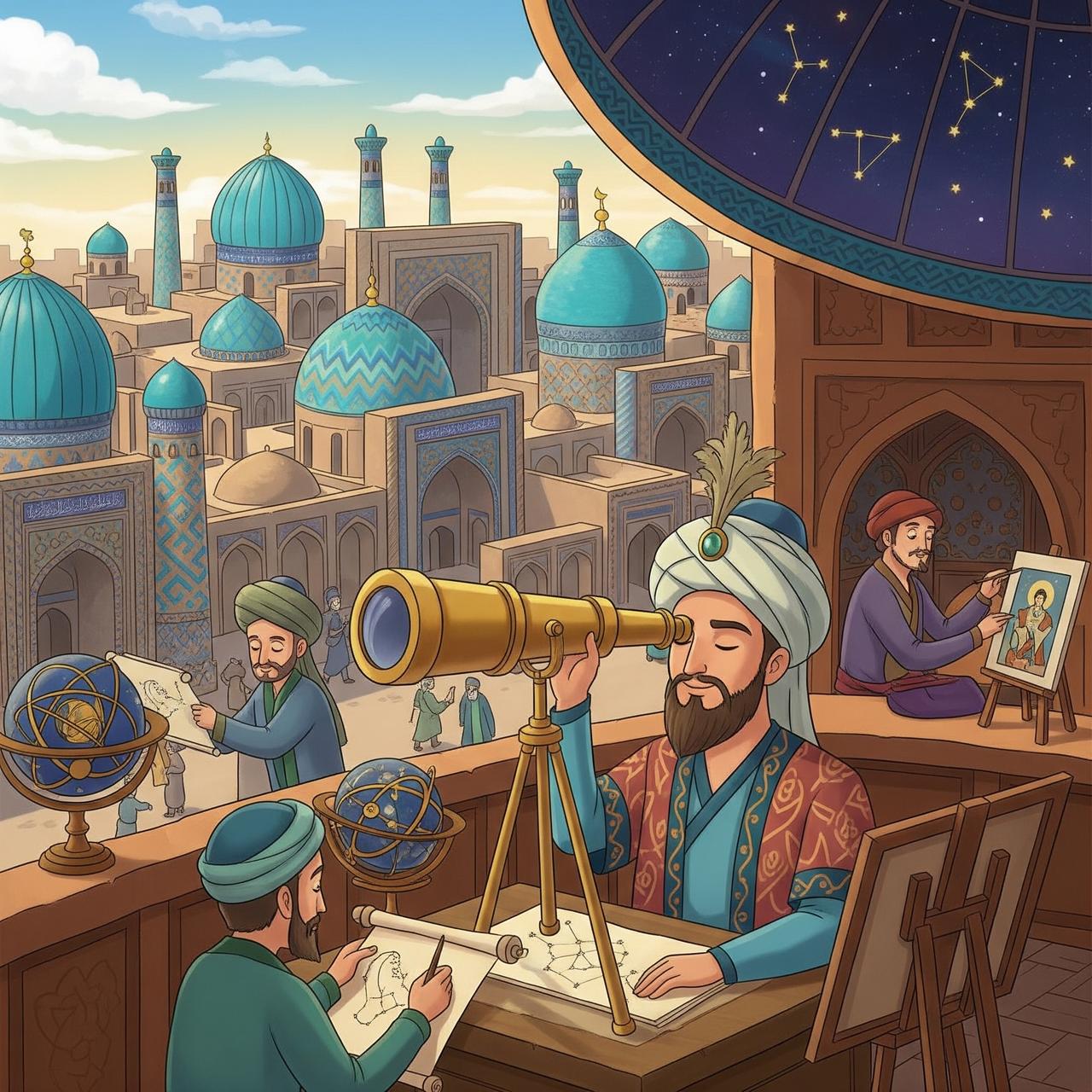
In particular, Ulugh Beg, Timur’s grandson, was not only a ruler but also a prominent astronomer. Astronomy is the science that studies stars, planets, and other celestial bodies. Ulugh Beg commissioned the construction of a massive observatory in Samarkand, a center for observing celestial phenomena. Through his work there, he produced highly accurate star charts. These achievements represented one of the most advanced scientific accomplishments of their time.
In architecture, the Timurids developed a distinctive style. Their mosques, madrasas (schools of the time), and turbehs (monumental tombs) were adorned with brilliant blue and turquoise tiles. With their towering domes, monumental gateways, and exquisite craftsmanship, these structures left visitors in awe. These works stand as evidence of the Timurids’ power and refined taste.