



Tomb of Murad II
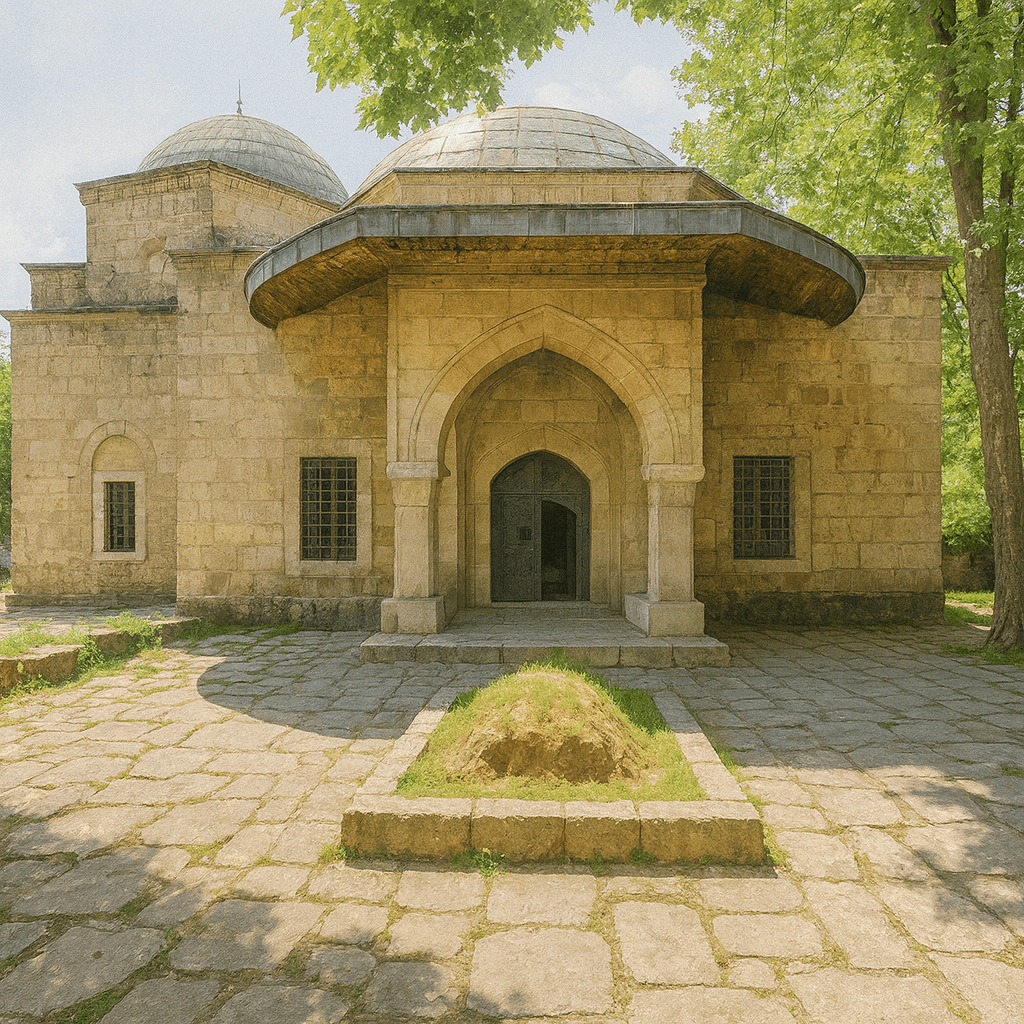
The Tomb of Murad II is one of the significant tombs built by Ottoman sultans in Bursa. The tomb is located within the expansive garden of the Muradiye Külliyesi. Upon Murad II’s death in 1451, his son Fatih Sultan Mehmet commissioned its construction in accordance with his father’s will.
The most striking feature of this tomb is the complete openness of its roof. Before his death, Murad II requested that rain and sunlight directly reach his grave. For this reason, the center of the dome was left open, and instead of a marble sarcophagus, his body was buried directly in the earth and covered again with soil. Thus, this tomb remains a unique example in Ottoman history.

(Generated by Artificial Intelligence)
Structure of the Tomb
The tomb is constructed with two rows of brick and one row of rubble stone. At the center of the square-plan structure stands a dome supported by four columns dating back to the Byzantine period. The center of this dome features a large opening. A vaulted gallery encircles the tomb.
The window on the eastern façade was later converted into a door, and an adjacent section was added. In this section, the coffins of Murad II’s children—Şehzade Alaaddin, Şehzade Ahmet, Orhan—and his daughter Şehzade Hatun are placed.
Who Was Murad II?
Murad II was the sixth Ottoman sultan and is known among the people as Koca Murat. He was born in Amasya in 1402 and ascended the throne in 1421 at the age of 19.
During his reign, he led major campaigns in both Anatolia and the Balkans.
- In Anatolia, he incorporated the beyliks of Aydın, Menteşe, Teke, and Germiyan into the Ottoman state.
- In Rumelia, he brought Serbia under tribute and annexed the regions of Thessaloniki, Macedonia, Thessaly, and Ioannina to Ottoman territory.
- He defeated Crusader armies at the Battle of Varna in 1444 and the Second Battle of Kosovo in 1448, thereby solidifying Ottoman dominance in the Balkans.
Murad II occasionally abdicated the throne in favor of his son Mehmed II (Fatih Sultan Mehmet), but he resumed command of the army during Crusader campaigns. He died in Edirne in 1451 and was buried in this tomb in Bursa.

(Generated by Artificial Intelligence)
Significance of the Tomb
The Tomb of Murad II is not merely the burial place of a sultan; it is also a structure that reflects the Ottoman Empire’s humble side. Unlike the grand tombs of other sultans, this one draws attention through its simplicity and humility. These qualities mirror Murad II’s personal character.