
KURE Kids Header Line
badge icon

This content was originally written in Turkish for children and is automatically translated into English using artificial intelligence.

article-image

Turtle

Last Updated: 06/28/2026

Have you ever imagined carrying your home on your back? Turtles do exactly that! They are charming, four-legged reptiles that live inside a hard, bony shell. These armored creatures move slowly but steadily throughout their lives and can live for many decades in the wild. Let us get to know these fascinating friends more closely.

Swimmers of the Sea and Walkers of the Land
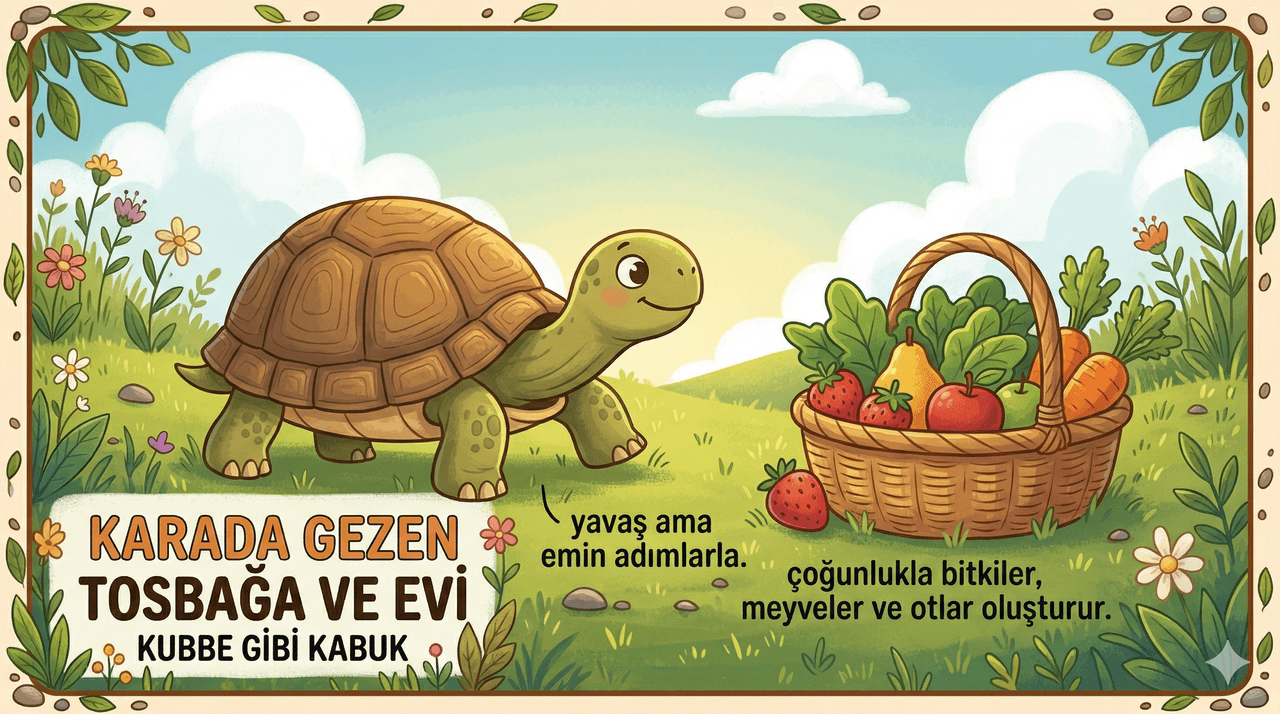
Generated by Artificial Intelligence.

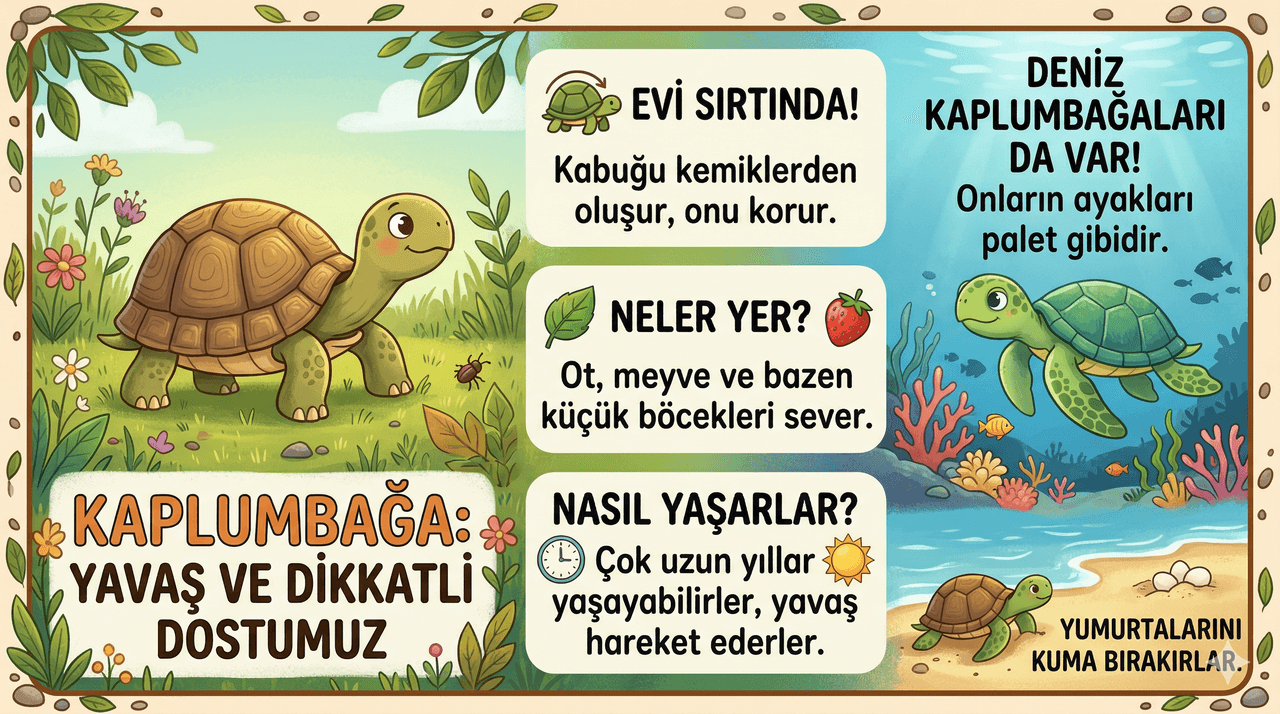
Turtles are generally divided into two groups: those that live on land and those that live in water. Land-dwelling turtles are also called tortoises and have short, sturdy, cylindrical legs. Land turtles have more rounded and dome-shaped shells. Their diet consists mostly of plants, fruits and grasses.

Sea turtles, on the other hand, have flippers instead of legs, which allow them to swim gracefully through the water. Their shells are flatter and lighter than those of land turtles, making swimming easier. Depending on their habitat and species, sea turtles feed on food such as jellyfish and sea sponges.

Superpowers in Nature
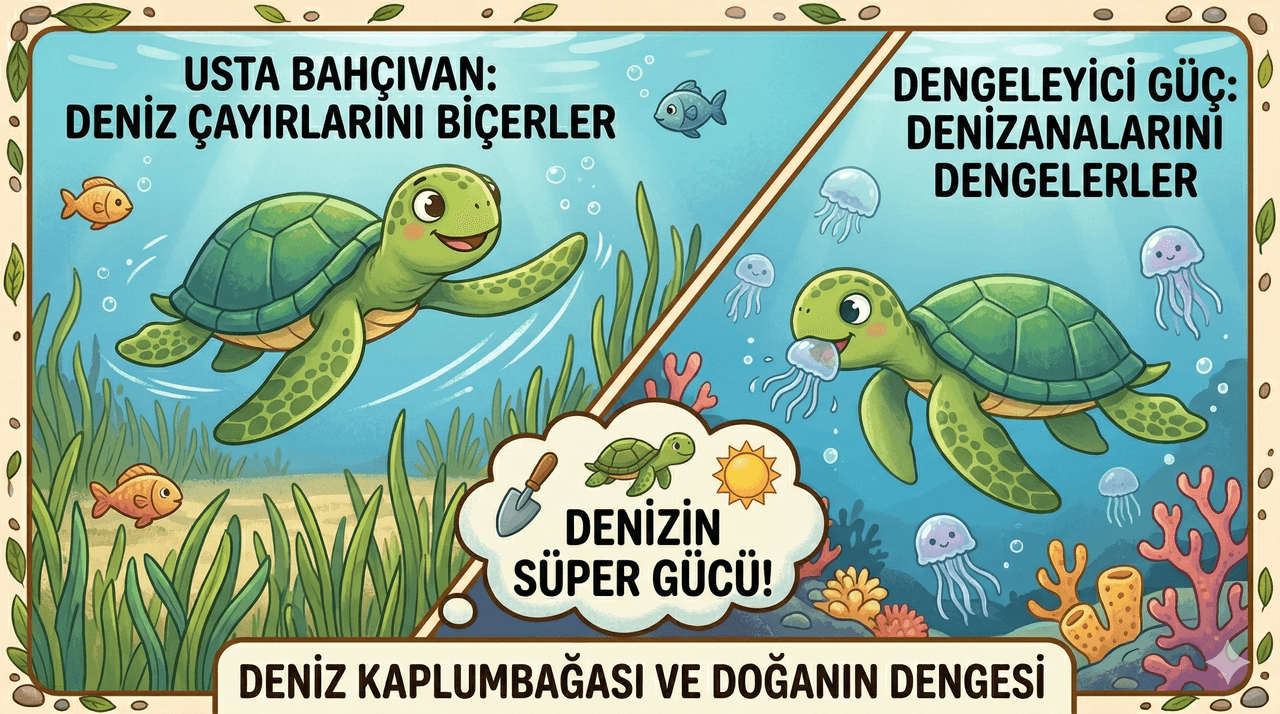
Generated by Artificial Intelligence.

Sea turtles possess vital superpowers that help maintain the balance of nature. Carnivorous sea turtles feed on creatures like jellyfish and sponges, preventing their populations from growing excessively and keeping them in check.

Herbivorous turtles act like master gardeners of the ocean. While feeding, they graze on seagrass beds, helping these underwater forests grow healthier and more robust.

No Teeth But Powerful Jaws!
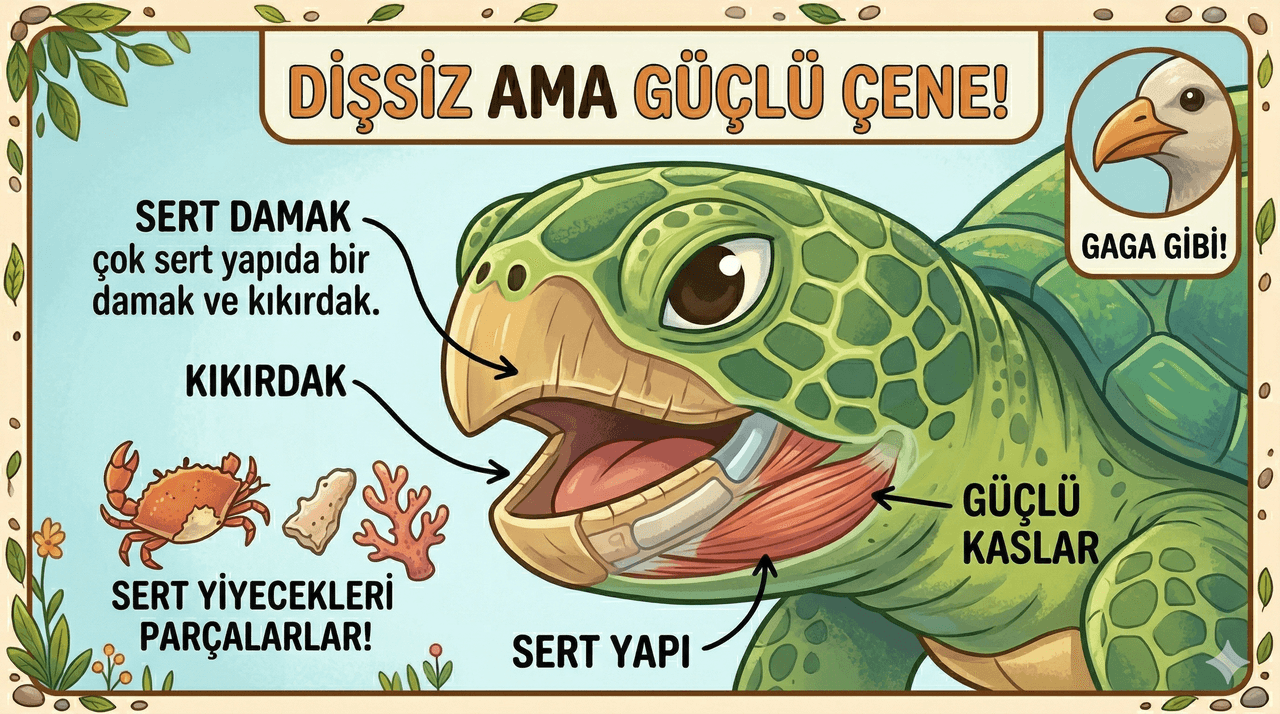
Generated by Artificial Intelligence.

If you look closely at a turtle’s face, you will notice that its mouth resembles a bird’s beak. Interestingly, turtles have no teeth at all.

So how do they eat hard foods without teeth? Instead of teeth, they have a strong, hardened palate and cartilage that serve the same function. Thanks to this powerful and rigid structure, they can easily crush and enjoy hard-shelled prey found in the sea.

The Journey of Tiny Hatchlings to the Sea

When it is time to lay eggs, female sea turtles come ashore and dig a nest in the sand, carefully depositing their eggs into the hole. After covering the eggs tightly with moist sand to hide them, they return to the sea.

After about two months buried in the sand, the hatchlings emerge from their eggs and climb to the surface. Guided by the natural light on the horizon, the tiny hatchlings immediately begin walking toward the sea.

Don't Forget to Look at These!
Science and Technology
cat img
History and Culture
cat img
Art and Literature
cat img
image
Most Read
Yanmayan El Deneyi
arrow
image
Last Added
21 Haziran Yaz Gündönümü
arrow
ilham-notu-bg
INSPIRATION NOTE FOR CURIOUS KIDS!

While playing or swimming near the shore, you can pick up plastic waste around you to prevent sea turtles from mistakenly thinking it is food. Remember, protecting the oceans and these lovely creatures is in your hands!

KURE Kids Kure Card Pin Icon
KURE Kids Kure Card Book Icon
Gemini_Generated_Image_ad8x9ead8x9ead8x.png

Turtle

Lifespan

50 - 100+ years

Where It Lives

In forests, deserts, rivers, and vast oceans

Type

Reptile

Nutrition

Generally herbivorous (some species also eat small insects or fish)

Size

10 cm - 2 metres

Weight

150 grams - 900 kg

Who Wrote?
Kids Writing
AuthorMuhammed Efe ÇuhadarJune 28, 2026

What Did We Talk About?

bottom-bg-effect-bottom
bottom-bg-effect-top

Turtles are remarkable creatures that have shared the Earth with us for millions of years. However, artificial lighting along coastlines can disorient hatchlings emerging from eggs, preventing them from finding the sea. Additionally, plastic waste dumped into the oceans causes serious harm to these animals. Therefore, we must keep our oceans clean and carefully protect the habitats of turtles.

Bibliographies

Ecological Research Association. "General Information about Sea Turtles." EKAD. Accessed March 23, 2026. https://ekad.org.tr/projeler/deniz-kaplumbagalari-projesi/.

Ege University Press. "Kaplumbağalar." Ege Üniversitesi. Accessed March 23, 2026. https://basimveyayinevi.ege.edu.tr/files/basimveyayinevi/icerik/kaplumbagalarekitap.pdf.

Karagöz, Bilge Nur. "Kaplumbağaları Tanıyalım." *Meraklı Minik*. Accessed March 23, 2026. https://merakliminik.tubitak.gov.tr/wp-content/uploads/sites/159/2025/09/65002ed2-4679-4bd8-8f72-3b55288014bf-1.pdf.

Kaya, Elif Ebren. "Deniz Kaplumbağalarının Cinsiyetini Kumun Sıcaklığı Belirliyor!" *TÜBİTAK Bilim Genç*, June 22, 2025. Accessed March 23, 2026. https://bilimgenc.tubitak.gov.tr/bunu-biliyor-muydunuz/deniz-kaplumbagalarinin-cinsiyetini-kumun-sicakligi-belirliyor

National Geographic Kids. "10 Totally Awesome Facts About Turtles!" Accessed March 23, 2026. https://www.natgeokids.com/uk/discover/animals/sea-life/turtle-facts/.

TÜBİTAK Bilim Genç. "Kirliliğin Öldürdüğü Kaplumbağalar." Accessed March 23, 2026. https://bilimgenc.tubitak.gov.tr/makale/kirliligin-oldurdugu-kaplumbagalar.

TÜBİTAK Meraklı Minik. "Meraklı Minik Etkinlik Dosyası." Accessed March 23, 2026. https://merakliminik.tubitak.gov.tr/wp-content/uploads/sites/159/2025/09/f939a2b2-f648-4987-b90a-3e81b575243c-1.pdf.

TÜBİTAK e-Dergi. "Cilt 20, Sayı 235, Sayfa 19." Accessed March 23, 2026. https://e-dergi.tubitak.gov.tr/edergi/yazi.pdf?dergiKodu=4&cilt=20&sayi=235&sayfa=19&yaziid=4219

Ülkar, Derya. "Kaplumbağalar Hakkında İlginç Bilgiler." Halkbank Kültür ve Yaşam. Accessed March 23, 2026. https://kulturveyasam.com/kaplumbagalar-hakkinda-ilginc-bilgiler/.

ilham-notu-bg
ilham-notu-bg
ilham-notu-bg
HEYY!
Did You Know?
These?
Lamb
Lamb
Ask to Küre