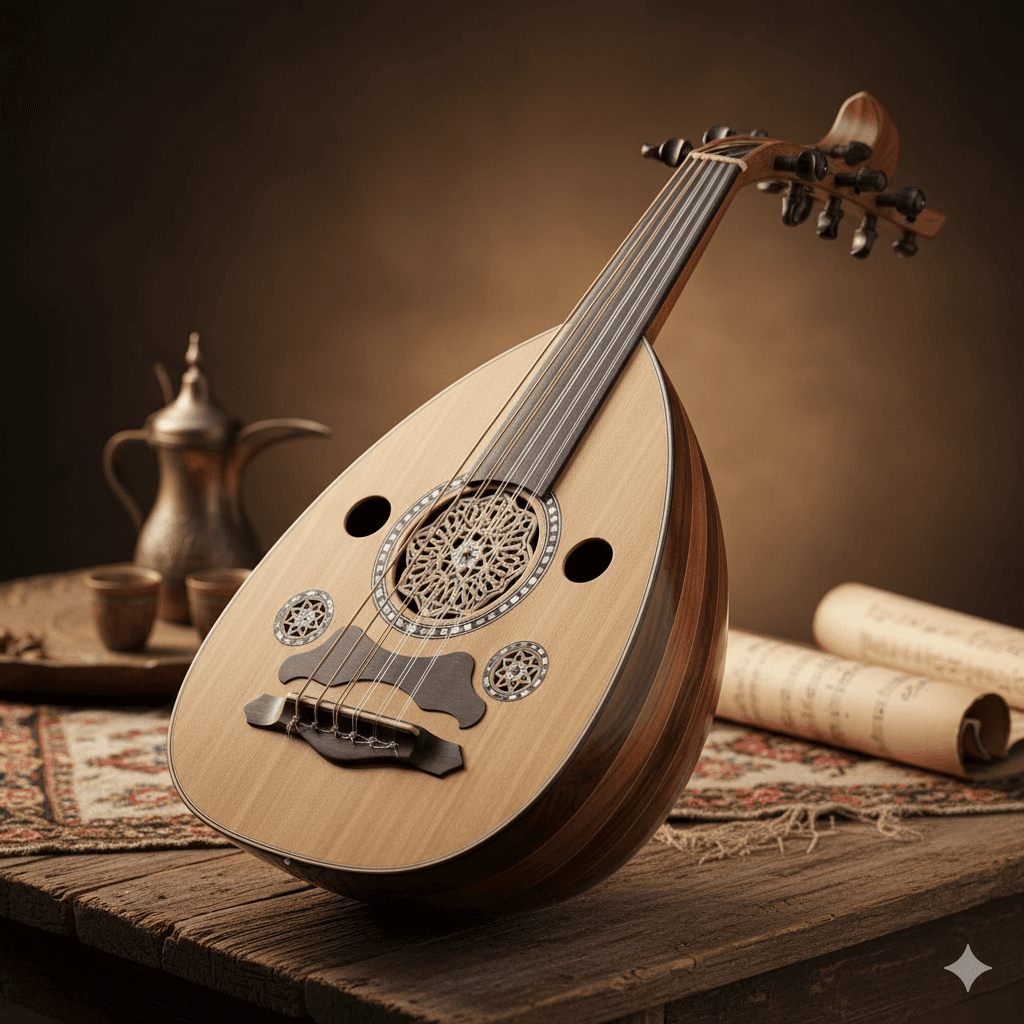




Ud
The ud is a short-necked, stringed instrument of Middle Eastern origin. It is used in Arabic, Turkish, and Iranian music. In Türkiye, it is known as “ud”; in Iran, as “barbat”; and in Greece, as “uti”. In organology, the ud is regarded as the typical example of short-necked lutes.
History and Origin
The exact origin of the ud is not definitively known, but evidence indicates that similar instruments were in use in Mesopotamia around 2000 BCE. Instruments considered ancestral to the ud were depicted in ancient Egypt between 1320 and 1085 BCE.
During the Sasanian period, an instrument called the “barbat” was developed by the Arabs into what became known as the ud. The term “ud” first appears in Arabic texts from the 7th century. Music theorists and performers such as Al-Farabi and Ziryab introduced modifications to the ud’s construction and playing technique.

Generated by Artificial Intelligence.
Structure and Components
The ud typically has 11 to 13 strings. Its body is made from poplar or rosewood and consists of three main parts:
- Body: Round or semi-circular in shape; it features sound holes on the front surface. The body provides acoustic resonance.
- Neck and Fretboard: Notes are produced by pressing the strings against the frets on the neck. The neck is attached to the body via a wedge joint.
- Strings: Made of nylon or silk; some strings are wound with silver or copper. The tuning system is arranged according to the requirements of the maqam structure.
The ud is played with a plectrum held in the right hand, while the left hand presses the strings to produce different pitches. Today, the plectrum is generally made of flexible plastic.

Generated by Artificial Intelligence.
Historical Development
Over time, the ud evolved in various cultures:
- Early Ud and Barbat: The barbat had a small body with a skin soundboard, whereas the ud features a larger body with a wooden soundboard.
- Arab and Andalusian Period: The ud was refined by Arab musicians and introduced to Spain.
- Ottoman Period: During the 15th to 19th centuries, the ud was used in court music; from the 19th century onward, it began to be manufactured in Istanbul with its modern structure.
- 20th Century and Today: With only minor changes in the number of strings and tuning system, the ud has preserved its basic structure for approximately a thousand years.
Applications
The ud is used in various musical traditions including classical Turkish music, Arabic music, and folk music. It is well suited for expressing maqam-based and melodic structures. Today, the ud is played both in traditional styles and in modern genres.