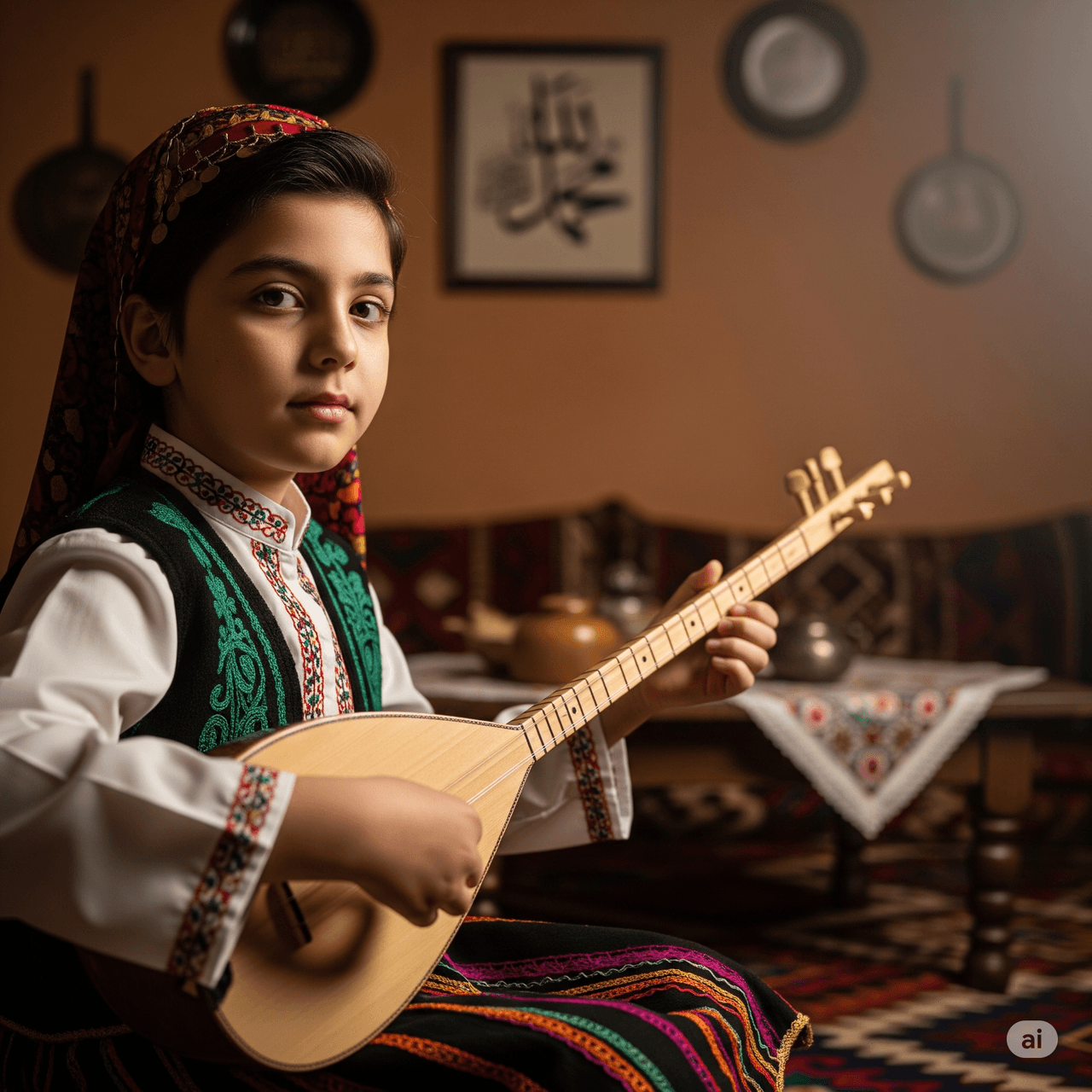




What is Turkish Music?
The history of Turkish music is a field of study that traces the development of music created by the Turks over thousands of years. This history follows not only songs but also the evolution of musical instruments, composers, societal changes, and cultural shifts. Through migrations from Central Asia to Anatolia and the states they established, the Turks developed a rich and diverse musical culture.
To facilitate understanding, this musical history is divided into periods. This allows both musical developments and historical events to be examined together.

Generated by artificial intelligence.
Why Do We Study the History of Turkish Music?
Turkish music is a deeply rooted art form with a history spanning thousands of years. To better understand this music, we must examine how it has changed over time. Historians divide time into periods to explain events and developments more clearly. A similar approach is applied to music history, making it easier to comprehend musical evolution.
Timur Vural notes that the periods used in Western music do not always apply to Turkish music. Therefore, he proposes seven original periods for Turkish music that more clearly reflect both musical development and social change.
Early Turkish Music (6th century BCE – 6th century CE)
This period encompasses the musical culture of Turkic communities in Central Asia. Chinese sources mention music associated with the Huns. Early musical instruments included the kopuz, davul, and flute. Ozans (poet-musicians) narrated stories through music among the people. Music was important during both entertainment and ceremonial occasions in this era.
Kök-Türk and Uyghur Period (6th–10th centuries CE)
The Kök-Türks and Uyghurs used music not only for entertainment but also in religious rituals and state ceremonies. Some musical terms appear in the Orkhon Inscriptions. Archaeological finds include the kopuz and similar instruments. This period is regarded as the time when written sources on Turkish music began to emerge.

Generated by artificial intelligence.
Early Islamic Period (10th–14th centuries CE)
After the Turks adopted Islam, significant changes occurred in music. Important thinkers such as Al-Farabi and Ibn Sina examined music from both scientific and philosophical perspectives. Musical education began in palaces and madrasas, and a new form of military music called nevbet emerged. Religious musical genres also began to develop during this period.
Early Ottoman Turkish Music (14th–16th centuries CE)
With the foundation of the Ottoman State, music became an integral part of court culture. Religious orders such as the Mevlevi order made significant contributions to music. Theoretical foundations of Turkish music were documented in books called edvar written during this period. Many individuals associated with the court laid the groundwork for classical Turkish music.
Development Period of Ottoman Music (17th century – 1826)
This period is regarded as the golden age of classical Turkish music. Great composers emerged, and new makams and usuls were developed. Renowned composers such as Itri lived during this time. The Tulip Era was a period of great flourishing in art and music. Interest in music grew not only in the palace but also among the general public.

Generated by artificial intelligence.
Late Ottoman Turkish Music (1826–1923)
During this period, the influence of Western music began to be felt in Turkish music. With the abolition of the Janissary Corps, mehter music came to an end and was replaced by Western-style military music. Staff notation became widespread, and female composers and soloists began to gain prominence. Classical Turkish music and Western music coexisted during this time.
Turkish Music in the Republican Era (1923–Present)
With the proclamation of the Republic, music education acquired an institutional structure. Institutions such as the Musiki Muallim Mektebi and the Ankara State Conservatory were established. A new system of notation and theory based on the Arel–Ezgi–Uzdilek framework was developed. Folk music collections were compiled, and a transition to polyphonic music began. Today in Türkiye, both traditional Turkish music and contemporary musical genres coexist.