



What Is a Flight Safety Card?
What Is a Flight Safety Card?
When you board an aircraft, you will typically find a durable, laminated, and illustrated card in the pocket behind the seat in front of you. This card is known as the flight safety card. Required by international aviation regulations to be present on every aircraft, these cards contain vital information designed to ensure passenger safety in the event of an emergency. Each card is specially designed for a specific aircraft model and varies according to the aircraft’s configuration and safety equipment.

(Generated by artificial intelligence)
Function and Importance of Flight Safety Cards
Flight safety cards are designed to convey information not only through verbal announcements but also through universally understandable visual materials. Thanks to this visual language, passengers speaking different languages can easily comprehend complex emergency procedures and access this information quickly. The cards illustrate step by step critical actions such as fastening the seatbelt and assuming the brace position during an emergency landing. This ensures that passengers respond appropriately and consciously during moments of panic.

(Generated by artificial intelligence)
Card Content and Key Safety Procedures
While the content of a flight safety card varies depending on the aircraft model and its safety equipment, it is expected to include the following essential information:
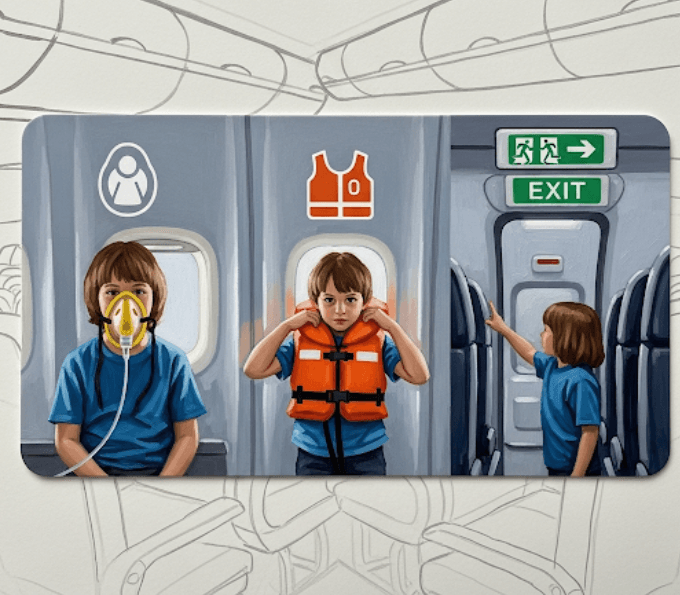
- Emergency Exits: Illustrated instructions show where the emergency exits are located on the aircraft and how to operate them. This section is critical for enabling passengers to reach the exits quickly during evacuation.
- Oxygen Masks: The card demonstrates how to use oxygen masks that automatically deploy from the ceiling in the event of a sudden cabin pressure loss. It details how to place the mask over the face, stretch the elastic band, and maintain continuous breathing.
- Life Vests: For scenarios involving landings on water or large bodies of water, the card explains step by step where life vests are stored (typically under the seat) and how to put them on and inflate them. Important warnings, such as the requirement to inflate the vest only after exiting the aircraft, are also included in this section.
- Seatbelts: Although basic instructions on how to fasten and unfasten the seatbelt are standard, the card visually illustrates how to release it quickly in an emergency.
- Brace Position: The card shows the safest posture passengers should adopt during a possible hard landing or impact. This position is designed to protect vulnerable areas such as the head and neck.

(Generated by artificial intelligence)