



What is a Glider?
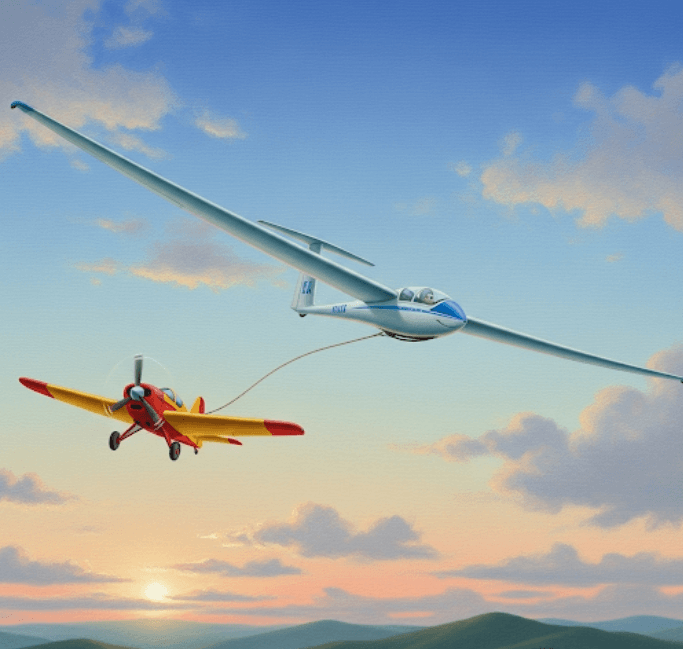
Have you ever imagined gliding through the air like a bird? The glider is an aircraft that does exactly that. Although it resembles an airplane, it flies in a fundamentally different way. Since it has no engine, a glider relies on the power of wind and rising currents of warm air, known as thermals, to stay aloft. This allows it to soar silently and gracefully through the sky, much like a soaring eagle. Gliders are especially beloved for offering a quiet, immersive flight experience deeply connected with nature.
(Generated by artificial intelligence.)
How Does It Fly? 🛫
Glider wings are specially shaped to remain airborne. The upper surface of the wing is more curved, while the lower surface is flatter. As air flows over the wing, it moves faster above than below. This difference in speed creates an area of low pressure above the wing and high pressure below. This pressure difference generates an upward force that lifts the glider into the air. This force is called lift. Since gliders lack an engine, they are initially launched either by being towed into the air by a powered aircraft or by using a winch. Once they reach sufficient altitude, they detach from the towline and begin to glide on their own.
(Generated by artificial intelligence.)
What Is It Used For? 🏞️
Glider flight is most commonly practiced as a recreational sport. Gliding allows aviation enthusiasts to experience flight free from engine noise, immersed in the natural environment. Competitions are sometimes held, with pilots awarded for flying the greatest distance or remaining airborne the longest. Gliders are not only used for sport but also for scientific research, such as studying atmospheric conditions and wind currents.