




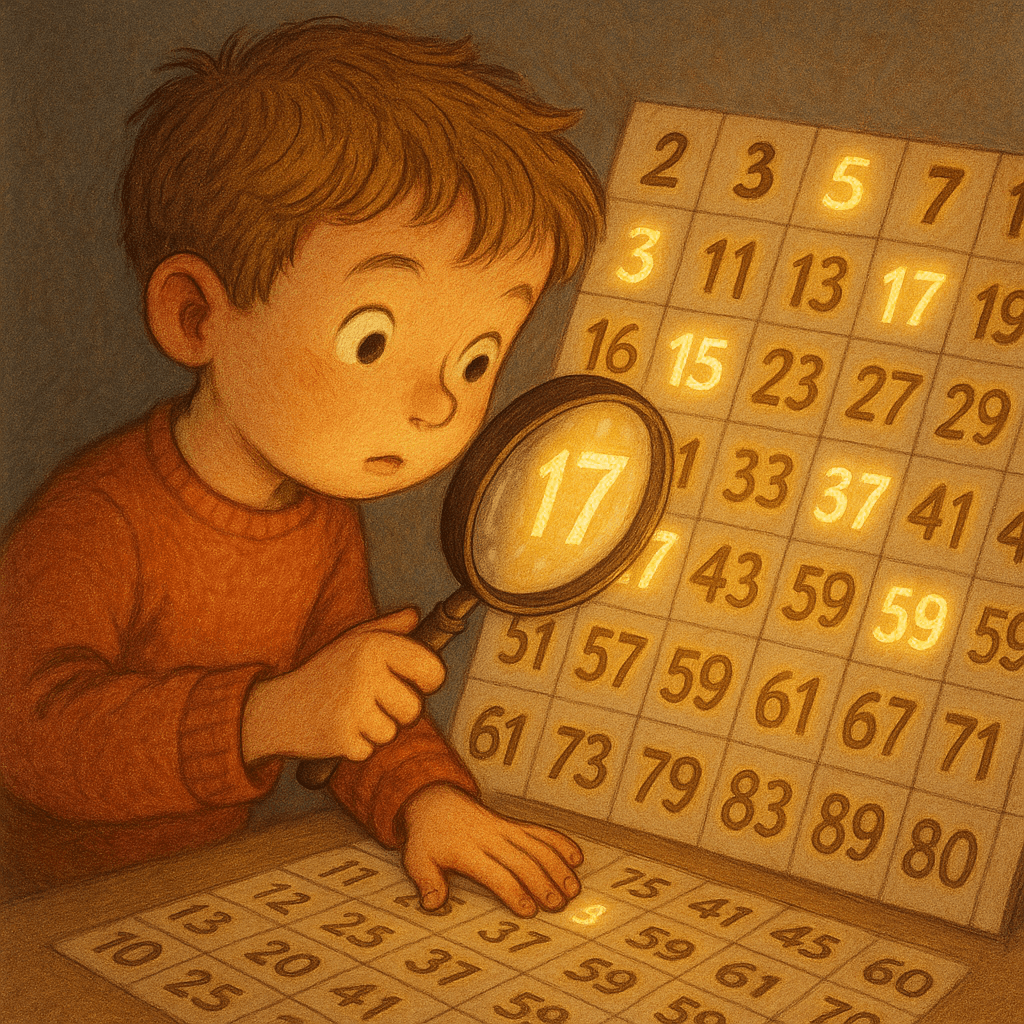
What Is a Prime Number?
A prime number is defined as a positive integer that is divisible only by 1 and itself. In other words, no other positive integer can divide a prime number. For this reason, prime numbers serve as fundamental building blocks in the formation of all other numbers.
The first ten prime numbers: 2, 3, 5, 7, 11, 13, 17, 19, 23, 29

(Generated by Artificial Intelligence.)
Properties of Prime Numbers
Prime numbers hold a unique position in mathematics.
-The smallest prime number is 2, and it is also the only even prime number.
-All other prime numbers are odd.
-There are infinitely many prime numbers. This means there is always a larger prime number.
Every positive integer is either a prime number or a product of prime numbers.
For example:
12 = 2 × 2 × 3
These numbers are the prime factors of 12.
Coprime Numbers
Two numbers are coprime if their only common positive divisor is 1. For example, the numbers 9 and 10 have no common divisor other than 1, so they are coprime.
Numbers that are not prime can still be coprime. However, any two prime numbers are always coprime.
Applications of Prime Numbers
Prime numbers are used in everyday life, particularly in computer security and data encryption, where large prime numbers are essential.
The RSA encryption method secures information by using the product of two large prime numbers, making it extremely difficult for others to access the data.
Encryption systems rely on the difficulty of factoring large numbers into their prime components to ensure security.

(Generated by Artificial Intelligence.)
Distribution of Prime Numbers
Between 1 and 100 there are 25 prime numbers. They are:
2, 3, 5, 7, 11, 13, 17, 19, 23, 29, 31, 37, 41, 43, 47, 53, 59, 61, 67, 71, 73, 79, 83, 89, 97
However, counting prime numbers individually becomes increasingly difficult for larger values.
To address this, mathematicians have developed a rule called the Prime Number Theorem, which allows for an approximate estimation of how many primes exist up to a given limit.
For example:
-Between 1 and 1,000 there are 168 prime numbers.
-It is estimated that there are approximately 8,686 prime numbers between 1 and 100,000. The actual number is 9,592.