



What Is Ecology?
Have you ever thought about how birds, trees, insects, and even you and I are connected to one another?
Ecology is the science that studies the relationships between living organisms and their environment. Through ecology, we learn how forests, lakes, deserts, and cities function, and how living and non-living elements in nature are interconnected.

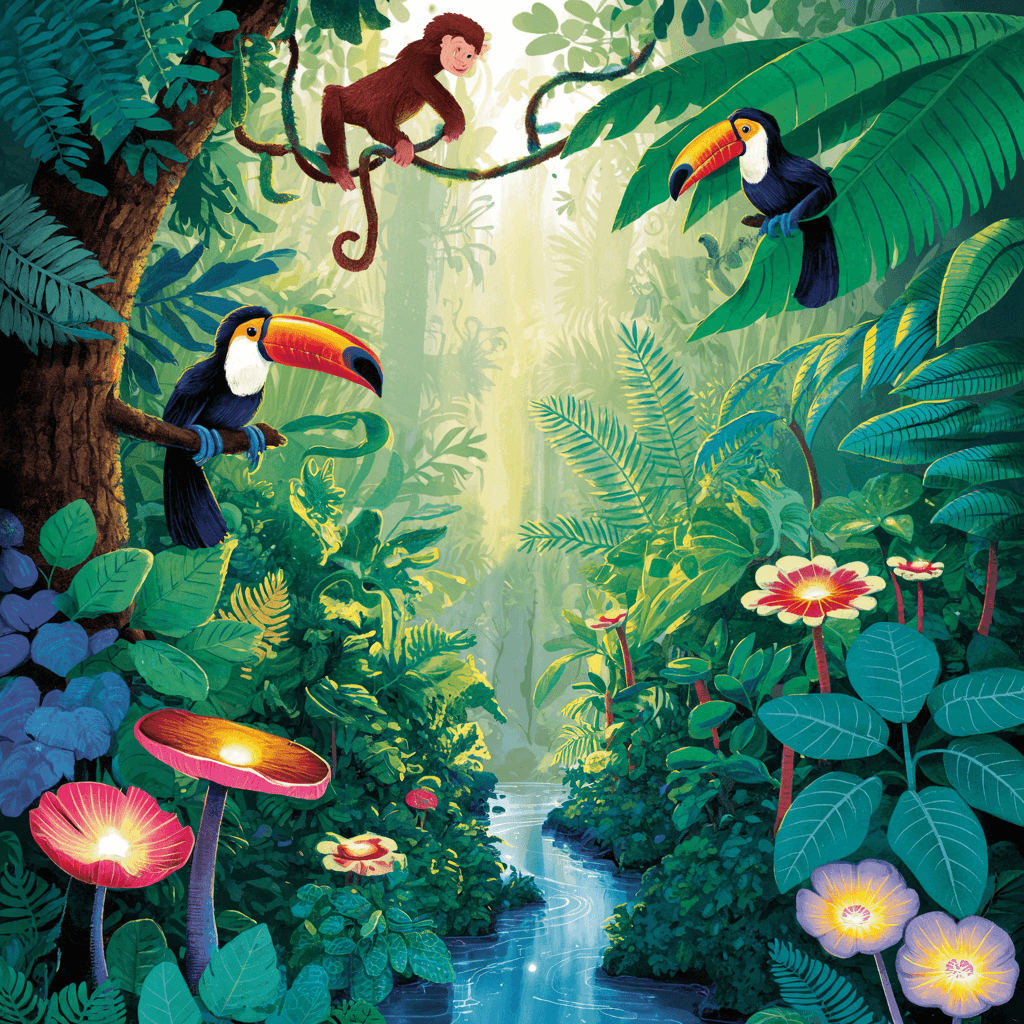
Nature and Living Things (Generated by Artificial Intelligence)
The word "ecology" comes from ancient Greek: "oikos" means home, and "logos" means study. Thus, ecology essentially means the "home of nature and the rules of this home."【1】
What Is the Purpose of Ecology?
Ecology guides us in understanding the world. For example, trees produce oxygen, while humans and animals breathe it in. Soil provides life to plants, and sunlight is essential for the survival of all living beings. Ecology helps us comprehend these relationships.
Without ecological knowledge, it would be very difficult to protect our water resources, forests, and animals. Therefore, ecology helps humans use nature more consciously.
Who Are Ecologists?
An ecologist is a scientist who carefully studies nature. They can observe everything from microscopic organisms to vast forests.
One ecologist might study the microbes living in the soil.
Another ecologist might track the migration routes of birds in a forest.
Another might examine how fish, algae, and sea turtles coexist in the oceans.
Thanks to the work of ecologists, we learn the mysteries of nature and discover ways to protect our environment.

Depiction of an Ecologist (Generated by Artificial Intelligence)
Subfields of Ecology
Ecology is not a single field; it has many subfields:
Individual Ecology: Studies the relationship between individual organisms and their environment.
Population Ecology: Examines how organisms of the same species live together and reproduce.
Ecosystem Ecology: Seeks to understand the interactions between living and non-living components in large systems such as forests, lakes, and deserts.

Habitats of Different Organisms (Generated by Artificial Intelligence)
Ecology and Other Sciences
Ecology is a part of biology, but it is also closely linked to many other scientific disciplines. For example:
Botany: Studies plants.
Zoology: Examines animals.
Soil Science (Pedology): Investigates the properties of soil.
Chemistry and Physics: Help us understand how energy and matter function in nature.
This is why ecology acts as a great bridge, connecting many areas of science with nature.
Citations
[1]
Şahin, K. “Çevre Bilimine Giriş / 1. Hafta”, Ondokuz Mayıs Üniversitesi Açık Ders Materyali, erişim tarihi: 26 Ağustos 2025, https://avys.omu.edu.tr/storage/app/public/ksahin/64208/1.%20Hafta.%20%C3%87evre%20bilimine%20giri%C5%9F%20(1).pdf