



What Is Energy?
Energy, in its simplest definition, is the ability to do work. It is energy that enables you to run, jump, move your toys, and even allows the lamp in your room to emit light. Behind every movement and change we observe around us lies energy. Just as a car needs fuel to move, all living beings, including us, require energy to live.

Windmill Motion (Generated by Artificial Intelligence.)
Where does this energy come from, and where is it stored? There are many fascinating types of energy. Let us now explore the two most common ones together: kinetic and potential energy.
The Energy of Motion: Kinetic Energy
The energy possessed by all moving objects is called kinetic energy. You have kinetic energy when you run, a ball rolls, a swing sways in the wind, or a bicycle speeds down a hill. In other words, if something is moving, it has kinetic energy!

A Bicycle Speeding Down a Hill Has Abundant Kinetic Energy. (Generated by Artificial Intelligence.)
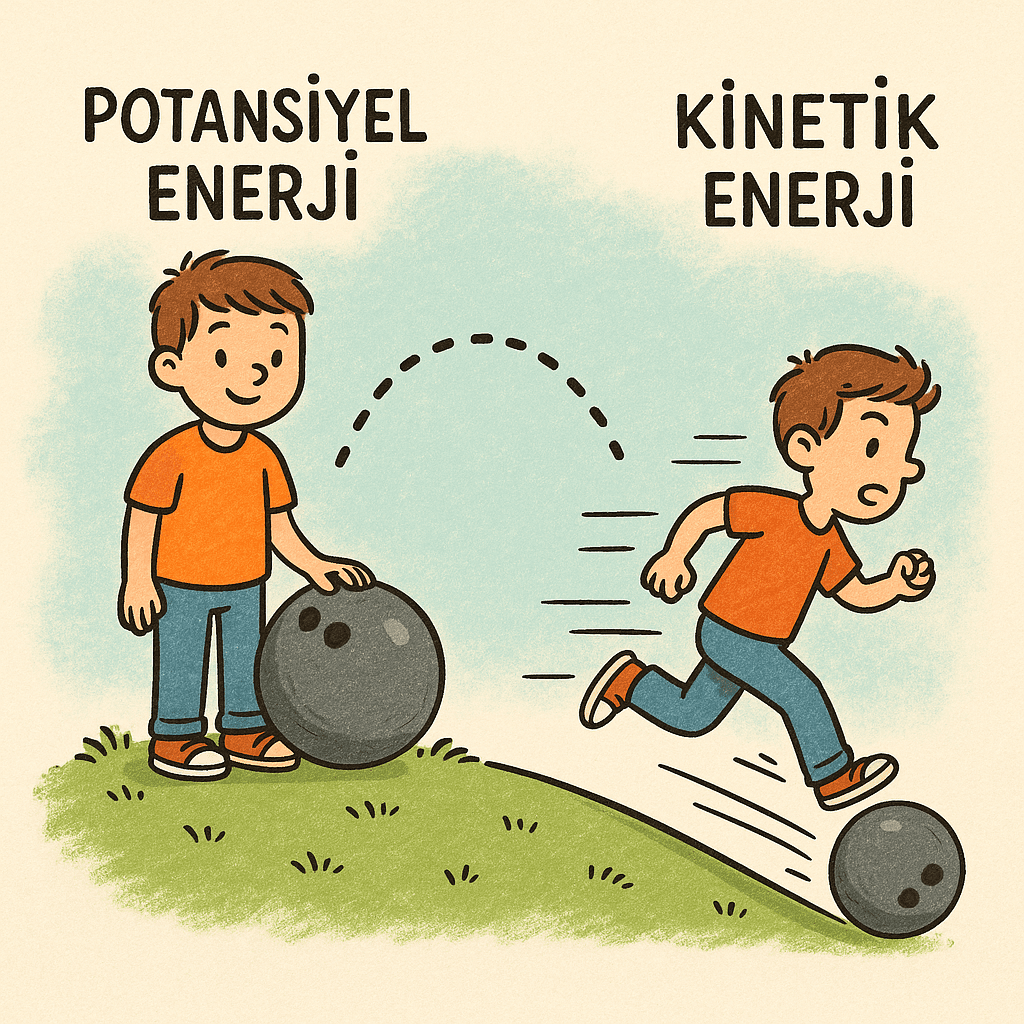
The amount of kinetic energy depends on two factors: the mass of the object and how fast it is moving. For example, consider a bowling ball and a tennis ball rolling at the same speed. The bowling ball has much greater kinetic energy because it is heavier. Similarly, among two cars of the same weight, the one moving faster has higher kinetic energy.

(Generated by Artificial Intelligence.)
Stored Energy: Potential Energy
Potential energy is energy stored within an object, meaning it is held in reserve. This energy arises due to the object’s position or condition. For instance, imagine holding a ball in your hand. By lifting it above the ground, you give it potential energy. When you release it, this stored energy is released and causes the ball to fall to the ground.

When You Pause for a Moment at the Top of a Slide, You Accumulate Potential Energy. (Generated by Artificial Intelligence.)
We can also observe potential energy elsewhere. When you stretch a rubber band or compress a spring, potential energy builds up inside. When you release the spring, this stored potential energy rapidly transforms into motion energy—that is, kinetic energy. Just as you accumulate potential energy while waiting at the top of a slide, and it converts to kinetic energy as you begin to slide down!
Time Travel
When humans learned to control fire thousands of years ago, they took their first major step in using energy. Fire provided them with energy for warmth, cooking food, and illumination during the night.