




What Is Inside Black Holes?
A black hole is a region in space where gravity is so strong that nothing, not even light, can escape from it. They are among the largest and most mysterious structures in the universe.
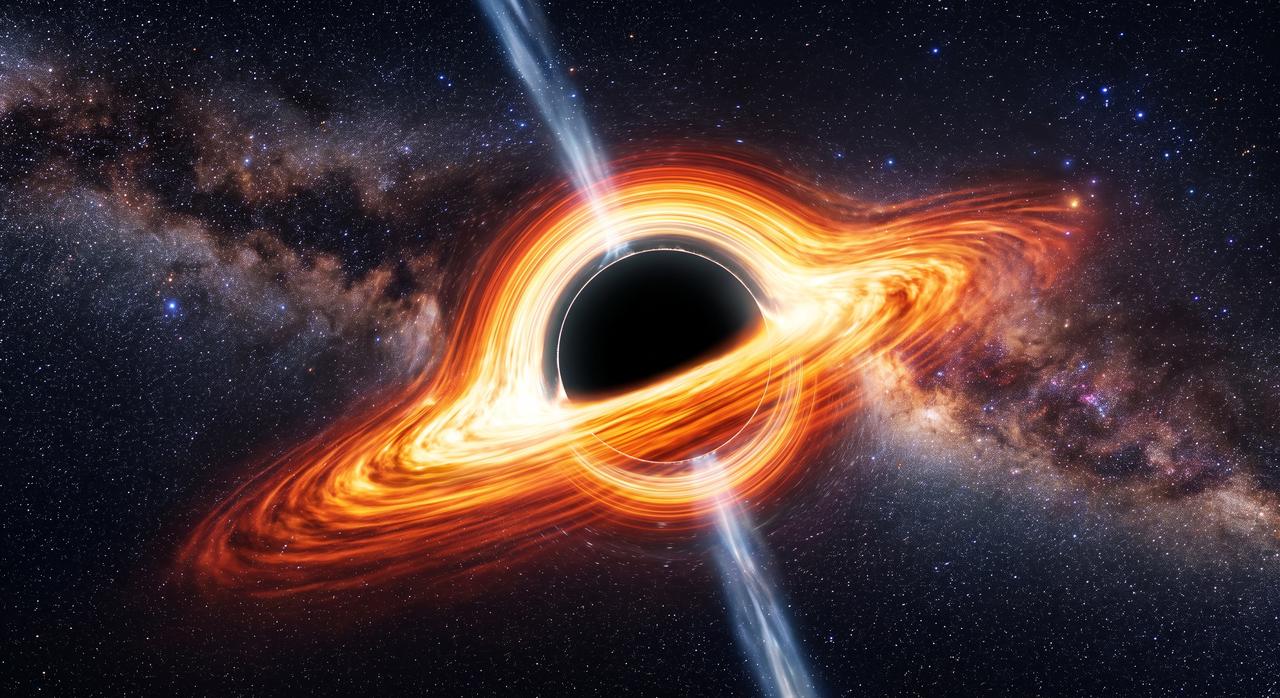
Representative view of a black hole. (Generated by artificial intelligence)
They form when massive stars end their lives by collapsing under their own gravity or through enormous accumulations of mass in the early universe. Their gravitational forces are so intense that they pull in surrounding gas, dust and even stars.
What Is Inside?
We cannot directly observe what lies inside a black hole because its gravitational pull prevents even light from escaping. However, according to scientific research and theories, the interior of a black hole consists of the following components:
- Event Horizon: A mysterious boundary surrounding the black hole. No object — light, rockets or planets — that crosses this boundary can ever return to the outside.
- Singularity (Compressed Matter): Located at the exact center of the black hole. All matter from the collapsed massive star is compressed into this infinitesimally small point, creating an unimaginable density of mass.
- Spaghettification: When an object is pulled into a black hole, the side closer to the center experiences a much stronger gravitational pull than the side farther away. As a result, the object stretches and thins out like a strand of spaghetti as it moves toward the center.
- Other Universes and White Holes: According to some scientists’ theories, the interior of a black hole may not be an absolute end. Matter drawn inside might not vanish completely at the center but could instead rebound, forming an entirely new “baby universe” in another time or dimension, or a “white hole” that ejects matter outward.
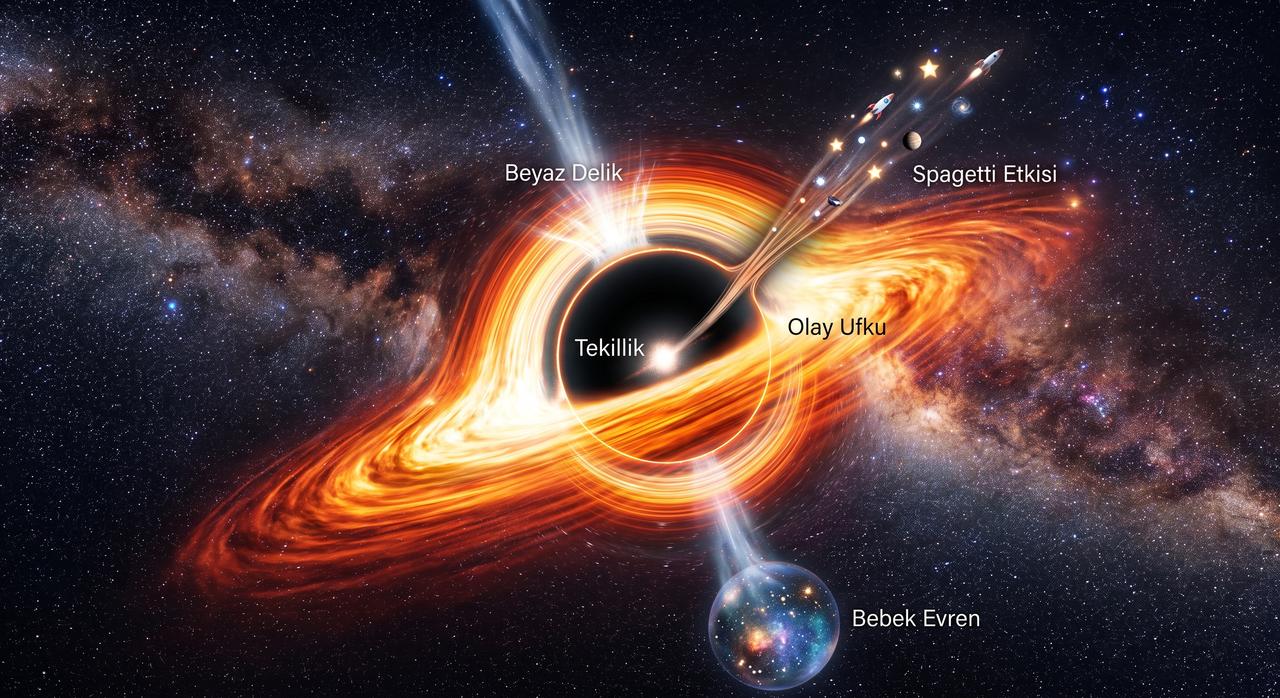
The mechanism of a black hole. (Generated by artificial intelligence)
How Do They Appear?
Black holes cannot be seen directly because they do not emit or reflect light — they are completely black. However, gas and dust particles orbiting and being pulled into the black hole become extremely hot and glow. This creates a bright, ring-shaped halo of light around the black hole.
How Large Are They?
Black holes vary greatly in size and mass. Stellar black holes may be several times more massive than the Sun, while supermassive black holes at the centers of galaxies can reach millions or even billions of times the mass of the Sun.
How Long Do They Last?
Black holes are incredibly long-lived. According to physicist Stephen Hawking’s theory, they can slowly lose energy and evaporate over time through a process called “Hawking radiation.” However, it could take trillions of years for a massive black hole to vanish completely.
Where Are They Found?
Black holes are distributed throughout the universe. Stellar black holes can be found in various locations within galaxies, while nearly every large galaxy hosts a supermassive black hole at its center. For example, our own galaxy, the Milky Way, contains a massive black hole named Sagittarius A* at its center.
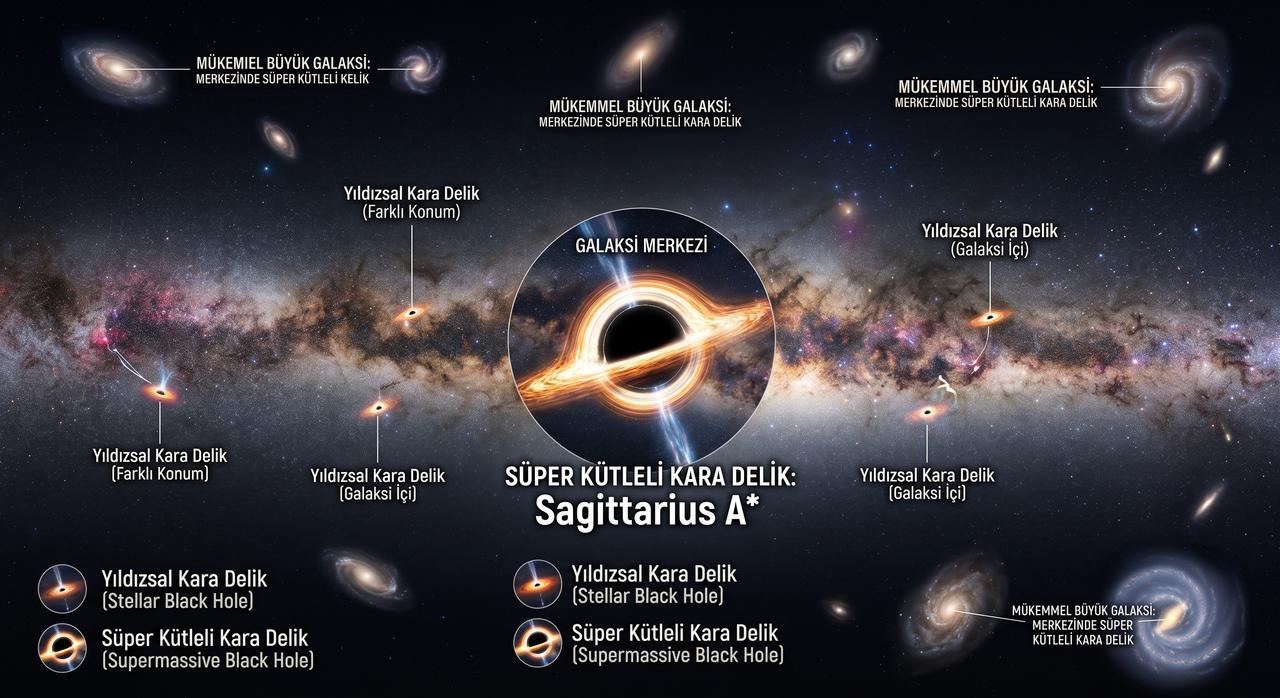
A visual depicting the location of the black hole in our galaxy. (Generated by artificial intelligence)
Risk Level
Black holes are not runaway vacuum cleaners in space; they only pull in objects that enter their area of influence. Since Earth is not near any black hole, they currently pose no threat to our planet.