



What Is the Golden Ratio?
When we look around us, we see many harmonious and aesthetically pleasing shapes and patterns in nature, architecture, art, and even in our own bodies. This harmony and balance is achieved through a special number known as the Golden Ratio. The symbol for the Golden Ratio is the Greek letter Phi (Φ), and this number is approximately equal to 1.618.
Where Do We Encounter the Golden Ratio?
Golden Ratio in Nature
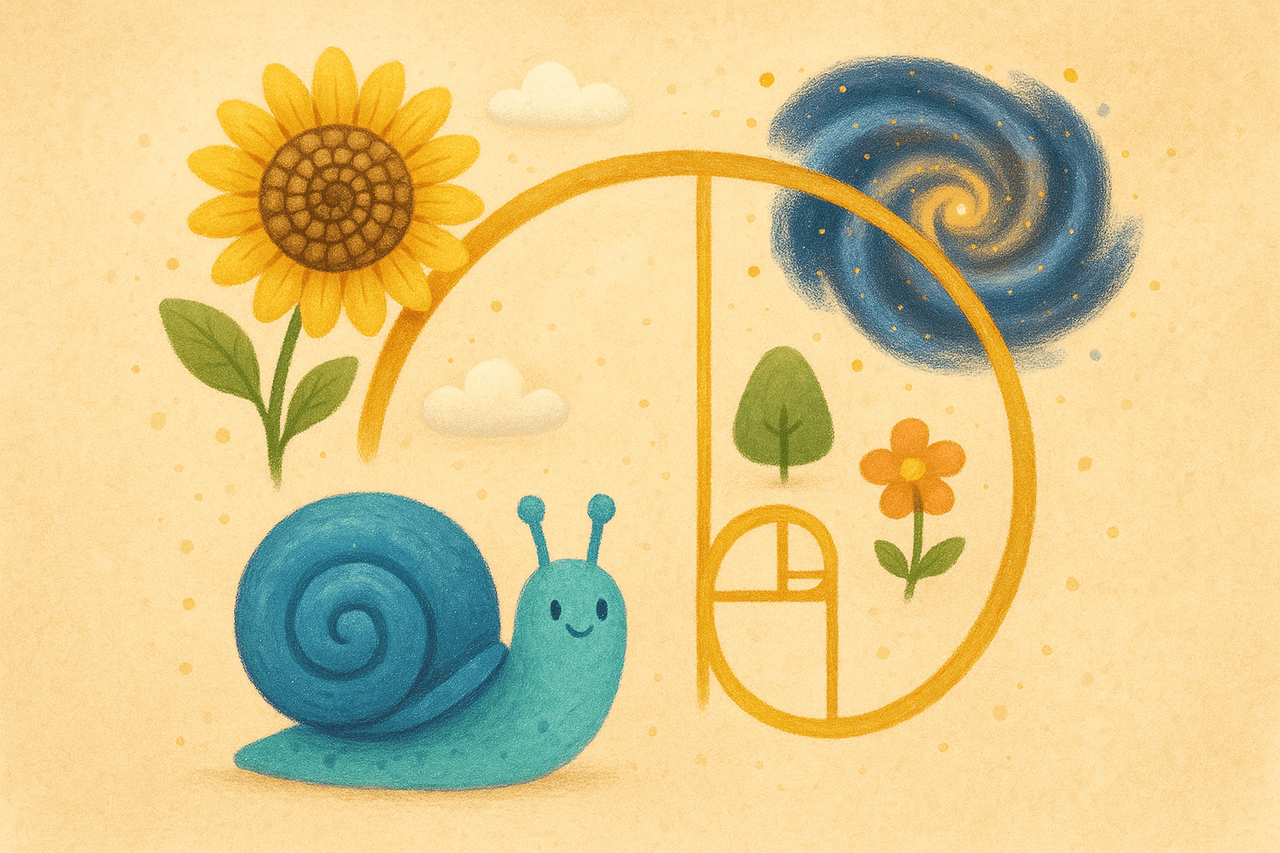
Doesn't a sunflower, a pineapple, or a snail shell also appear highly orderly to you? This is because the Golden Ratio appears frequently in nature. The arrangement of leaves in plants, the number of petals in flowers, and even the spirals in pinecones all follow patterns based on the Golden Ratio. For example, the seeds of a sunflower form two distinct spirals that rotate in opposite directions. The number of spirals in these patterns is typically 13 and 21. These numbers belong to a special sequence known as the Fibonacci Sequence.

Generated by Artificial Intelligence.
Golden Ratio in Art and Architecture
The Golden Ratio appears not only in nature but also in human creations. It has been used in famous architectural works such as Mimar Sinan’s Süleymaniye and Selimiye Camileri, the Parthenon, and even the Egyptian pyramids. Architects and artists have employed the Golden Ratio to create designs that are visually harmonious and aesthetically balanced.
For instance, a Golden Rectangle is a rectangle whose side lengths are in the Golden Ratio. The inward-curving spiral that fits within this rectangle is called the Golden Spiral. Natural forms such as those seen in snail shells and hurricanes resemble the Golden Spiral.

Generated by Artificial Intelligence.
What Is the Fibonacci Sequence?
Fibonacci was an Italian mathematician who lived in the 12th century. In his sequence, each number is the sum of the two preceding numbers: 0, 1, 1, 2, 3, 5, 8, 13, 21, 34, and so on. The ratio of consecutive numbers in this sequence approaches the Golden Ratio of 1.618.

Fibonacci Sequence – Golden Ratio Relationship (Pixabay)
Time Travel
The ancient Greek sculptor Phidias, who lived between 490 and 430 BCE, used the Golden Ratio in his sculptures. The Greek letter Phi (Φ), which symbolizes the Golden Ratio, is derived from the first letter of Phidias’ name.

Generated by Artificial Intelligence.