

What is UNESCO?
UNESCO, the United Nations Educational, Scientific and Cultural Organization, was established in 1945, immediately after the Second World War. The world had endured two major wars within a short time, and these conflicts had changed the lives of millions. These wars revealed that peace must be built not only through weapons but also through the ideas of people. It was with this conviction that UNESCO was founded. Wars begin in the minds of people; therefore, peace must also begin in the minds of people.
Its founders aimed to make the world a fairer, more peaceful and more conscious place. To achieve this goal, UNESCO promotes international cooperation in the fields of education, science, culture, communication and information sharing.
A Young Institution, Like Childhood
UNESCO was born like a young dream. In November 1945, 44 countries came together and declared, “Let us create a true institution of peace.” The first step toward UNESCO was taken with the agreement signed on 16 November 1945. This date is still celebrated today as “International Day of Tolerance”.
UNESCO’s headquarters is located in Paris. Its first General Conference was held in 1946. Since then, nearly all countries in the world have joined UNESCO. Türkiye is one of the original 20 countries that founded the organization.

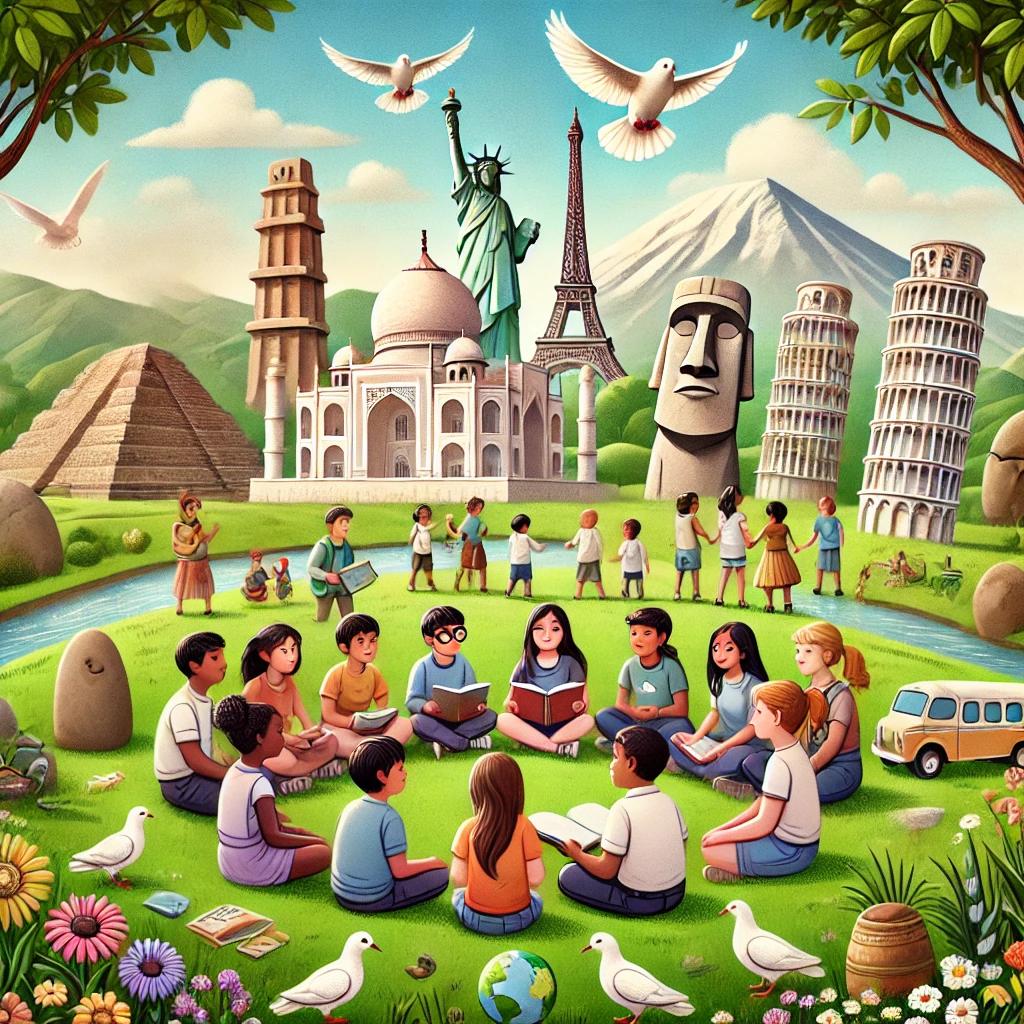
UNESCO’s areas of impact (generated by artificial intelligence)
What Does UNESCO Do?
UNESCO is as curious as a child, as patient as a teacher, and as sincere as a friend. It has many responsibilities, but its most important ones are these:
In Education
According to UNESCO, every child must go to school, learn, and develop their capacity for thought. Through the “Education for All” project, it supports equal educational opportunities for girls and boys. It monitors, guides and encourages education from preschool through university.
UNESCO wants children and young people to receive quality and inclusive education. Because knowledge is power, but this power must be used only for good.
Culture and Heritage
UNESCO is tasked with preserving our past. Ancient cities, historical structures, legends, songs, games, recipes… All of these are our cultural heritage.
Places in Türkiye such as Göbeklitepe, Cappadocia, the Historic Areas of Istanbul, and Safranbolu are protected by UNESCO. But it is not only stone structures that are safeguarded; traditions such as Karagöz shadow theatre, the Mevlevi Sema Ceremony, Turkish coffee, and ebru art are also under UNESCO’s protection. Because without knowing our past, we cannot build our future.
Communication and Information
UNESCO works to ensure that people can express their ideas freely. It advocates for communication channels such as radio, television and the internet to be free and impartial. It states that access to information is the right of everyone.
It also runs projects to equip children and young people with the skill of critical thinking.
Türkiye and UNESCO: A Strong Friendship
Türkiye is one of the founding members of UNESCO. In 1949, the Türkiye National Commission for UNESCO was established to guide activities within the country.
Many elements from Türkiye appear on UNESCO’s global lists:
- 22 World Heritage Sites
- 31 Intangible Cultural Heritage elements
- 8 cities included in the UNESCO Creative Cities Network
- 9 cities listed as Learning Cities
This means that Türkiye shares both its past and its future with UNESCO.

UNESCO’s vision (generated by artificial intelligence)
A Global Journey in Education
UNESCO does not limit education to the classroom; it transforms it into a way of life. It believes in the philosophy of “lifelong learning.” To this end, it connects the world through various initiatives such as the ASPnet (Associated Schools Project), UNESCO Chairs, UNITWIN networks, and the Learning Cities Programme.
In Türkiye, 36 schools are members of ASPnet. These schools work on themes of peace, tolerance and intercultural understanding.
Why Is It Important?
UNESCO works to make the world a better place. It defends everyone’s rights, demands justice, and supports human effort. UNESCO is sometimes a book, sometimes a schoolbag, sometimes a mosaic tile. It is a friend to cultures, beliefs and ideas. And above all, it is the future of children.