




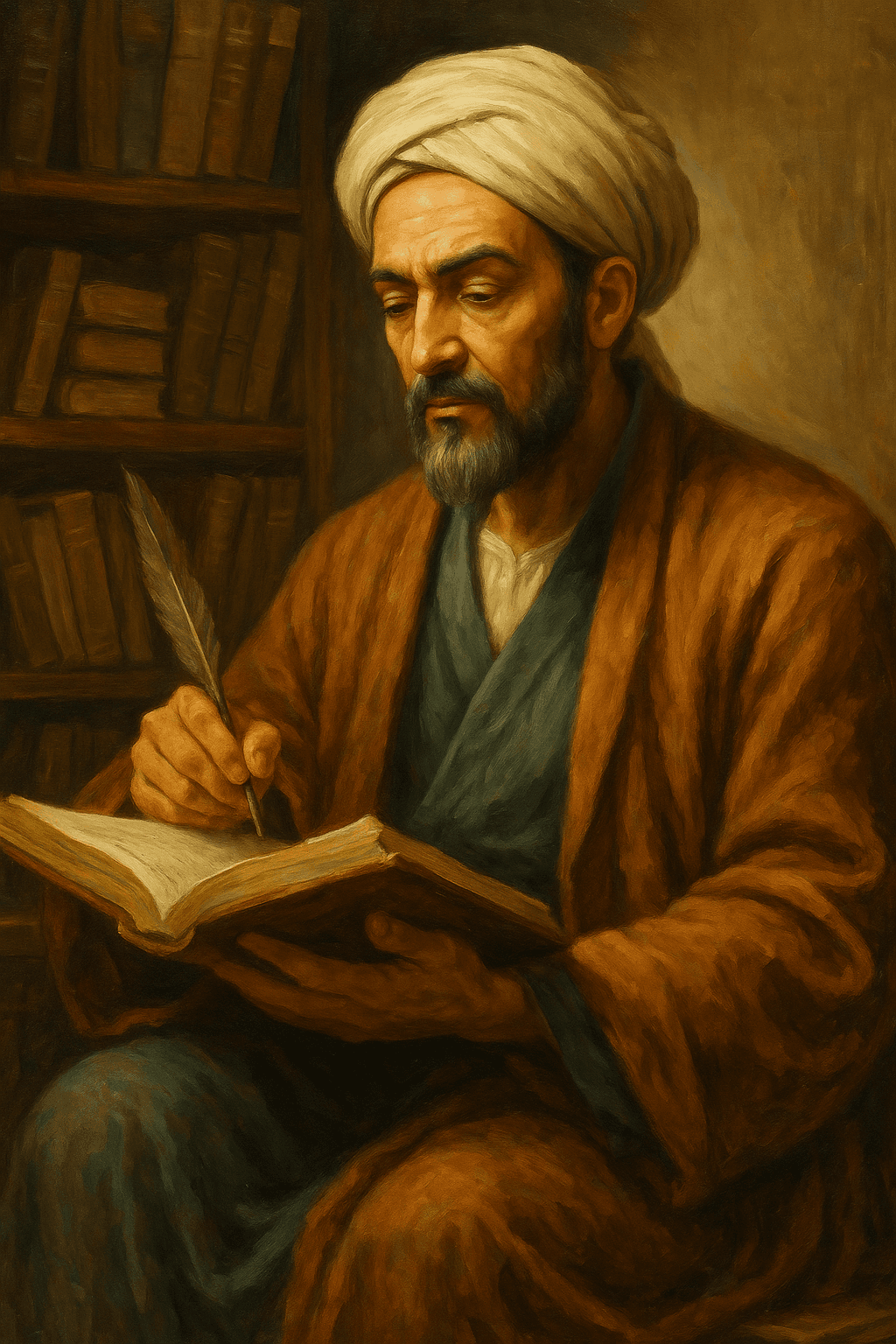
Who is Ibn Khaldun?
Ibn Khaldun (1332–1406) was a prominent thinker, historian, and social scientist of the medieval period. He is regarded as one of the founders of the discipline now known as sociology. He is renowned for his works on history, politics, economics, and social structures.
Life
Ibn Khaldun was born in 1332 in the city of Tunis in North Africa. His full name was Abdurrahman ibn Muhammad ibn Khaldun al-Hadrami. His family belonged to a scholarly lineage that had migrated from Al-Andalus (modern-day Spain) to Tunis.
Ibn Khaldun received education from an early age in Arabic language, mathematics, philosophy, Islamic sciences, and literature. His intelligence and knowledge attracted attention at a young age, leading him to hold important positions in various cities. He lived in Cairo, Fez, Algiers, and Damascus, serving both as a teacher and in state offices.

(Generated by Artificial Intelligence)
Educational and Professional Career
After completing his education at a young age, Ibn Khaldun held various state offices. He served as an advisor to numerous rulers in Al-Andalus and North Africa, undertook diplomatic missions, and occasionally worked as a judge. One of the places where he spent the longest time was Cairo in Egypt, where he taught at major madrasas such as Al-Azhar.
At the same time, Ibn Khaldun witnessed many political events and kept detailed notes on the societies he observed during these periods. His political experiences and exposure to different governance structures across regions deepened his understanding of history and society. As a result, his writings include not only theoretical knowledge but also significant observations drawn from his own life.
Works
Ibn Khaldun’s most famous work is the book titled Muqaddimah. This work addresses the writing of history and the development of societies. The Muqaddimah covers numerous subjects beyond historiography, including economics, politics, education, religion, urban life, and nomadic communities.
This book is regarded as a pioneering text in the development of modern sociology. Ibn Khaldun argued that history is not merely about recounting the past, but about understanding the causes of events and how societies change over time.

(Generated by Artificial Intelligence)
Views and Contributions
- He proposed the idea that societies are born, grow, weaken over time, and eventually disintegrate.
- He asserted that humans are compelled to live together, explaining this concept through the notion of “social existence.”
- He argued that states can remain strong only if they are just.
- He compared nomadic societies with settled societies, investigating the reasons behind their differing structures.