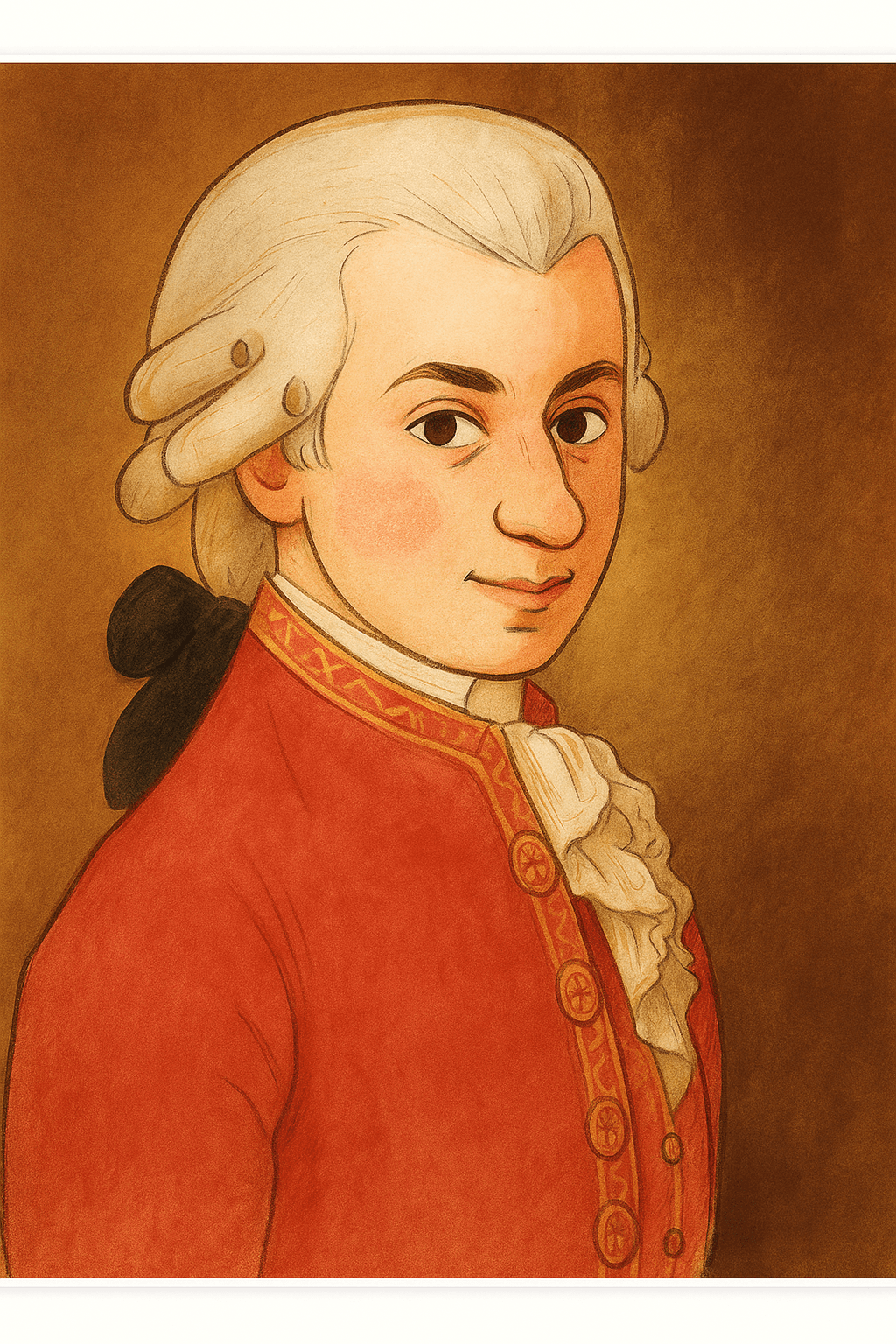




Wolfgang Amadeus Mozart
One of the brightest stars of classical music, whose full name is Johannes Chrysostomus Wolfgangus Theophilus Mozart, is a composer revered with admiration across the world for centuries. Despite his short life, Mozart composed hundreds of works and is renowned both for his genius and the innovations he brought to music.

Wolfgang Amadeus Mozart (Image generated by artificial intelligence).
👶 Birth and Childhood
Mozart was born on 27 January 1756 in the city of Salzburg, Austria. His father, Leopold Mozart, was one of the respected music teachers of the time and quickly recognized his son’s extraordinary talent. His sister, Maria Anna, known as “Nannerl,” was also a gifted musician. The siblings grew up immersed in music; their home was nearly always filled with melodies.

Representational image of Mozart beginning to play the piano in childhood (Image generated by artificial intelligence).
Even at the age of three, Mozart curiously touched the keys of the clavichord, and by five he had begun composing short pieces. His father noticed this interest and guided him toward music, soon preparing for a journey that would take them beyond Salzburg.
🎓 Education
The greatest influence on Mozart’s education was his father. Leopold Mozart ensured that his son not only learned to read musical notation but also understood the emotion and meaning behind music. Mozart received musical training alongside his formal schooling, but what truly shaped him were his travels.
He traveled with his father to various cities across Europe, met local musicians, and listened to diverse musical styles. These journeys enriched both his ear and his imagination.
🎹 Entry into Music
Mozart seemed to have an innate connection to music. Even before he could read or write, he could write down notes and invent melodies. At four years old he began playing the clavichord, and by six he was improvising on the violin. As soon as his father recognized this talent, he took him on concerts to introduce him to audiences in different cities. The young Mozart became known as a “musical prodigy” for his naturalness and sincerity, which astonished listeners.

Representational image of young Mozart giving his first concert in Europe (Image generated by artificial intelligence).
🌍 Development and Early Concerts
At just six years old, Mozart embarked on a European tour. He performed in cities such as Munich, Vienna, Paris, and London, achieving dazzling success at every concert and receiving invitations from kings and nobility of the era.
During these travels, he did not merely perform—he observed different musical traditions and incorporated them into his own style.

Representational image of Mozart on stage (Image generated by artificial intelligence).
By the age of twelve, he had composed his first stage work, Bastien und Bastienne. He had also written the opera La finta semplice during the same period. These early compositions foreshadowed the genius he would become.
🎼 Compositions and Music
Mozart’s music possesses a refined, emotional beauty that touches every listener. Throughout his life, he composed over six hundred works, including symphonies, concertos, chamber music, operas, and sacred music. Some of his most famous operas are The Abduction from the Seraglio, The Marriage of Figaro, and The Magic Flute. These works blend both playful and profound emotions.

Representational image of Mozart composing his works (Image generated by artificial intelligence).
Mozart also united two cultures in music by incorporating Ottoman rhythms in his famous piano piece, Rondo alla Turca (Turkish March). This composition remains one of the most recognized and beloved works worldwide today.