

Xanthos (Ksanthos) – Antalya
Xanthos, a magnificent ancient city built on two hills along the banks of the Eşen River (known in antiquity as the Xanthos River), is located in the Kınık Village of the Kaş District in Antalya. Known as the administrative center of the Lycian League, Xanthos stands as one of history’s most significant witnesses, renowned for both its legends and its impressive ruins.

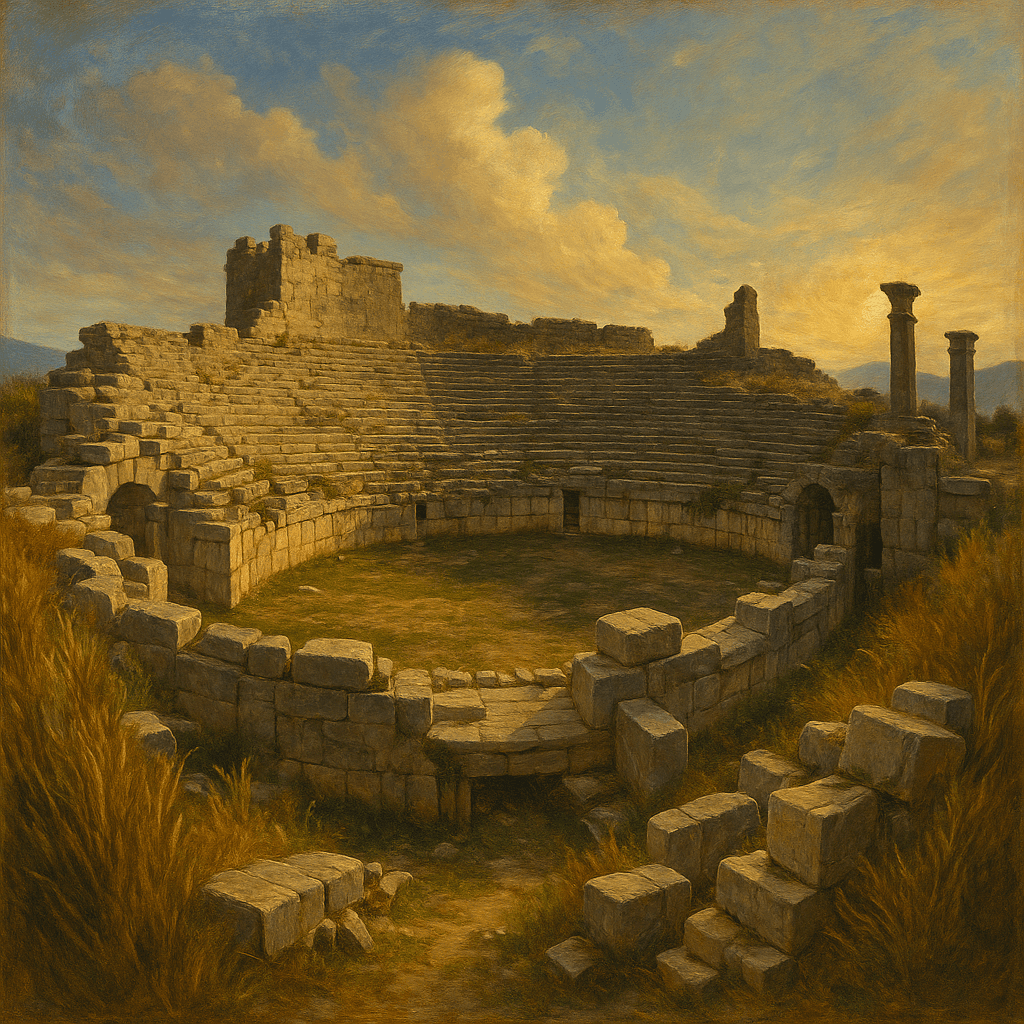
(Generated with Artificial Intelligence)
Where and When Was It Founded?
The history of Xanthos extends back to the 8th century BCE. The city was constructed on two acropolises: one known as the Lycian Acropolis and the other as the Roman Acropolis. In ancient sources, the city’s name in the Lycian language is recorded as Arnna. According to Homer, the people of Xanthos participated in the Trojan War.

(Generated with Artificial Intelligence)
Courageous Resistance
In 545 BCE, Xanthos became famous in history for its heroic resistance against the attack led by the Persian commander Harpagus. According to Herodotus, the inhabitants first destroyed their families and possessions to prevent them from falling into enemy hands, then fought until the last drop of their blood. The city was later rebuilt and came under the rule of the Ptolemies, the Seleucid Kingdom, the Roman Empire, and the Byzantine Empire in successive periods.
Important Structures
- Harpy Monument: This 5th century BCE tomb features reliefs depicting winged creatures with female heads, believed to carry the souls of the dead to the heavens. The original is housed in the British Museum.
- Nereid Monument: A 4th century BCE tomb constructed in the form of a temple. Its statues and reliefs were taken to England.
- Roman Theater and Agora: These structures, the heart of the city’s social and commercial life, date to the Roman period.
- Kherei Monument: The largest Lycian-language inscription in the region, this tomb features bilingual inscriptions in Lycian and Greek.
UNESCO World Heritage Site
Xanthos, together with its neighboring site of Letoon, was inscribed on the UNESCO World Heritage List in 1988. This decision recognizes the city’s universal value, reflected in its unique architecture, inscriptions, and historical events that embody the distinctive character of Lycian civilization.

(Generated with Artificial Intelligence)