


This article was automatically translated from the original Turkish version.
+2 More
Kaş
Mayor(s) | Erol DEMİRHAN | ||||||||
|---|---|---|---|---|---|---|---|---|---|
District Governor | Tevfik KUMBASAR | ||||||||
Vegetation Cover | Akdeniz | ||||||||
Surface Area | 2231 km2 | ||||||||
Total Population | 63.921 | ||||||||
Number of Neighborhoods in the District | 54 | ||||||||
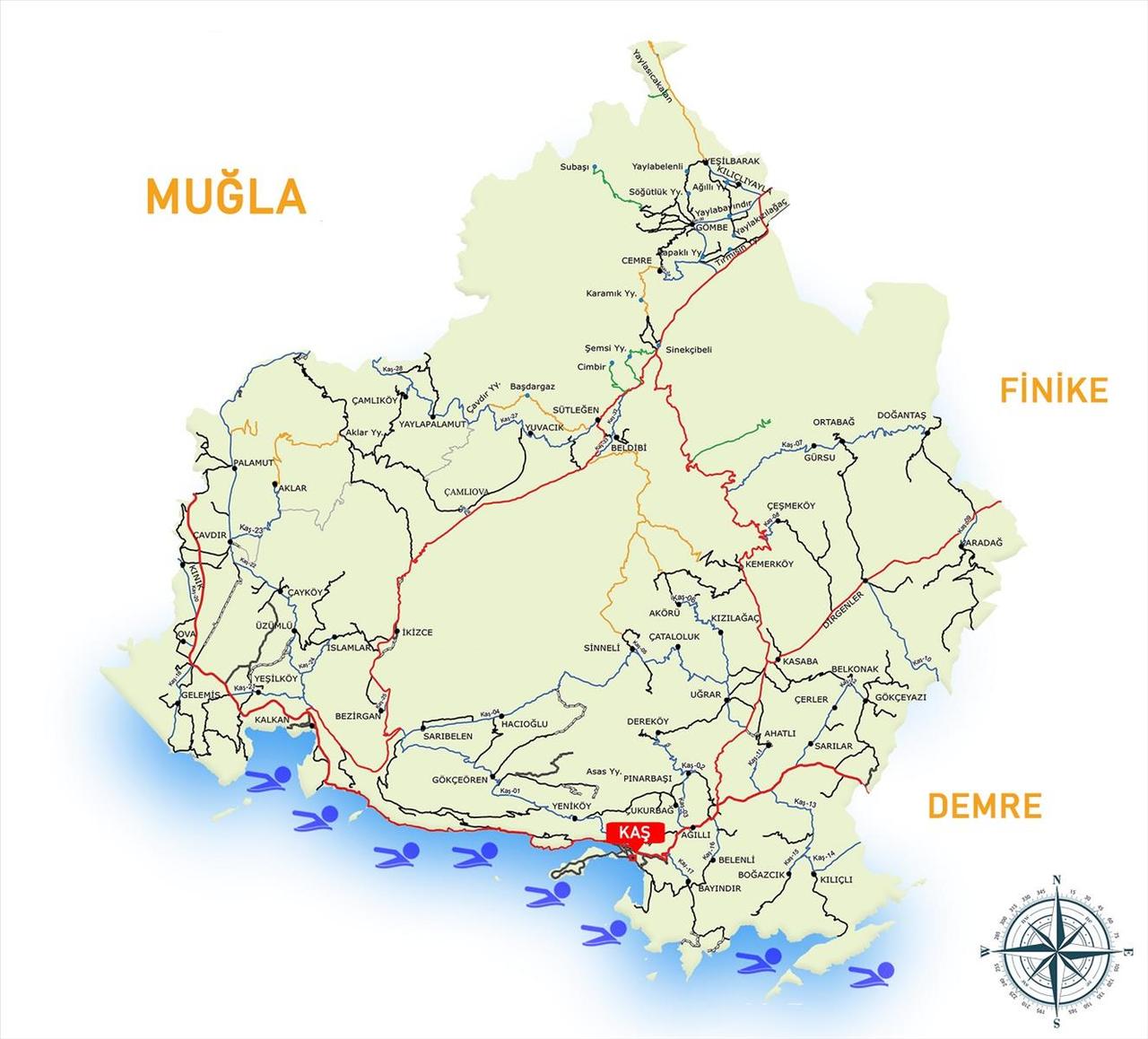
Kaş is a district of Türkiye on its southern coast, linked to Antalya. Located at the southwestern tip of the Teke Peninsula, it is one of the coastal towns opening onto the Mediterranean Sea. The district is distinguished by its natural beauty, historical fabric, and protected coastline. It borders Fethiye district of Muğla to the west, Elmalı to the north, and Demre to the east. Directly across the sea, just 2 kilometers away, lies the Greek island of Meis (Kastellorizo).

Kaputaş Beach (Anadolu Agency)
Kaş district covers an area of 2,231 km² and is characterized by a rugged land topography. Situated at the foothills of the Taurus Mountains, the district features a deeply indented coastline composed of ridges extending perpendicularly toward the sea and numerous coves. Region exhibits a Dalmatia type of coastline. Although it is not rich in rivers or underground water sources, the mountainous building terrain offers considerable diversity in natural formations.
The district experiences a Mediterranean climate judgment. Summers are hot and dry, while winters are mild and rainy. The Mediterranean climate dominates up to an elevation of 700 meters; at higher elevations, continental climate traits become noticeable. This situation has facilitated the development of coastal agriculture, summer tourism, and transhumance activities.
According to 2023 TÜİK ADNKS data, the total population of Kaş district is 63,053, of whom 31,139 are male and 31,914 are female. The district comprises 54 neighborhood. Coastal neighborhoods are densely populated, while inland villages are more sparsely settled. During summer months, the population increases significantly due to the influx of domestic and foreign tourists.
Kaş was originally established as the ancient city of Antiphellos, part of the Lycian civilization. Initially serving as the harbor of a settlement named Phellos, Antiphellos gradually gained commercial and cultural importance and evolved into a significant independent city. The city became urbanized from the 4th century BCE and flourished during the Hellenistic and Roman periods with the construction of monuments, sarcophagi, and other structures. During the Ottoman period, Kaş was incorporated into the administrative system as a coastal village and retained its district status during the Republican era.
Kaş district has 54 neighborhoods. Some are located along the coastline, while others are situated in mountainous areas. Settlement patterns have developed in accordance with the rugged terrain, and road networks connect the neighborhoods. The district center is the area where public institutions and commercial activities are concentrated.
Access to Kaş is possible via black. Inter-city connectivity is provided by road. The nearest major airports are in Dalaman or Antalya. Internal travel between neighborhoods is carried out using municipality vehicles or private transport. Due to the mountainous terrain, access to some rural neighborhoods is limited.
Although economic activities are not directly detailed in the sources, it is evident that Kaş has an economy largely based on tourism due to its coastal structure, natural beauty, and ancient ruins. The seasonal population increase during summer contributes to the growth of accommodation and service sectors. Olive cultivation, small-scale agriculture, and local trade are also observed economic activities.
Antalya İl Kültür ve Turizm Müdürlüğü. *Dünden Bugüne Antalya - Cilt 1: Kaş*. Accessed April 20, 2025.
Kaş Belediyesi. "Tarihçe." Accessed April 20, 2025.
Kaş Kaymakamlığı Governorship. "Coğrafi Yapı." Accessed April 20, 2025.
Nufusu.com. "Kaş Nüfusu 2023." Accessed April 20, 2025.

Kaş
Mayor(s) | Erol DEMİRHAN | ||||||||
|---|---|---|---|---|---|---|---|---|---|
District Governor | Tevfik KUMBASAR | ||||||||
Vegetation Cover | Akdeniz | ||||||||
Surface Area | 2231 km2 | ||||||||
Total Population | 63.921 | ||||||||
Number of Neighborhoods in the District | 54 | ||||||||
Natural Structure and Geographic Features
Climate Characteristics
Population and Settlement
History
Administrative Structure and Neighborhoods
Transportation and Infrastructure
Tourism and Economic Activities