




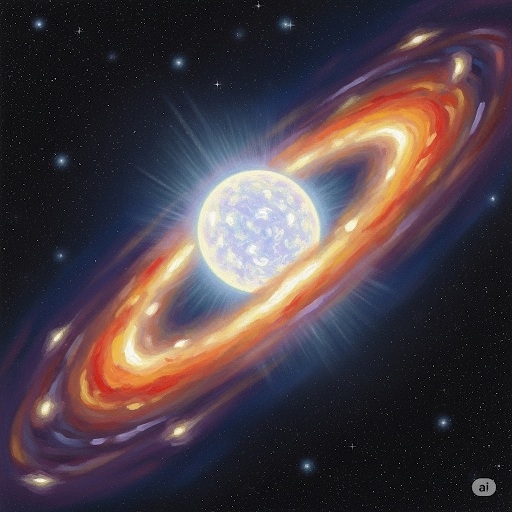
Neutron Star 🌌
Have you ever imagined a gigantic star shrinking and compressing into an incredibly small space? Neutron stars are celestial objects exactly like this. When a very massive star reaches the end of its life, it collapses in a massive explosion known as a supernova, leaving behind an object of incredible density. This is what we call a neutron star. Neutron stars are among the smallest yet densest objects in the universe. They are so massive that even if all the mountains and oceans on Earth were combined, they would not weigh as much as a tiny fragment of a neutron star.

(Generated by artificial intelligence.)
How Do They Form?
The formation of neutron stars occurs much like a giant balloon deflating. A star at least eight times more massive than the Sun begins to collapse inward once its fuel is exhausted. This collapse happens so rapidly and powerfully that the star’s core becomes extraordinarily compressed. This process triggers a supernova explosion. After the explosion, the star’s outer layers are flung into space, leaving behind only a tiny, super-dense core. This core is now a star composed entirely of neutrons.

(Generated by artificial intelligence.)
Properties of Neutron Stars
As their name suggests, neutron stars are made up of neutrons formed when protons and electrons merge under extreme pressure. This makes them among the densest objects in the universe. A single teaspoon of material from a neutron star could weigh more than all the people on Earth combined.
These stars rotate extremely rapidly. Some can spin hundreds of times per second. During this rotation, powerful magnetic fields around them emit beams of radiation into space. From Earth, these beams appear to flash on and off at regular intervals, like a lighthouse. Such neutron stars are called pulsars.

(Generated by artificial intelligence.)