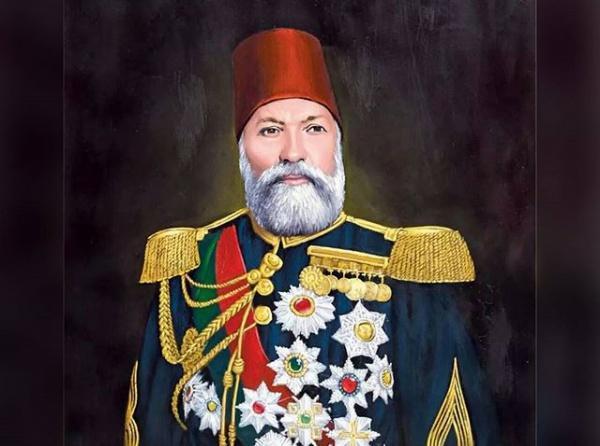




Gazi Osman Pasha
Gazi Osman Paşa was born in Tokat in 1833. His real name was Osman Nuri. His father, Mehmed Efendi, was an official at the timber customs office in Istanbul, and his mother was Şâkire Hatun. Osman was the only male child in the family. At the age of seven or eight, he moved to Istanbul with his family, where he began his education in military schools. He first attended the Beşiktaş Military Rüştiyesi and then the Askerî İdadî. In 1853, he graduated second in his class from Harbiye and became a soldier. He was a highly diligent student, which led to his rapid promotion to important posts.

Gazi Osman Paşa (Gazi Osman Paşa Middle School)
A Brave Commander in War
Osman Paşa achieved great success in many wars. He first participated in the Crimean War, where he rose from second lieutenant to captain. He later held important posts in Syria, Crete, and Yemen. While suppressing the Cretan uprising, he was promoted to colonel, and his successes in Yemen earned him the rank of brigadier general. In 1876, when the Serbs declared war on the Ottoman Empire, he defeated the Serbian army under Russian generals and was promoted to marshal. Everywhere he served, he worked tirelessly for his homeland.
The Defense of Plevne
This defense is a heroic epic filled with the courage Gazi Osman Paşa and his soldiers showed in protecting their homeland. Let us examine this glorious defense in detail.
Arrival at Plevne
Plevne is a city in northern Bulgaria. In 1877, when the Russians declared war on the Ottoman Empire, Gazi Osman Paşa was commander of an army in Vidin. He received orders to go to Plevne. On July 7, 1877, Osman Paşa arrived in Plevne with 25,000 soldiers. He ordered the digging of trenches around the city—ditches and walls to protect his troops—because he knew the Russians would arrive with a much larger force.
The First Battle of Plevne
On July 8, 1877, the Russians, under the command of the German-born General Schilder, attacked Plevne. This is known as the First Battle of Plevne. Osman Paşa and his soldiers resisted with great courage. Despite being vastly outnumbered, the Russians were defeated. This was the first major setback the Russians suffered in Rumelia!
The Second Battle of Plevne
The Russians did not give up and launched another attack on July 18 with additional troops. This battle lasted a full 26 hours! Osman Paşa and his soldiers again displayed fierce resistance. The Russians were defeated once more and forced to retreat. Osman Paşa’s intelligence and his soldiers’ bravery astonished everyone.
The Third Battle of Plevne
This time, the Russians received assistance from the Romanians and attacked Plevne for the third time between September 7 and 11, 1877. But Osman Paşa and his soldiers once again stopped them! After this great victory, Osman Paşa was granted the title “Gazi.” Gazi is a special honor bestowed upon those who make great sacrifices for their homeland. The Defense of Plevne lasted 145 days and entered military history.
The Siege and Final Effort
Realizing they could not capture Plevne, the Russians surrounded the city on September 13, cutting off all entry and exit. Over time, food and ammunition supplies dwindled. Osman Paşa never considered surrendering. On the morning of December 10, 1877, he divided his 40,000 soldiers into two groups and attempted to break through the siege by crossing the Vid River. However, he encountered heavy fire from Russian and Romanian artillery. Osman Paşa was wounded by a shrapnel fragment. When his soldiers realized they could no longer fight, they were forced to surrender.
Osman Paşa’s Courage
After being captured, Osman Paşa endured captivity in Bugot, Bucharest, Kharkov, and Russia. Yet his courage was so remarkable that even the Russian Tsar admired him and awarded him the “Double Eagle Order.”

Gazi Osman Paşa (Gazi Osman Paşa Middle School)
Return to Istanbul and Later Years
Osman Paşa was released from captivity and returned to Istanbul in 1878. He was welcomed with a grand ceremony. Sultan Abdülhamid II held him in high esteem and entrusted him with important duties. Osman Paşa served in the palace and offered ideas to strengthen the army. He united Muslims against British pressure on the Ottoman Empire. He also participated in the Ottoman-Greek War of 1897. He died on April 4 or 5, 1900, at the age of 68, and was buried beside the Tomb of Fatih Sultan Mehmed.
Osman Paşa’s Family
Osman Paşa married Zâtıgül Hanım and had four sons: Nureddin, Kemaleddin, Cemaleddin, and Hüseyin Abdülkadir.
Osman Paşa was not only a brave soldier but also highly educated. He spoke Arabic fluently, and had some knowledge of Persian and French.
The Plevne March
His love for his homeland and his diligence made him a hero admired by all. His name is still proudly sung in the Plevne March:
The Danube River says it will not flow,
It says it will not destroy my surroundings,
The glorious Osman Paşa,
Says he will not leave Plevne.
The enemy crossed the Danube,
Scouted all the outposts,
Alongside Osman Paşa,
Five thousand cannons fired at once.
Plevne March (Master Kemânkeş)
Gazi Osman Paşa was a courageous and intelligent commander who worked tirelessly for his homeland. His story teaches us how vital love of country and determination truly are!