


This article was automatically translated from the original Turkish version.
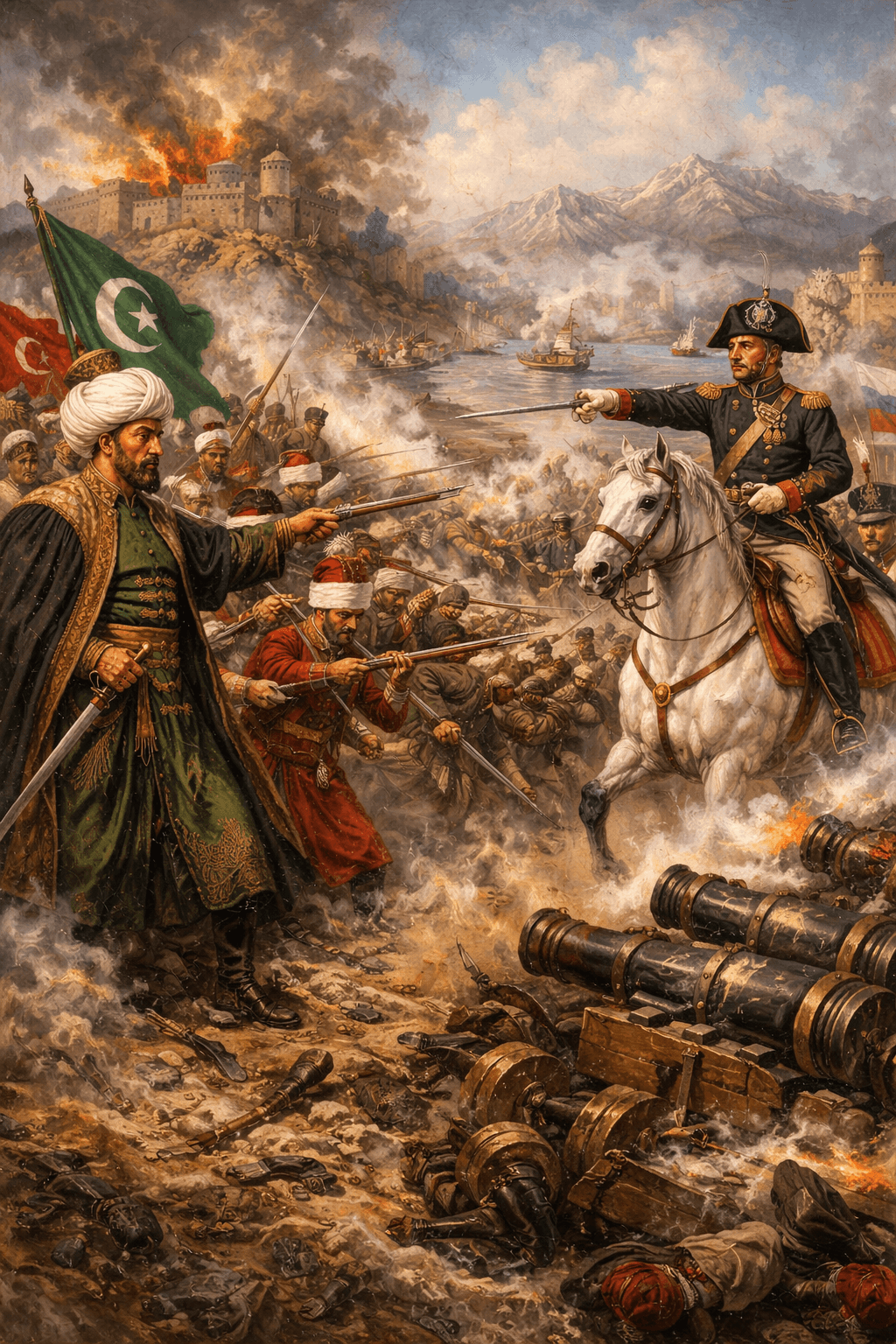
Depiction of the Ottoman-Russian War of 1806–1812 (Generated by Artificial Intelligence)
Geography | Balkans (Danube Basin) / Black Sea coasts / Caucasus / Mediterranean | ||||||||
|---|---|---|---|---|---|---|---|---|---|
Territorial Changes | Restoration of Fășa (Poti) and some Black Sea coastal fortresses to the Ottomans Return of Wallachia and Moldavia to Ottoman sovereignty Cession of Bessarabia to Russia | ||||||||
Battles | Siege of Slobozia (1811) Raids on Trabzon and Akçaabat (1807 / 1810) Siege of Fășa Fortress (1807 / 1809) Battles of Silistra (1809–1810) Sieges of Ismail (1807 / 1809) | ||||||||
Important Fronts | Aegean Sea Black Sea Coasts Caucasus Front Danube Front | ||||||||
Commanders | Dmitriy Senyavin Ivan Gudovich Pyotr Bagration Ivan Mikhelson Mikhail Kutuzov Russian Empire: Tsar I. Alexander Çelebi Mustafa Pasha Yusuf Ziya Pasha Pehlivan İbrahim Ağa Alemdar Mustafa Pasha Sultan II. Mahmud (1808–1812) Ottoman Empire: Sultan III. Selim (1806–1807) | ||||||||
Parties | Russia Ottoman State | ||||||||
History | 1806 – 28 May 1812 | ||||||||
The 1806–1812 Ottoman-Russian War was a comprehensive conflict lasting six years between the Ottoman State and Russia, centered on territorial dominance and influence in the Balkans and the Caucasus, as well as security in the Black Sea. It concluded with the Treaty of Bucharest. The war began when Russian forces occupied Moldavia and Wallachia after the Ottomans replaced the pro-Russian voivodes of these regions without Russian consent. Sieges of fortresses along the Danube such as Ismail and Silistra, naval raids targeting Trabzon and Akçaabat on the Black Sea coast, and struggles over the Faş Kalesi and the Kingdom of Imereti were among the key developments that shaped the course of the war. Expanding hostilities in the Caucasus, marked by Russian advances and the fall of Ottoman fortresses, ended with the Treaty of Bucharest signed on 28 May 1812. Under the treaty, Bessarabia was ceded to Russia, Moldavia and Wallachia were returned to Ottoman control, and several Caucasian fortresses were restored to Ottoman administration.
Through the Treaty of Jassy signed in 1792, the Ottoman State had fully ceded Crimea to Russia and largely lost its dominance over the northern Black Sea coast. In the late 18th century, Napoleon Bonaparte’s expansionist policy in the Mediterranean temporarily brought Ottoman-Russian relations closer. The French occupation of Venice and some Aegean islands in 1797, followed by the invasion of Egypt in 1798, prompted the Ottoman Empire and Russia to form an alliance for the first time in their histories. However, this cooperation did not last long. Alongside Napoleon’s threat to Europe, Ottoman efforts to limit Russian influence in key regions such as Moldavia and Wallachia triggered a new crisis between the two states. Ottoman Sultan III. Selim, while cultivating close ties with France, recognized Napoleon as emperor in early 1806 and even granted him the title of “padishah.”【1】
In the same year, the Ottomans dismissed the pro-Russian voivodes of Moldavia, Alexander Moruzi, and Wallachia, Constantine Ipsilanti, replacing them with French sympathizers. This development was viewed by Russia as a violation of Ottoman agreements regarding the Danubian Principalities. Tsar Alexander I issued orders on 4 October 1806 to General Ivan Mikhelson to rapidly occupy Moldavia and Wallachia without declaring war. Indeed, in November 1806, a Russian force of 40,000 to 60,000 troops crossed the Dniester (Turla) River without a formal declaration of war and easily seized control of the two principalities. Initially, the Ottomans refused to believe this sudden occupation; the reality became clear only when the Moldavian voivode personally informed III. Selim.

Map of Ottoman Balkan Territories at the Start of the War (David Rumsey)
Eventually, Istanbul was forced to respond to this aggressive move by Russia. On 22 December 1806, III. Selim closed the Dardanelles to Russian ships and formally declared war on Russia. In this decree, the Ottoman government cited the Russian occupation of Muslim territories in Crimea and Georgia, as well as Russian interference in Ottoman internal affairs, as justifications for war.【2】 Thus, the 1806–1812 Ottoman-Russian War began.
In the early months of the war, hostilities erupted simultaneously on both Ottoman-Russian fronts. Russian forces launched offensives in both the Balkans and the Caucasus in early 1807. While mobilizing its own army, the Ottoman State continued to strengthen its ties with France. This situation alarmed Britain and triggered a separate crisis targeting the Ottomans: in early 1807, the British fleet forced its way through the Dardanelles and reached the outskirts of Istanbul. However, this Anglo-Ottoman tension soon subsided, and the Ottomans refocused on Russia as their primary threat.
At the outset of the war, the Russian army rapidly advanced through Moldavia into Wallachia and reached Bucharest. Ottoman fortresses in the region were caught unprepared. In 1807, the Russians began besieging strategic fortresses such as Hotin, Bender, and Ismail. However, the Ottomans quickly regrouped and adopted a defensive stance along the Danube. The Ottoman army was led by Grand Vizier Ibrahim Hilmi Pasha, with Vizier Alemdar Mustafa Pasha arriving to reinforce the region; local ayan such as Pehlivan Ibrahim Ağa played a critical role in the defense. Indeed, during the spring and summer of 1807, the Ottomans mounted a successful resistance, particularly in the Ismail region of the Danube Delta. A Russian force of approximately 6,000 troops under General Zass besieged Ismail in September 1807 but encountered fierce resistance. Led by Pehlivan Ibrahim Ağa, Ottoman units and local volunteers inflicted heavy losses on the besiegers. As a result of these clashes, the Russians suffered significant casualties and were forced to withdraw. Thus, Ismail Fortress was saved from falling in 1807;【3】 the Ottomans gained morale in the early phase of the war, and Russian advances were temporarily halted.
Another significant development on the Balkan front occurred near Silistra. Russian forces advancing toward this strategic fortress on the Danube encountered strong Ottoman resistance. In a battle known as the Battle of Tatariçe, fought near Silistra, Ottoman troops under Pehlivan Ibrahim Ağa halted a Russian army of approximately 60,000 men. In this engagement at Tatariçe in September 1807, the Russian army lost over 10,000 soldiers. Thanks to Pehlivan Ibrahim Ağa’s resistance, Russian advances along the Danube were temporarily repelled, and a balance was restored on the front as winter approached. These developments allowed the Ottomans to gain valuable time.
In early 1807, the Russian Imperial Navy sought to pressure the Ottomans through active operations in the Black Sea and even near the Straits. Under Admiral Dmitriy Senyavin, the Russian fleet captured Tenedos in March 1807 and established it as a base. Senyavin then engaged the Ottoman navy in the Battle of Lemnos, inflicting heavy losses on the Ottoman fleet. The Russian fleet’s presence in the Aegean posed a serious threat to Istanbul. However, during the same period, major power balances in Europe were rapidly shifting. Napoleon’s successive defeats of Prussia and Russia culminated in his signing of the Treaty of Tilsit with the Russian Tsar in July 1807, which affected the course of the war on the Ottoman front. Having made peace with France at Tilsit, Alexander I agreed to a temporary truce with the Ottomans. On 26 August 1807, Ottoman and Russian representatives signed the Yerköy Armistice, halting hostilities on the Danube front. As part of this armistice, the Russians agreed to partially withdraw from Moldavia and Wallachia. Simultaneously, Senyavin’s fleet, on the Tsar’s orders, withdrew from the Straits and ended its operations in the Aegean. Thus, the war was temporarily suspended, and conditions were prepared for peace negotiations.

Painting of the Battle of Lemnos (Picryl)
Peace initiatives after Tilsit proved fruitless. Although negotiations between the Ottomans and Russians were conducted under Napoleon’s mediation, the parties failed to reach a lasting agreement. Meanwhile, the succession of Sultan II. Mahmud to the Ottoman throne in July 1808, replacing III. Selim, and the Ottoman signing of the Treaty of Dardanelles with Britain in 1809 created new diplomatic alignments. By late 1808, the armistice between Russia and the Ottoman State was effectively over. Tsar Alexander, with his relations with France becoming uncertain, decided to revive the war against the Ottomans in the south. From early 1809, hostilities intensified on both the Danube and Caucasian fronts.
The Russian army had been reinforced during the armistice period and was placed under the command of the experienced General Mikhail Kutuzov. In 1809, the Russians launched an offensive to reclaim positions lost north of the Danube. In September 1809, troops under General Zass advanced once again toward Ismail Fortress. This time, Ottoman defenses were weaker than the previous year; Pehlivan Ibrahim Ağa, who had successfully defended Ismail, had been reassigned elsewhere, and command of the fortress had been given to Çelebi Mustafa Pasha. Unrest emerged within the fortress under Mustafa Pasha’s administration. Seeking to consolidate his authority, the pasha removed Ibrahim Ağa’s loyalists from the fortress and also withdrew the garrison of nearby Yergöğü Fortress under Ahmed Pasha. These missteps left Ismail vulnerable. Facing the Russian siege, Mustafa Pasha attempted to negotiate a truce with the enemy but failed. On 1 September 1809, the Russians began a fierce bombardment of the fortress from both land and river. On 27 September 1809, Ismail Fortress surrendered to the Russians; its ammunition and supplies fell into Russian hands. The loss of Ismail was a major blow to the Ottomans. This outcome was not solely due to Çelebi Mustafa Pasha’s errors; the failure of the central government to send timely reinforcements, provisions, and munitions had also weakened the defense. With the fall of Ismail, the Russians secured definitive dominance in Bessarabia.
In late 1809, the Russians targeted other fortresses along the Danube. In October 1809, Russian forces under Prince Pyotr Bagration approached Silistra and laid siege to it. As Silistra’s situation became critical, Grand Vizier Yusuf Ziya Pasha reappointed Pehlivan Ibrahim Ağa to reinforce the city. Ibrahim Ağa arrived promptly and confronted the Russians at the Tatariçe position near Silistra. In the ensuing battle, Ottoman defenses succeeded; Pehlivan Ibrahim Ağa achieved a victory that cost the Russians approximately 10,000 casualties. Following this defeat, the Russian army lost its momentum and retreated. Both sides, due to the approaching winter, were unable to launch major operations by the end of 1809.
In 1810, Tsar Alexander appointed the renowned commander Mikhail Kutuzov to lead the Danube Army to accelerate the war effort. Kutuzov pursued a more decisive strategy on the Balkan front. In the summer of 1810, the Russians captured fortresses in succession, placing the Ottomans in a dire situation. In June 1810, key locations such as Babadağ, İbrail, and Tulça fell into Russian hands. In July 1810, Kutuzov’s forces successfully captured Silistra Fortress. Although Ottoman defenders resisted heroically during the siege, Silistra could not withstand the heavy artillery bombardment. With the loss of Silistra, one of the Ottomans’ strongest defensive positions on the Danube was lost. Fighting also occurred in the Niğbolu and Rusçuk regions during the same year. After fully securing Moldavia and Wallachia, the Russians began raids across the Danube into Ottoman territory south of the river. The Ottomans, in turn, withdrew to defensive lines south of Silistra, particularly around Şumnu and Varna, attempting to halt Russian advances. By the end of 1810, both sides were exhausted. Nevertheless, the Russians consolidated their captured fortresses and intensified pressure on the Ottomans for peace.
The other major front of the Ottoman-Russian War was the Caucasus and the eastern shores of the Black Sea. In this region, the conflict intensified over control of Georgian territories and fortresses along the Black Sea coast. At the end of the 18th century, Russia annexed the Kingdom of Kartli-Kakheti in eastern Georgia (1801) and began rapidly expanding its influence in the Caucasus. Western Georgia, under Ottoman influence, was divided among small principalities: Imereti, Megrelia (Samegrelo), Guria, and Abkhazia. The Ottoman State sought to protect its territories in this region for the security of the Black Sea, while Russia aimed to extend its dominance westward into Georgia. When the war erupted, Tsar Alexander I appointed the experienced general Ivan Gudovich as commander of the Caucasian forces. The Russian strategy was to capture Ottoman fortresses along the Black Sea coast and sever Ottoman ties with the Caucasus.
Faş Kalesi (Poti), located at the mouth of the Rioni River on the eastern Black Sea coast, was a critical position for the Ottomans on the Caucasian line. At the start of the war, the Ottomans reinforced the fortress and gave it special defensive importance. In April 1807, the Russian navy launched a surprise raid and captured Anapa Fortress. The fall of Anapa shook Ottoman resistance in the region. Subsequently, in the summer of 1807, the Russians turned their attention to Faş Kalesi. In July 1807, Russian troops under General Glazenap besieged Faş from land, while naval vessels blockaded it from the sea. Ferah Ali Pasha, commanding the Ottoman garrison, defended the fortress with support from local Abaza and Georgian populations. The initial Russian assault was repelled; Faş Kalesi remained in Ottoman hands until the end of 1807. According to Serhat Kuzucu’s findings, this first Russian offensive in 1807 failed, and the fortress remained under Ottoman control for two years. Thanks to Faş’s resistance, the Ottomans gained valuable time on the Caucasian front until 1809.

Location of Faş (TDV İslam Ansiklopedisi)
However, in 1809, conditions shifted against the Ottomans. Napoleon’s war with Austria (the Wagram campaign of 1809) enabled Russia to allocate greater resources to the Caucasus. General Ivan Gudovich now planned a comprehensive operation to capture Faş Kalesi. Although the Ottomans sent forces under Şerif Pasha and Selim Pasha to defend the fortress, personal rivalry between the two pashas undermined the defense. In September 1809, the Russians besieged Faş Kalesi for the second time. Under sustained artillery fire from land and naval blockade, the fortress, after prolonged resistance, fell to the Russians within the same year. With the capture of Faş Kalesi, Ottoman resistance in western Georgia collapsed. Following the fall of Faş, Russia effectively annexed the Kingdom of Imereti in 1810. King Solomon II of Imereti, unable to secure the military support he expected from the Ottomans, could not withstand the Russians; in 1810, Russian forces captured Kutaisi, the capital of Imereti, and incorporated this final Georgian kingdom into their territories. Simultaneously, other Ottoman-aligned principalities in western Georgia—Megrelia, Guria, and Abkhazia—also came under Russian influence between 1803 and 1810.
Seeking to gain superiority in the Caucasus, the Russians launched raids along the Anatolian coast of the Black Sea. Particularly to disrupt Ottoman maritime logistical support to the Caucasus, the Russian navy targeted the Trabzon region. According to reports by the French consul Dupré in Trabzon, a Russian naval detachment appeared off the coast of Trabzon in early February 1807. On 2 February 1807, two Russian warships approached Trabzon harbor and turned westward toward Akçaabat (Pulathane), harassing Ottoman merchant vessels there. On 16 February 1807, Russian ships arrived off the coast of Akçaabat and bombarded the town. During the approximately two-hour bombardment, several Ottoman ships anchored along the shore were sunk or damaged. When Russian landing parties attempted to go ashore, they were ambushed by Ottoman forces from Trabzon and surrounding areas. Local militia, supported by coastal artillery batteries, inflicted accurate fire on Russian vessels, causing damage and forcing the Russians to withdraw. According to the testimony of a captured Russian officer, the Russian objective was to create unrest in the city under the pretext of protecting their own consuls and the local Christian population. After the February 1807 operation, the Russian fleet withdrew to its base in the Black Sea.
The Russian navy reappeared off Trabzon during the summer of 1807. In June 1807, a large Russian fleet under Admiral Pustushkin—comprising three ships of the line, seven frigates, and other vessels totaling approximately sixteen ships—arrived off Trabzon and began preparations. On 18–19 June 1807, the Russians attempted another landing near Akçaabat. Smaller vessels from the Russian fleet bombarded Pulathane for four hours after noon, burning some Ottoman ships and capturing one. In response, Ottoman batteries in Trabzon returned fire, disabling two Russian boats. Severely damaged, the Russian forces withdrew from the area the next day, aided by favorable winds. Although these 1807 naval raids unsettled the Ottomans, they did not lead to a Russian occupation of the region. This was because, by the end of the year, the armistice required the Russian navy to cease such operations.
Near the end of the war, the Russians made one final landing attempt along the eastern Black Sea coast. In October 1810, Tsar Alexander I ordered an operation to end Ottoman control along the coast from Trabzon to Poti. In response, a powerful Russian fleet under Admiral Aleksey Sarychev was assembled; a landing force of five infantry battalions, 200 Cossack cavalry, and about 30 Rum volunteers was loaded onto the ships. The Russian fleet first sailed into the Black Sea in August 1810 for patrols but returned to base due to a storm. On 24 October 1810, approximately eight ships of the line and accompanying vessels returned off Trabzon. On 27 October 1810, the Russians attempted a landing at Sargana Burnu, west of Trabzon. However, this operation, which had failed three years earlier, was again thwarted by local resistance. Ottoman troops and local civilians united to resist the Russian landing parties. Faced with unexpected resistance, the Russian forces could not hold their ground and retreated to their ships, withdrawing into the Black Sea.
These raids on Trabzon and Akçaabat in 1807 and 1810 have been thoroughly documented through the reports of French consul Dupré, confirming the success of Ottoman resistance. Indeed, local sources record that the Russians suffered heavy losses during the 1810 landing attempt at Sargana Burnu and were forced to retreat. Following this failure, Tsar Alexander I realized he could not advance further along the Caucasian coast and turned toward peace with the Ottomans.
By 1811, news spread that Napoleon was preparing a major campaign against Russia. Tsar Alexander I sought to secure his southern front against the Ottomans before facing France. At this time, a final confrontation occurred on the Danube: between September and October 1811, General Kutuzov surrounded the main Ottoman army that had crossed south of the Danube at Slobozia, keeping it immobilized for an extended period. This situation became a decisive factor compelling the Ottomans to seek peace. On 31 October 1811, armistice negotiations began between the parties. After approximately seven months of talks, the Treaty of Bucharest was finally signed on 28 May 1812. This 16-article peace treaty formally ended the six-year war between the two empires.
According to the Treaty of Bucharest, the validity of previous treaties between the Ottoman State and Russia was confirmed. Russia agreed to return Moldavia and Wallachia to Ottoman control, but ceded the strategic region of Bessarabia—located between the Prut and Dniester rivers (today’s eastern Moldova)—to Russia. The new border was defined as the Prut River to the west and the Batum-Sohum line in the Caucasus to the east. The Ottomans not only lost Bessarabia to the north but also, under secret clauses of the treaty, agreed to the demolition of Ismail and Kili fortresses. Thus, these critical Danube fortresses, vital for defense against Russia, were neutralized. The treaty also provided for a general amnesty and internal autonomy for the rebels in Serbia, granting Russia a guarantee role in the Serbian issue. On the Caucasian front, the most favorable provision for the Ottomans was Russia’s agreement to return some occupied territories. Specifically, Faş Kalesi and other Ottoman territories along the eastern Black Sea coast were restored to the Ottoman State under Article 6 of the treaty. Russian forces fully withdrew from the fortresses and territories they had occupied along the western Black Sea coast of Georgia. At the same time, Russia extended its border with the Ottomans to the Danube River through its acquisition of Bessarabia.【4】
The six-year 1806–1812 Ottoman-Russian War, overshadowed by the Napoleonic Wars, produced lasting consequences for both the Ottoman State and the Russian Empire. The Ottomans escaped greater territorial losses thanks to the French threat in Europe; Russia, meanwhile, was compelled—albeit unwillingly—to reach a reasonable peace with the Ottomans to focus on its struggle against Napoleon. Although the Ottoman army displayed resistance on both fronts and achieved some successes under commanders such as Pehlivan Ibrahim Ağa, it ultimately could not prevent defeat. Russia continued its territorial expansion in the Caucasus (fully annexing Georgia) and strengthened its position along the northern Black Sea coast by incorporating Bessarabia into its borders.
Aydın, Mustafa. “Faş.” *TDV İslâm Ansiklopedisi*. Accessed February 3, 2026. https://islamansiklopedisi.org.tr/fas--gurcistan.
Beydilli, Kemal. “Pehlivan İbrâhim Paşa.” TDV İslâm Ansiklopedisi. Accessed February 3, 2026. https://islamansiklopedisi.org.tr/pehlivan-ibrahim-pasa.
Bogolyubov, Alexey. “Battle of Athos 1807.” 1853. The Russian Museum. PICRYL. Accessed February 3, 2026.
Doğanay, Pınar. “Osmanlı-Rus Savaşı ve İsmâil Kuşatması (1806-1812).” Ankara Anadolu ve Rumeli Araştırmaları Dergisi 5, no. 10 (December 2024): 55–81. https://doi.org/10.53838/ankarad.1552446.
Ertürk, Hatice. “1806-1812 Osmanlı-Rus Savaşı Sırasında İmereti Krallığı’nın Siyasi Durumu.” *Dünya İnsan Bilimleri Dergisi* 2025, no. 2 (2025): 265–288. https://doi.org/10.55543/insan.1703890.
Hayta, Necdet. “1806-1812 Osmanlı-Rus Savaşı’nda Kafkas Cephesi.” In *VIII. Uluslararası Atatürk Kongresi (Atatürk ve Türk Kültür Coğrafyasında Kafkasya ve Çevresi), 13-15 Ekim 2015 / Gence – The VIIIth International Congress on Atatürk (Atatürk and the Caucasus and Its Vicinity in the Turkish Cultural Geography), 13-15 October 2015 / Ganja*, edited by Uğur, Merve, pp. 191–208. Ankara: Atatürk Araştırma Merkezi, 2017. Accessed February 3, 2026. https://www.academia.edu/49278843
Johnston, Alexander Keith. “Map of Turkey to illustrate the war with Russia 1807-1812.” *Atlas to Alison’s History of Europe*, Archibald Alison; Edinburgh and London: William Blackwood and Sons, 1848. David Rumsey Map Collection. Accessed February 3, 2026. https://www.davidrumsey.com/luna/servlet/detail/RUMSEY.
Kurat, Akdes Nimet. Rusya Tarihi: Başlangıçtan 1917’ye Kadar. Ankara: Türk Tarih Kurumu, 1987.
Kuzucu, Serhat. “1806–1812 Osmanlı–Rus Savaşı’nda Faş Kalesi.” *Gaziantep Üniversitesi Sosyal Bilimler Dergisi* 22, no. 1 (2023): 189–200. https://doi.org/10.21547/jss.1196892.
Vernadsky, George. Rusya Tarihi. Çeviren Egemen Çağrı Mızrak ve Doğukan Mızrak. İstanbul: Selenge Yayınları, 2010.
Yılmaz, Özgür. “1806-1812 Osmanlı-Rus Savaşı’nda Rusların Trabzon ve Akçaabat Saldırılarına Dair Bazı Yeni Bilgiler.” *Karadeniz İncelemeleri Dergisi* 13, no. 26 (2019): 461–490. https://acikerisim.samsun.edu.tr/items/adcf6b1a-9d8c-4ed2-bb4a-977de45a41d7.
Şirokorad, A. B.. Rusların Gözünden 240 Yıl Kıran Kırana Osmanlı-Rus Savaşları: Kırım, Balkanlar, 93 Harbi ve Sarıkamış. Çeviren Nergize Turaeva. İstanbul: Selenge Yayınları, 2009.
[1]
Şirokorad, Osmanlı-Rus Savaşları, s. 265-276.
[2]
Akdes N. Kurat, Rusya Tarihi: Başlangıçtan 1917’ye Kadar (Ankara: TTK, 1987), s. 299-300.
[3]
Pınar Doğanay, “Osmanlı-Rus Savaşı ve İsmâil Kuşatması,” s. 73.
[4]
George Vernadsky, Rusya Tarihi, çev. Doğukan Mızrak, (İstanbul: Selenge Yayınları, 2009), s. 252.

Depiction of the Ottoman-Russian War of 1806–1812 (Generated by Artificial Intelligence)
Geography | Balkans (Danube Basin) / Black Sea coasts / Caucasus / Mediterranean | ||||||||
|---|---|---|---|---|---|---|---|---|---|
Territorial Changes | Restoration of Fășa (Poti) and some Black Sea coastal fortresses to the Ottomans Return of Wallachia and Moldavia to Ottoman sovereignty Cession of Bessarabia to Russia | ||||||||
Battles | Siege of Slobozia (1811) Raids on Trabzon and Akçaabat (1807 / 1810) Siege of Fășa Fortress (1807 / 1809) Battles of Silistra (1809–1810) Sieges of Ismail (1807 / 1809) | ||||||||
Important Fronts | Aegean Sea Black Sea Coasts Caucasus Front Danube Front | ||||||||
Commanders | Dmitriy Senyavin Ivan Gudovich Pyotr Bagration Ivan Mikhelson Mikhail Kutuzov Russian Empire: Tsar I. Alexander Çelebi Mustafa Pasha Yusuf Ziya Pasha Pehlivan İbrahim Ağa Alemdar Mustafa Pasha Sultan II. Mahmud (1808–1812) Ottoman Empire: Sultan III. Selim (1806–1807) | ||||||||
Parties | Russia Ottoman State | ||||||||
History | 1806 – 28 May 1812 | ||||||||
No Discussion Added Yet
Start discussion for "Ottoman-Russian War of 1806–1812" article
Causes and Beginning of the War (1806)
Initial Conflicts and the 1807 Armistice
Balkan Front
Naval Operations in the Black Sea and Aegean
Resumption of the War (1808–1810)
Danube Front
Caucasian Front and Western Black Sea Coast
Faş Kalesi and Western Georgia
Trabzon and Akçaabat Raids
Peace Negotiations and the Treaty of Bucharest (1812)