This article was automatically translated from the original Turkish version.
Date(s) | 15 August 1461 | ||||||||
|---|---|---|---|---|---|---|---|---|---|
Place | Eastern Black Sea Trabzon | ||||||||
Parties | Empire of Trebizond Ottoman State | ||||||||
Ottoman Sultan | Mehmed II | ||||||||
Empire of Trebizond Emperor | David IV Komnenos | ||||||||
Route of Campaign | Trabzon Zigana Pass Bayburt Plain Erzincan Koyulhisar Kastamonu (capture of Sinop) Ankara Bursa Edirne | ||||||||
Outcome | the conquest of the Anatolian coast of the Black Sea was completed Trabzon was incorporated into Ottoman territories | ||||||||
The conquest of Trabzon is regarded as a pivotal military campaign both within the political and military strategy of Fatih Sultan Mehmed’s reign and in consolidating the Ottoman Empire’s dominance over the Black Sea. This conquest, which took place on 15 August 1461, is not viewed merely as a regional siege but as a reflection of Ottoman eastern policy. Following the conquest, Ottoman authority was firmly established along the southern coast of the Black Sea, and the region’s port and trade potential was directly integrated into the Ottoman state system.
The conquest also holds special significance within the Ottoman Empire’s multifaceted balance of power strategy, which involved the Akkoyunlus to the east, the Crimean Khanate to the north, and Balkan powers to the west. The elimination of the Empire of Trebizond marked the end of the last powerful political entity claiming to inherit the Byzantine legacy, enabling the Ottoman state to achieve a major goal both geopolitically and ideologically. The conquest of Trabzon, extensively documented in Ottoman historiography and contemporary chronicles, has left a rich legacy of sources concerning military preparations, siege strategies, diplomatic contacts, and post-conquest construction activities.
Trabzon is one of the key port cities of the Eastern Black Sea region, situated on the western slopes of Boztepe, at the point where the Değirmendere Valley meets the Black Sea. The city features a stepped urban layout rising from the sea and is divided into three main sections by the natural ravines formed by the Zâganosdere and Kuzgundere valleys. This natural geographical configuration granted Trabzon a distinct advantage in both defense and urban planning. Due to its favorable position for both maritime and overland transport, the city has historically served as a vital center for trade, military logistics, and diplomacy.
Since antiquity, the region has functioned as a strategic port where overland routes connecting the eastern Black Sea coast with Anatolia’s interior and the Caucasus met the sea. According to ancient sources, Trabzon was founded in the 8th century BCE as a colony of Miletus and was known as Trapezus, meaning “table,” a name linked to the steep slopes and table-like topography of its original settlement area, Aşağıhisar. During the Roman and Byzantine periods, the city gained importance as both a military base and a commercial hub, playing a crucial role in transporting silk and spices from Iran via the Black Sea to the Mediterranean world.

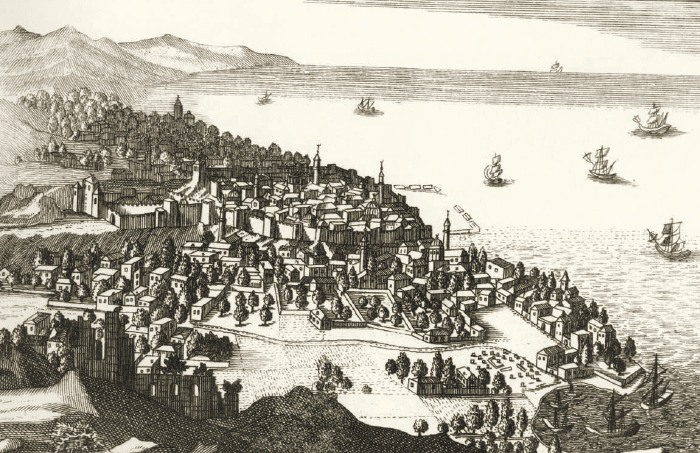
Map of Trabzon from Early Period to 1869 (Conquest and City of Trabzon
Throughout the Middle Ages, Trabzon, thanks to its geopolitical position, became an indispensable center for states asserting dominance over the eastern shores of the Black Sea.【1】 During the Seljuk, Ilkhanid, and Turkmen beylik periods, the city maintained its role as a regional power center through maritime trade and overland connections via mountain passes. The Zigana Pass, in particular, served as the main artery linking Trabzon to major inland centers such as Erzurum and Tabriz. This route formed the basis of the path later used by the Ottoman army during the conquest.
The city’s port, one of the few reliable natural harbors along the eastern Black Sea, fulfilled a strategic function in both regional trade and military logistics. Control of Trabzon’s sea access ensured connectivity with Crimea to the north and the Caucasus to the northeast, while its landward position secured the safety of Anatolia’s eastern frontier. For the Ottomans, therefore, the capture of Trabzon was not merely a regional conquest but a decisive step toward establishing complete naval security across the Black Sea and bringing the eastern trade routes under Ottoman control.
The history of Trabzon prior to its Ottoman conquest is marked not only by its continuous role as a port and commercial center but also by a layered past shaped by changing political dominions. Founded in antiquity by colonists from Miletus, the city became one of the most important strategic centers on the eastern Black Sea coast during the Roman and Byzantine periods. Under Roman administration, Trabzon was developed as a military supply base; during the Byzantine (Eastern Roman) era, it received further attention, with its walls, churches, port facilities, and palace complex being renovated and strengthened.

Map of Trabzon (Conquest and City of Trabzon
In 1204, following the Latin occupation of Constantinople during the Fourth Crusade, the Komnenos brothers Alexios and David, fleeing from the eastern provinces of Byzantium, established an independent state in Trabzon with the support of Queen Tamar of Georgia. This political entity, known as the “Empire of Trebizond” or the “Komnenos State,” inherited Byzantine cultural heritage and administrative traditions and emerged as an independent power center in the eastern Black Sea region.
From its foundation, this state maintained close relations with Turkmen beyliks in inland Anatolia and with Genoese and Venetian trading colonies to the west. Its port facilitated the movement of goods ranging from grain and furs from Crimea to silk and spices from Iran and Central Asia. Trabzon also served as a refuge for nobles, clergy, and military experts fleeing from Byzantium.

Map of Trabzon Walls (Conquest and City of Trabzon
Throughout the 14th century, the Empire of Trebizond sought to maintain balanced relations with major eastern powers such as the Ilkhanids and Timurids, as well as with Turkmen beyliks in Anatolia. However, the rising power of the Ottomans in Anatolia began to threaten this independent status. By the mid-15th century, as Ottoman influence expanded toward the Black Sea, Trabzon became a target due to both its geographical position and its symbolic representation of Byzantine succession.
In the period preceding the conquest, the Trabzon government forged an alliance with the Akkoyunlu ruler Uzun Hasan through marriage and pursued diplomatic contacts with the Pope and the Kingdom of Georgia to strengthen resistance against the Ottomans. However, these initiatives failed to halt Ottoman advances. The Ottoman campaign launched in 1461 exposed the limits of Trabzon’s multifaceted alliance strategy and ultimately led to the city’s incorporation into Ottoman rule.
In the mid-15th century, the Empire of Trebizond, facing Ottoman expansion in Anatolia, sought to preserve its existence. The fall of Constantinople in 1453 eliminated the Byzantine Empire, leaving Trabzon as the last symbolic and strategic representative of Byzantine heritage. This status rendered it a target for Ottoman ambitions.
To counter Ottoman pressure, the Trabzon government pursued alliances both east and west. In 1458, Theodora, sister of Emperor John IV of Trebizond, was married to Uzun Hasan of the Akkoyunlus. This marriage created a kinship bond and secured Akkoyunlu commitments to protect Trabzon from external threats.
Simultaneously, Trabzon established diplomatic contact with Pope Pius II and took steps toward joining a planned crusade against the Ottomans. These efforts revealed that Trabzon was not merely seeking regional alliances but was actively pursuing international coalitions against Ottoman expansion. Relations with the Kingdom of Georgia aimed to secure potential military support from the east.
During this period, Ottoman-Akkoyunlu relations deteriorated. Uzun Hasan harbored Turkmen beys expelled from Ottoman territories and seized control of Koyulhisar Castle north of Sivas, weakening Ottoman border security. These developments compelled the Ottomans to plan a military campaign in the east. The 1461 campaign had three primary objectives:
1. Establish complete dominance over the Black Sea – Bring northern trade routes and ports under Ottoman control.
2. Limit Akkoyunlu influence – Disrupt Ottoman opposition strongholds in Eastern Anatolia and sever Turkmen beys from Akkoyunlu support.
3. Annex the Empire of Trebizond – Eliminate the last powerful political entity claiming Byzantine heritage and reinforce Ottoman political unity.
The campaign plan was meticulously designed so that only the Sultan and his closest circle knew the target was Trabzon, thereby preventing early intervention by Trabzon’s allies.
The Trabzon campaign of 1461 was conceived as a joint operation by Ottoman land and naval forces. Fatih Sultan Mehmed shared the campaign’s objective only with a limited military circle and kept the army’s final destination secret. This strategy had two main purposes: first, to prevent the Empire of Trebizond and its allies from preparing defenses; second, to deter potential countermeasures by Akkoyunlu, Georgian, or Western alliances.

Ottoman Fleet off the Coast of Trabzon (Conquest and City of Trabzon)
The Sultan departed Edirne on 23 March 1461, reaching Bursa via Gelibolu and Mudanya.【4】 In Bursa, he consulted with Grand Vizier Mahmud Pasha on logistical and military arrangements. Even at this stage, the army’s destination was not disclosed; rumors even circulated that the army might turn westward.
The army’s route proceeded from Bursa to Ankara, then to Kastamonu. This path ensured a secure passage from Anatolia’s interior to the northern coasts and enabled coordination between the land army and naval forces heading for the Black Sea. Ottoman state officials transmitted orders to Kasım Bey, Sanjakbey of Gelibolu, to prepare the fleet for deployment to the Black Sea.
When the Ottoman army reached Kastamonu, its true target—Sinop—was officially revealed. This revelation directly affected both troop morale and strategic planning. Sinop, located in the central Black Sea region, controlled key northern trade routes and coastal security. Its harbor, one of the most defensible natural ports in the Black Sea, could serve as a logistical base and supply point for the fleet.
Simultaneously with the land army’s northward advance from Kastamonu, a fleet of approximately 300 vessels under the command of Kasım Bey, Sanjakbey of Gelibolu, sailed into the Black Sea. Upon reaching Sinop, the fleet blockaded the harbor, combining with the approaching land forces to subject the city to dual pressure.
İsfendiyaroğlu İsmail Bey, recognizing the futility of resistance against Ottoman forces, surrendered without a fight. In return, the Ottoman administration granted İsmail Bey the Sanjak of Üsküp and relocated him from the region.
The capture of Sinop became a strategic turning point for subsequent phases of the campaign. The Ottoman fleet now had a secure base from which to advance eastward and support the land army’s march toward Trabzon.
After securing Sinop, the Ottoman land army turned eastward through the interior rather than following the coastal route. This choice enhanced the army’s security against sudden attacks from the coast and allowed control over key fortresses along the way.
Koyulhisar Castle, strategically positioned above the Kelkit Valley north of Sivas, was a critical transit point on this route. The castle not only controlled the overland road to Trabzon but also served as a security outpost along the frontier where Akkoyunlu influence was evident. Establishing control over this region was essential to securing the Ottoman eastern campaign axis.
Upon reaching Koyulhisar, Ottoman forces encountered limited resistance, and the castle fell quickly under Ottoman control. Thus, the most significant intermediate defensive line blocking the advance eastward was eliminated. The fall of Koyulhisar also generated fear among the Akkoyunlus, prompting Uzun Hasan to feel compelled to establish direct contact with the Ottomans.
After the fall of Koyulhisar, the Ottoman army advanced toward Erzincan, where it was met by a diplomatic delegation headed by Uzun Hasan’s mother.
When the Ottoman army reached Erzincan after passing Koyulhisar, it entered the western frontier of Akkoyunlu territory. This phase of the campaign was decisive not only for securing the overland route to Trabzon but also for redefining the balance of power between the Ottomans and Akkoyunlus through diplomatic engagement.
Upon learning of the Ottoman army’s approach by both land and sea, Uzun Hasan avoided open battle. Recognizing the destructive power of Ottoman artillery and the numerical superiority of the Ottoman forces, he opted for diplomacy. To this end, he dispatched his mother, Sâre Hatun, as an envoy to Fatih Sultan Mehmed.
Fatih Sultan Mehmed showed Sâre Hatun great respect, addressing her as “mother” and keeping her with him throughout the campaign. According to Neşrî’s Kitâb-ı Cihannümâ, a notable dialogue occurred between Sâre Hatun and Fatih. In response to her question, “Hey son, why go through so much trouble for Trabzon?”, Fatih replied, “Mother, these hardships are not for Trabzon. Perhaps these hardships are for Allah. For we hold the sword of Islam. If we do not endure these hardships, we do not deserve to be called ghazis. Moreover, we will stand before the Lord on the Day of Judgment.”【5】
Following this meeting, no conflict arose between the two sides. The Ottoman army passed through Akkoyunlu territory and continued its advance toward Trabzon. The Akkoyunlus’ decision not to intervene militarily saved the Ottomans valuable time and energy before the siege.
After the Akkoyunlu contact, the Ottoman army turned toward the Zigana Pass, one of the most formidable natural barriers connecting the interior of the Black Sea region with Eastern Anatolia and leading to Trabzon. Located between Gümüşhane and Maçka, the pass presented major challenges for large armies due to its high altitude and steep slopes. Transporting heavy artillery and supplies was slow, requiring some equipment to be dismantled and carried in pieces across narrow paths and steep inclines.

Ottoman Army Crossing the Zigana Pass (History of Trabzon)
Fatih Sultan Mehmed personally walked on foot through the steepest sections of the pass, marching alongside his soldiers to maintain morale.【6】 To maintain discipline and accelerate siege preparations, continuous communication was maintained between the rear supply units and the vanguard forces during the crossing.
The successful crossing of the Zigana Pass brought the Ottoman army to the landward walls of Trabzon. From this point, the land siege could begin, while simultaneously, the Ottoman fleet approached the Trabzon harbor from the Black Sea to complete the naval blockade. Thus, the siege reached a stage where coordinated land and sea operations were feasible.
Upon reaching Trabzon after crossing the Zigana Pass, Ottoman land forces encircled the city’s western and southern walls. Trabzon’s natural defensive advantage lay in its sea-bound northern side and its steep slopes on other sides. Consequently, the siege plan focused on massing land forces directly against the walls and blocking all maritime assistance.
The Ottoman fleet, under the command of Kasım Bey, Sanjakbey of Gelibolu, completed the naval blockade by surrounding the Trabzon harbor. Positioned at the harbor entrance, the fleet prevented reinforcements from arriving by sea and eliminated any possibility of escape for defenders. Part of the fleet moved within cannon range to bombard the sea-facing sections of the walls, creating a psychological effect that complemented the pressure from the land front.

Ottoman Army at Zağnos Walls (History of Trabzon)
On the land front, artillery units were positioned at the weakest points of the walls.【7】 Although Trabzon’s walls had been strengthened over centuries, the continuous bombardment from Ottoman cannons caused stones to loosen and some towers to sustain damage. During the siege, trenches were filled, and specialized mining units tunneled beneath sections of the walls to plant explosives.
This coordinated land-sea pressure completely severed the city’s external connections; food and ammunition supplies became impossible to obtain. Morale within the city declined steadily, and the Empire of Trebizond’s capacity to resist diminished day by day.
The simultaneous pressure from Ottoman land and naval forces rapidly weakened Trabzon’s defenses. Land forces advancing through the Zigana Pass blocked the southern and western walls, while the Ottoman fleet completely sealed off the northern coastline. Thus, the city was entirely isolated from the outside world.
Throughout the siege, Ottoman cannons fired incessantly at designated weak points on the walls, while the fleet blocked the harbor, eliminating both external aid and escape routes. Depletion of food supplies, weakening of the defense lines, and declining morale among the population accelerated the decision to surrender.

Fatih Sultan Mehmed’s Entry into Trabzon (Conquest and City of Trabzon)
As noted in Neşrî’s Kitâb-ı Cihannümâ, the conquest occurred in the Hijri year 865 (1461 CE).【8】 Modern research, based on the Trabzon provincial register, accepts 15 August 1461 as the date of surrender.【9】 Facing overwhelming Ottoman superiority, Emperor David Komnenos IV recognized the futility of continued resistance and agreed to negotiate surrender terms. Through the agreement, the city was peacefully handed over to the Ottomans; in return, the emperor and his family were granted personal safety. David Komnenos and members of the court were transported to Constantinople aboard Ottoman ships.
After the surrender, Fatih Sultan Mehmed established Ottoman administration in Trabzon; properties of some local elites who had participated in resistance were confiscated. With Trabzon’s incorporation into Ottoman rule, Ottoman control over the entire Black Sea coastline was completed, and the last independent political entity claiming Byzantine heritage was eliminated.
Following its incorporation into the Ottoman Empire in 1461, Trabzon was transformed into a strategic administrative center on the eastern Black Sea coast. Fatih Sultan Mehmed immediately organized Trabzon as a sanjak directly subordinate to the central government.

Photograph Showing the Geography of Trabzon (Conquest and City of Trabzon)
In the post-conquest period, the Ottoman administration implemented a settlement policy encouraging Muslim populations from various regions of Anatolia to settle in Trabzon.【10】 Soldiers’ families, artisans, and merchants were brought to the city to sustain trade and production. A significant portion of the Greek population remained in the city, continuing their activities in maritime trade and crafts. Thus, Trabzon preserved its multicultural social structure during the Ottoman period.

Photograph Showing the Geography of Trabzon (Conquest and City of Trabzon)
Administratively, Ottoman laws and taxation systems were immediately implemented.【11】 A judge was appointed to the city, and land was reorganized under the timar system. Additionally, new military units were stationed for security, and port activities were brought under state control.
These measures ensured Trabzon’s rapid integration into the Ottoman administrative system and laid the foundation for the enduring Ottoman authority along the eastern Black Sea coast.
Significant architectural changes occurred in Trabzon after its incorporation into Ottoman rule. These transformations involved both the construction of new Ottoman administrative and religious structures and the repurposing of existing Byzantine and Komnenos-era buildings.

Church Converted into a New Friday Mosque (Conquest and City of Trabzon)
After the conquest, several churches in Trabzon were converted into mosques.【12】 The most prominent of these, the Hagia Sophia Church, was soon converted into a mosque. Other churches within and around the city walls were transformed into neighborhood mosques. This transformation reflects the common post-conquest religious and architectural practice observed in Ottoman cities.
The Ottoman administration prioritized urban development in Trabzon. Markets and bazaars were reorganized, trade routes and port infrastructure were strengthened. New neighborhoods were established to accommodate the influx of population brought by the settlement policy. These neighborhoods typically formed around mosques, with water channels, public baths, and caravanserais constructed to serve residents.

Hagia Sophia Church Converted into a Mosque (Conquest and City of Trabzon)
The city’s commercial center concentrated around the harbor, where caravanserais were built to serve both local and international trade.【13】 Thus, Trabzon continued to function as a major commercial and logistical center on the eastern Black Sea coast after the conquest.
This architectural and urban transformation reflects the Ottoman administration’s goal of transforming Trabzon not merely into a military and strategic center but also into a regional hub of economic and cultural significance.
The Ottoman conquest of Trabzon in 1461 marked a turning point in Ottoman strategy in the Black Sea. With this conquest, the Ottomans established uninterrupted control along the southern coast from Sinop to Trabzon. Thus, the last political entity representing Byzantine heritage was eliminated, and Ottoman authority was firmly established along the eastern coastline.

Trabzon in the 19th Century (Conquest and City of Trabzon)
However, at this time, independent powers still existed along the northern coast of the Black Sea.【14】 Genoese trading colonies and the independent Crimean Khanate remained on the Crimean Peninsula. Thus, the conquest of Trabzon strengthened Ottoman dominance over the Black Sea but did not, by itself, transform it into a fully “Ottoman inland sea.” This process was completed with the 1475 Crimean campaign, when the Ottoman fleet captured Genoese strongholds such as Caffa, Sudak, and Kerch, bringing the Crimean Khanate under Ottoman suzerainty. From that point onward, foreign merchant vessels were barred from entering the Black Sea, and the sea came entirely under Ottoman control.
From the standpoint of eastern border security, the conquest of Trabzon eliminated the possibility of Akkoyunlu or other regional powers gaining access to the Black Sea. A lasting Ottoman advantage was established in Ottoman-Akkoyunlu relations; the elimination of the last independent state claiming Byzantine heritage produced a result fully aligned with the empire’s political and ideological objectives.

Trabzon in the Reign of Abdulhamid II (Conquest and City of Trabzon)
Commercially, Trabzon remained a vital node in the Ottoman international trade network.【15】 Grain, furs, and fish from Crimea; silk, spices, and precious metals from Iran and Central Asia were transported through Trabzon to inland Anatolia. This trade increased customs revenues and contributed to regional economic development.
Culturally, the conquest of Trabzon paved the way for the transmission of Ottoman urban planning, administrative systems, and architecture to the Eastern Black Sea region. Greek, Armenian, and Muslim communities coexisted for centuries; Trabzon preserved its multicultural character throughout the Ottoman period.
Emir, Osman, Miraç Tosun, Yasin Topaloğlu, and İsmail Köse. “Bayburt’tan Trabzon’a: Fatih Sultan Mehmed’in Trabzon Sefer Güzergâhı.” *Belleten* 89, no. 315 (August 2025): 481–506. Accessed August 14, 2025. https://dergipark.org.tr/tr/pub/ttkbelleten/issue/94080/1757389.
Ertaylan, İsmail Hikmet. “Akkoyunlu–Osmanlı Mücadelesi.” In *Türkmen Akkoyunlu İmparatorluğu: Siyasal, Sosyal ve Kültürel Tarihine İlişkin Makaleler Antolojisi*, edited by Necip Aygün Akkoyunlu and Adil Şen. Ankara: Grafiker Ltd. Şti. Accessed August 14, 2025. https://isamveri.org/pdfsbv/D088543/TY/TY_ERTAYLANIH1.pdf.
Hacıfettahoğlu, İsmail, ed. *Öncesi ve Sonrası ile Trabzon’un Fethi*. Trabzon Belediyesi Kültür Yayınları No: 91. 1st ed., October 2001. Ankara: Atlas Yayıncılık. Accessed August 14, 2025. https://isamveri.org/pdfsbv/D120121/2001/2001_HACIFETTAHOGLUI.pdf.
Hacıfettahoğlu, İsmail. “Kuruluşundan Fethine Trabzon’un Kısa Tarihi ve Fethi.” In *Türkmen Akkoyunlu İmparatorluğu: Siyasal, Sosyal ve Kültürel Tarihine İlişkin Makaleler Antolojisi*, haz. Necip Aygün Akkoyunlu ve Adil Şen. Ankara: Grafiker Ltd. Şti. Accessed August 14, 2025. https://isamveri.org/pdfsbv/D088543/TY/TY_HACIFETTAHOGLUI.pdf.
Lowry, Heath W. and Emecen Feridun. “Trabzon.” Türkiye Diyanet Vakfı İslâm Ansiklopedisi, Volume XL1, 2012: 296-301. Accessed August 14, 2025. https://islamansiklopedisi.org.tr/trabzon#1.
Neşrî, Mehmed. *Kitâb-ı Cihan-nümâ (Neşrî Tarihi)*, Volume I, ed. Faik Reşit Unat and Mehmed A. Köymen. Ankara: Türk Tarih Kurumu Basımevi, 1949. Accessed August 14, 2025. https://archive.org/details/Kitb-Cihan-NmNerTarihiI.Cilt-MehmedNer.
Neşrî, Mehmed. *Kitâb-ı Cihan-nümâ (Neşrî Tarihi)*, Volume II, ed. Faik Reşit Unat and Mehmed A. Köymen. Ankara: Türk Tarih Kurumu Basımevi, 1957. Accessed August 14, 2025. https://archive.org/details/Kitb-Cihan-NmNerTarihiII.Cilt-MehmedNer.
Parmaksızoğlu, İsmet. “Trabzon’un Fethi (21 Muharrem 866 – 26 Ekim 1461).” *Diyanet İşleri Başkanlığı Dergisi* 10, no. 112–113 (September–October 1971). Accessed August 14, 2025. https://isamveri.org/pdfdrg/D00033/1971_c10/1971_c10_112-113/1971_c10_112-113_PARMAKSIZOGLUI.pdf.
Öksüz, Hikmet, Veysel Usta, and Kenan İnan, eds. *Trabzon Tarihi: Siyasi Tarih (Birinci Cilt)*. Trabzon: Trabzon Ticaret ve Sanayi Odası, 2022. Accessed August 14, 2025. https://www.ttso.org.tr/dosyalar/TRABZON_TARIHI_BIRINCI_CILT.pdf.
Öztürk, Temel, ed. *Trabzon’da Fetih ve Şehir*. Trabzon: Trabzon Büyükşehir Belediyesi Kültür Yayınları, 2021. Accessed August 14, 2025. https://kurumsal.trabzon.bel.tr/Upload/BaglantiFotolar/ae509cb3-0908-4e89-a49a-d3f7bed3934c/20220907090612RUokC.pdf.
İnan, Kenan. “Trabzon’un Fethi.” In *Cumhuriyet’in 75., Osmanlı Devleti’nin 700. Yılında Trabzon Tarihi İlmi Toplantısı (6–8 Kasım 1998): Bildiriler*, edited by Kemal Çiçek, Kenan İnan, Hikmet Öksüz, and Abdullah Saydam. Trabzon: Trabzon Belediyesi Yayınları, 1999. Accessed August 14, 2025. https://isamveri.org/pdfsbv/D091134/1999/1999_INANK.pdf.
İnan, Kenan. “Trabzon’un Osmanlılar Tarafından Fethi.” Karadeniz Teknik Üniversitesi Sosyal Bilimler Enstitüsü Dergisi, no. 14 (2003): 71–84. Accessed August 14, 2025. https://isamveri.org/pdfsbv/D00199/2003_14/2003_14_INANK.pdf.
[1]
Temel Öztürk, ed., Conquest and City of Trabzon (Trabzon: Trabzon Metropolitan Municipality Cultural Publications, 2021), p. 261.
[4]
Temel Öztürk. (a.g.e), p. 30.
[5]
Mehmed Neşrî, Kitâb-ı Cihan-nümâ (Neşrî Tarihi), Vol. II, ed. Faik Reşit Unat and Mehmed A. Köymen (Ankara: Turkish Historical Society Press, 1957), p. 753.
[6]
Hikmet Öksüz, Veysel Usta and Kenan İnan, ed., History of Trabzon: Political History (Volume I) (Trabzon: Trabzon Chamber of Commerce and Industry, 2022), p. 78.
[7]
Hikmet Öksüz and others. (a.g.e), p. 81.
[8]
Temel Öztürk. (a.g.e), p. 122.
[9]
Temel Öztürk. (a.g.e), p.114.
[10]
Temel Öztürk. (a.g.e), pp. 298-299.
[11]
Temel Öztürk. (a.g.e), p. 299.
[12]
Temel Öztürk. (a.g.e), p. 54.
[13]
Temel Öztürk. (a.g.e), p. 56.
[14]
Temel Öztürk. (a.g.e), p. 58.
[15]
Temel Öztürk. (a.g.e), p. 59.


Date(s) | 15 August 1461 | ||||||||
|---|---|---|---|---|---|---|---|---|---|
Place | Eastern Black Sea Trabzon | ||||||||
Parties | Empire of Trebizond Ottoman State | ||||||||
Ottoman Sultan | Mehmed II | ||||||||
Empire of Trebizond Emperor | David IV Komnenos | ||||||||
Route of Campaign | Trabzon Zigana Pass Bayburt Plain Erzincan Koyulhisar Kastamonu (capture of Sinop) Ankara Bursa Edirne | ||||||||
Outcome | the conquest of the Anatolian coast of the Black Sea was completed Trabzon was incorporated into Ottoman territories | ||||||||
No Discussion Added Yet
Start discussion for "The Conquest of Trabzon" article
Geographical and Strategic Position
Trabzon Before the Conquest
The Path to Conquest
The Campaign and Siege
The Incorporation of Sinop into Ottoman Territory
Capture of Koyulhisar and Advance Eastward
Akkoyunlu Contact and the Role of Sâre Hatun
Crossing the Zigana Pass
Siege Organization and Land-Sea Coordination
The Surrender of Trabzon
Administrative and Social Order After the Conquest
Architectural and Urban Transformation
Long-Term Consequences and Legacy