


This article was automatically translated from the original Turkish version.
Caucasus Front
Start Date | 1914 | ||||||||
|---|---|---|---|---|---|---|---|---|---|
End Date | 1918 | ||||||||
Location | Eastern Anatolia Caucasus region | ||||||||
Parties | Ottoman Empire, Russia | ||||||||
Commanders | Enver Pasha (Ottoman Empire), General Nikolay Yudenich (Russia) | ||||||||
The Caucasian Front was the military theater of conflict opened between the Ottoman Empire and the Russian Empire in the regions of Eastern Anatolia and the Caucasus during World War I. The geographical and strategic importance of the region intensified long-standing tensions in Ottoman-Russian relations, leading to intense warfare on this front. The Caucasian Front is particularly remembered in history for the Sarıkamış Campaign, which resulted in heavy military and human losses for both sides.
Before World War I, the Caucasus held strategic significance as a border region between the Ottoman and Russian Empires. The area was also politically unstable due to its complex ethnic composition, home to numerous distinct ethnic groups. The Ottomans aimed to alter the eastern balance of power by bringing Russian southern borders under control. The Russians, in turn, sought to eliminate Ottoman threats through the Caucasus and strengthen their influence in the region.
In this atmosphere of conflict, especially after the outbreak of war in late 1914, the Ottoman Empire opened a front against Russia and launched military operations in Eastern Anatolia. Both sides began preparations to reinforce their forces and repel the enemy.
The Caucasian Front became active in 1914 when the Ottoman army launched operations against Russian forces. The front line extended from Eastern Anatolia into the Caucasus. The Ottoman objective was to prevent Russian forces from advancing deep into Anatolia and to break Russian dominance in the region. The Russians, for their part, defended the area to limit Ottoman presence and gain a strategic advantage in the war.
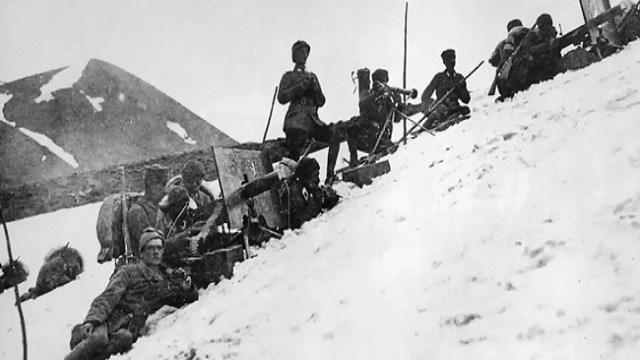
The most critical and tragic episode of the Caucasian Front was the Sarıkamış Campaign, which took place during the winter of 1914–1915. Planned under the orders of Enver Pasha, commander of the Ottoman Third Army, the campaign aimed to repel Russian forces with a surprise attack. However, due to the region’s extreme cold climate, inadequate logistical support, and poor planning, the campaign ended in massive losses. Approximately 60,000 Ottoman soldiers died from exposure or disease, making this campaign a pivotal turning point in front history.

Some of Our Soldiers at Sarıkamış (Turkish Historical Society)
After Sarıkamış, various smaller and medium-scale engagements continued on the front. In 1915 and 1916, both Ottoman and Russian forces carried out offensive and defensive operations to maintain their control over the region. During this period, local populations and ethnic groups in the area also became involved in various resistance movements as a result of the war’s impact. The harsh geographic conditions made both military planning and logistical support extremely difficult.
The Caucasian Front constituted a significant dimension of the Ottoman-Russian struggle throughout World War I. Tragic experiences such as the Sarıkamış Campaign severely weakened the Ottoman army’s strength in the east. Ultimately, Russia’s withdrawal from the war following the 1917 Revolution and the subsequent Treaty of Brest-Litovsk rendered the front inactive. The closure of the Caucasian Front altered the regional balance of power and played a role in shaping postwar borders.
Introduction to the Caucasian Front (Okan Aydoğan)
Accessed November 26, 2025.
Atatürk Araştırma Merkezi. "I. Dünya Savaşı’nda Kafkas Doğu Cephesi." Accessed June 7, 2025.
Belleten Dergisi. "Birinci Dünya Savaşı Kafkas Cephesi." Accessed June 7, 2025.
Milli Savunma Bakanlığı. "Birinci Dünya Savaşı Kafkas Cephesi Arşiv Belgeleri." Accessed June 7, 2025.
Türk Tarih Kurumu DergiPark. "Kafkas Cephesi Araştırmaları." Accessed June 7, 2025.
Türk Tarih Kurumu DergiPark. "Kafkas Cephesi Üzerine Makale." Accessed June 7, 2025.
Türkiye Taşkömürü Kurumu. "I. Dünya Savaşı’nda Kafkas Cephesinde Sarıkamış Savaşı." Accessed June 7, 2025.
YouTube. "Kafkas Cephesi Tarihi - Detaylı Anlatım." Accessed June 7, 2025.

Caucasus Front
Start Date | 1914 | ||||||||
|---|---|---|---|---|---|---|---|---|---|
End Date | 1918 | ||||||||
Location | Eastern Anatolia Caucasus region | ||||||||
Parties | Ottoman Empire, Russia | ||||||||
Commanders | Enver Pasha (Ottoman Empire), General Nikolay Yudenich (Russia) | ||||||||
Historical Background
Opening of the Caucasian Front
The Sarıkamış Campaign
Other Significant Battles and Developments
Outcomes and Historical Significance of the Front