

Kâşgarlı Mahmud: The Scholar Who Introduced the Turkish Language to the World
Our language is the most valuable bridge carrying our past into the future. Among the great scholars who dedicated their lives to introducing the Turkish language to the world is Kâşgarlı Mahmud, whose full name is Ebû’l-Kāsım Mahmûd bin el-Hüseyin bin Muhammed el-Kâşgarî. Thanks to his work, the beauty and richness of Turkish have reached us from centuries ago.
🕌Birth and Place of Birth
Although Kâşgarlı Mahmud’s exact date of birth is not known with certainty, it is accepted that he lived in the 11th century. According to sources, he was born in a place called Barsgan, which is believed to be either the village of Opal near Kâşgar or a region in the southwest of Kâşgar. In his work Dîvânü Lugâti’t-Türk, he refers to Opal as a village from his own region.

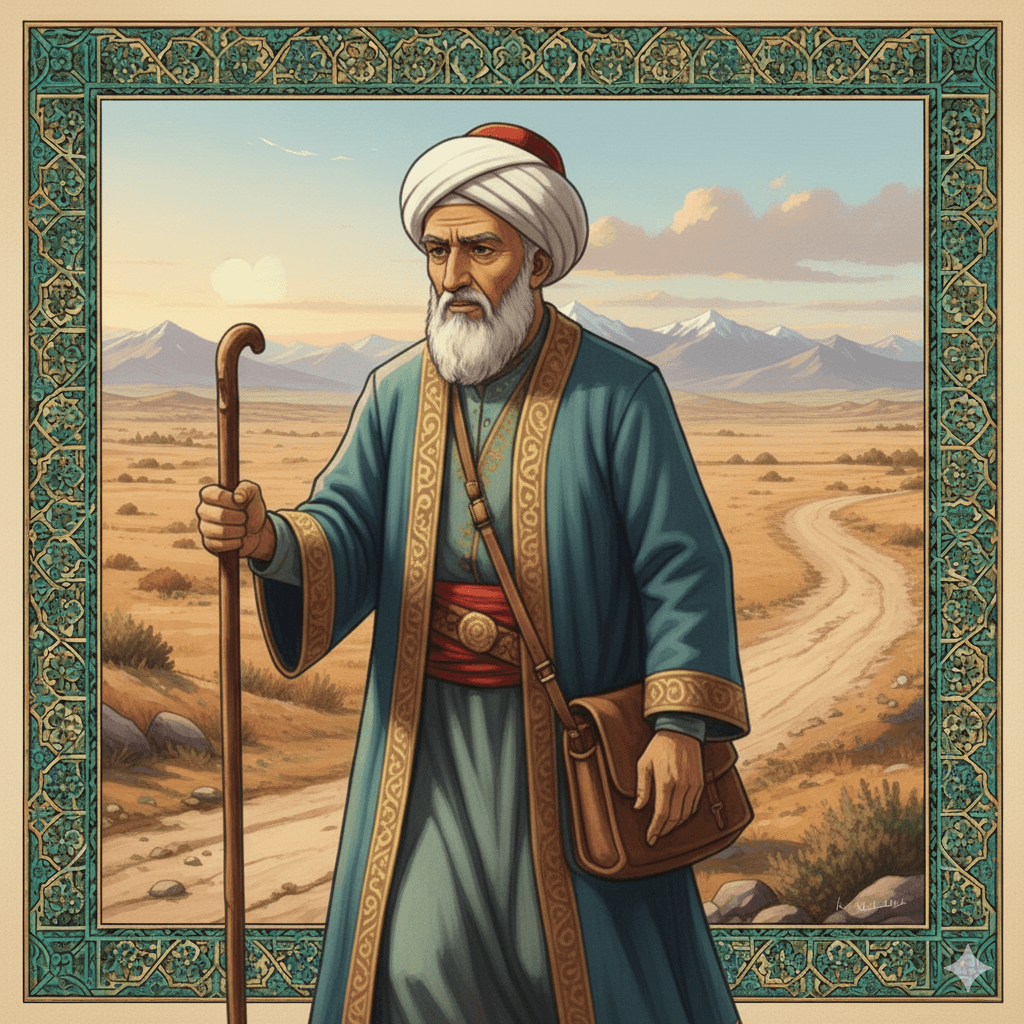
Kâşgar in the 11th century, within the geographical region of Eastern Turkistan (Image generated by artificial intelligence).
The title “Kâşgarlı” indicates his connection to Kâşgar, a historic city in Eastern Turkistan. At that time, Kâşgar served as the cultural center of the Karakhanid State.
🏠Family and Lineage
Kâşgarlı Mahmud’s father was Hüseyin b. Muhammed. His family belonged to a distinguished lineage and held a respected position. Some researchers suggest he may have been related to the Karakhanid ruling family, which enabled him to receive a high-quality education and learn Arabic and Persian at an early age.
🎓Education and Work on Language
Kâşgarlı Mahmud received education in madrasas and attained an advanced level of proficiency in Arabic. After completing his education, he traveled to regions inhabited by various Turkic tribes, documenting their languages, dialects, proverbs, and poetry. In doing so, he became one of the first scholars to systematically study the Turkish language and document Turkic culture.

Kâşgarlı Mahmud receiving education in a madrasa (Image generated by artificial intelligence).
During this period, his goal was to demonstrate that Turkish was as rich and powerful as Arabic.
🧭Era and Activities
Kâşgarlı Mahmud lived during a time when the Turks were embracing Islam and experiencing cultural development. Following an incident involving his family, he left his homeland and spent many years traveling among Turkic tribes conducting linguistic research. He later traveled to Baghdad, where he completed his greatest work.
Subsequently, he returned to Kâşgar and founded a school named Medrese-i Mahmûdiyye, where he taught students. Throughout his life, he placed great importance on science and education, and he died around the year 1090.
📚Works
Kâşgarlı Mahmud’s most famous work is Dîvânü Lugâti’t-Türk. This book contains thousands of Turkish words, proverbs, idioms, poems, and folk knowledge. Written in Arabic, its purpose was to teach Arabs the Turkish language and demonstrate its deep historical roots.

Manuscript of Dîvânü Lugâti’t-Türk (Image generated by artificial intelligence).
The work also explains the grammatical rules, dialectal variations, and linguistic features of Turkish. It is understood that Kâşgarlı Mahmud intended to write a grammar book titled Kitâbü Cevâhiri’n-Nahv fî Lugâti’t-Türk. Thus, he was not merely a lexicographer but also one of the founding figures of Turkish linguistic science.
🗺️The Map He Drew
The circular world map included in Kâşgarlı Mahmud’s work is among the earliest examples showing the regions inhabited by the Turks. The map marks the locations of Turkic tribes, cities, and major routes.
🔍Another notable detail in this map is Kâşgarlı Mahmud’s depiction of Japan (referred to as Cezîre-i Benkā). This information is of great significance as it demonstrates that Japan’s existence was known among the Turks of that era.

World map drawn by Kâşgarlı Mahmud in the 11th century (version updated with Latin script) (General Directorate of Mapping, Ministry of National Defense of Türkiye)
Although prepared according to the geographical understanding of the time, the map is remarkably advanced. Thus, Kâşgarlı Mahmud is remembered in history not only as a linguist but also as a geographer.
🌍Contributions to the Present
Kâşgarlı Mahmud’s work laid the foundation for Turkology. Thanks to the words he collected, we are able to study the form of Turkish a thousand years ago. Moreover, Dîvânü Lugâti’t-Türk is not merely a dictionary; it is a cultural text that describes the way of life, traditions, and thought patterns of the Turkish people.
Today, institutions, language and culture programs, and commemorative days bearing the name of Kâşgarlı Mahmud exist in various regions of the Turkish world.