



Rizvaniye Camii and Medresesi
Hello! Today, we are taking you to Şanlıurfa, to a very special place right next to Balıklıgöl: Rizvaniye Camii ve Medresesi. This building served both as a mosque and as a school where students once attended classes. Let us explore the history of this historic structure.
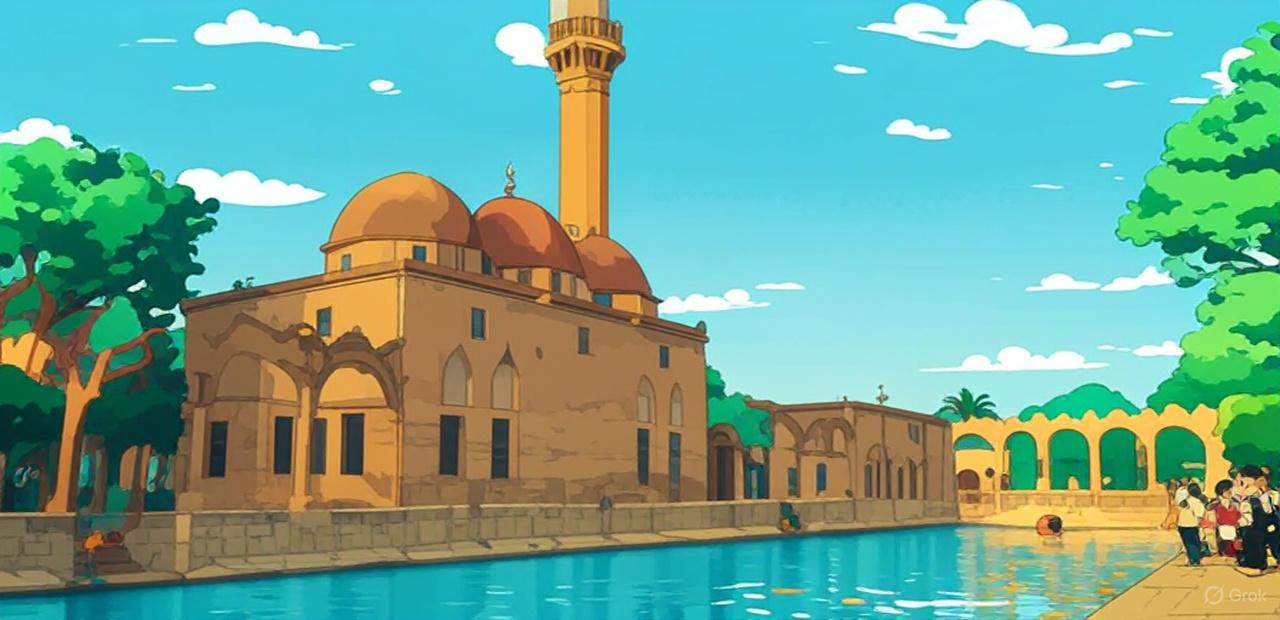
Rizvaniye Camii faces Balıklıgöl with a serene presence. The mosque and its adjacent former classroom rooms, standing here for hundreds of years, reveal the architecture of that era and how highly knowledge was valued.
The Mystery of the Structure
This beautiful building was constructed in 1736 by Rıdvan Ahmet Paşa, the governor of Rakka during the Ottoman Empire. A governor is a person who administers a region, and Rıdvan Ahmet Paşa was in charge of Şanlıurfa and its surroundings at that time.
The site of the mosque has a unique history. It is said that an older church once stood here from even earlier times. This reflects how different cultures and faiths coexisted on the same land. The building is constructed from large cut stones and is distinguished by its three large domes. A dome is a semi-circular roof covering the top of a structure.

(Generated by Artificial Intelligence.)
A Journey Through Time
Let us travel back 290 years to 1736. At that time, there were no cranes or trucks as we know them today. Craftsmen carved stones by hand and transported materials weighing thousands of kilograms using simple tools. The workers who built Rizvaniye Camii accomplished this feat through immense effort.
At that time, Şanlıurfa was one of the important cities of the Ottoman Empire. The medrese built alongside the mosque functioned as a school. Students here studied a wide range of subjects including religion, mathematics, and astronomy. The medrese rooms encircled the mosque courtyard in a “U” shape, transforming the area into an educational hub.

(Generated by Artificial Intelligence.)
Unique Features of the Mosque
One of the most striking features of Rizvaniye Camii is its wooden entrance door. This door was constructed using a special technique called “kündekâri,” in which small wooden pieces are interlocked like puzzle pieces without the use of nails or adhesive. The geometric and floral patterns adorning it are visually captivating.
The medrese located on the northern side of the courtyard has a “U”-shaped layout. At its center is a domed lecture hall where students held their lessons. This structure demonstrates that the mosque was not merely a place of worship but also a center for education and culture.