This article was automatically translated from the original Turkish version.
+2 More
Location | Location: Şanlıurfa beside the Halilürrahman Lake (Balıklıgöl). Türkiye – On the eastern shore of the Balıklıgöl Plateau | ||||||||
|---|---|---|---|---|---|---|---|---|---|
Construction Date(s) | 1736 (H.1149) | ||||||||
Building Type | An Ottoman-era külliye consisting of a mosque and a madrasa | ||||||||
Founder (Patron) | Ridvan Ahmed Pasha, Governor of Raqqa | ||||||||
Usage Status | The mosque is actively open for worship. The madrasa is used for cultural activities and tourism. | ||||||||
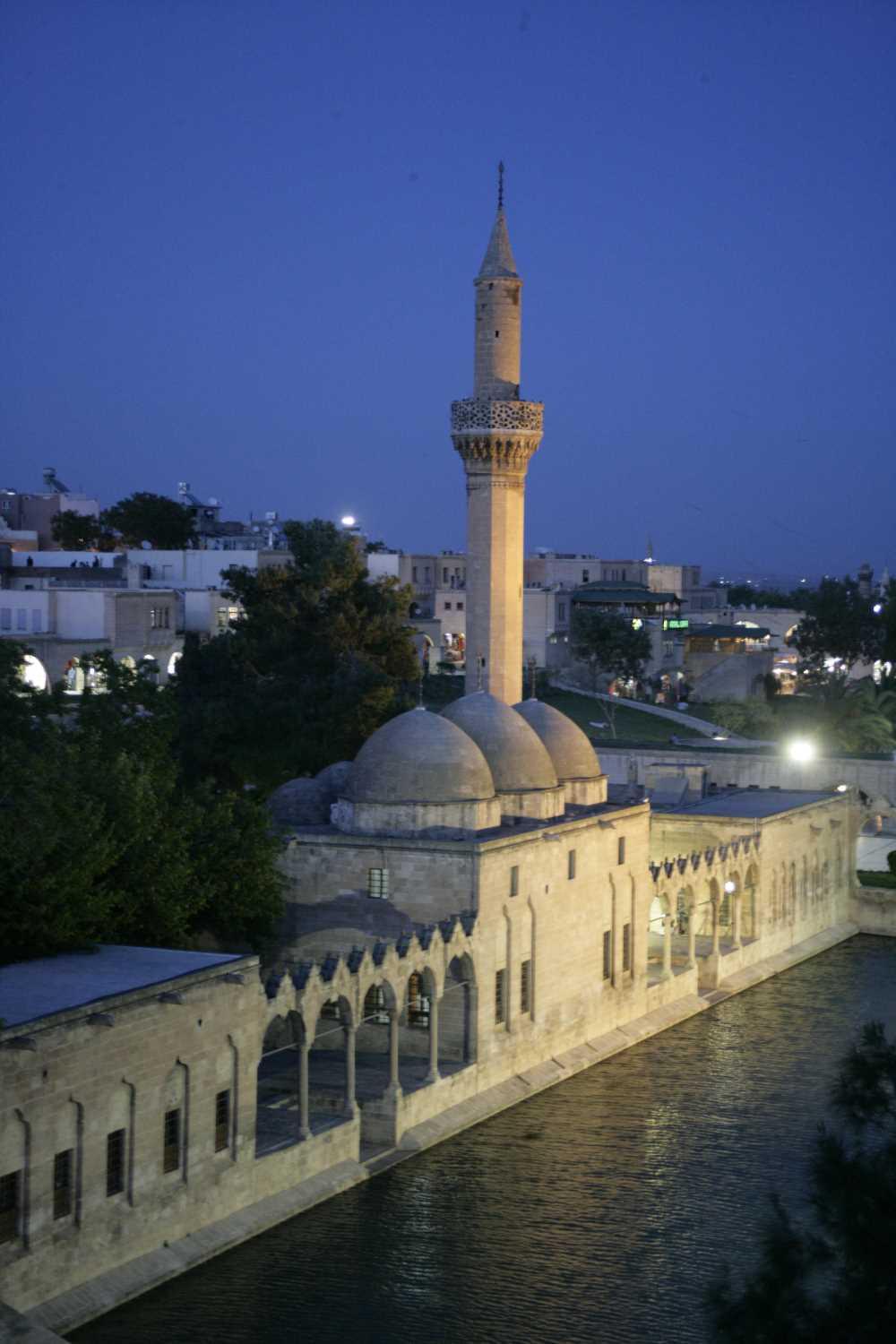
Rizvaniye Camii and Medresesi is a significant külliye complex located in the city center of Şanlıurfa, on the eastern shore of Balıklıgöl, reflecting Ottoman classical architecture. This architectural ensemble holds an important place within the historical, religious, and cultural landscape of the city. Constructed in the early 18th century, it retains original elements that draw attention. The külliye consists of a mosque and a medrese; together with the Halilürrahman Camii and Aynzeliha Gölü, these structures form key components of Urfa’s religious topography.
The Rizvaniye Külliye was commissioned in 1736 (H. 1149) by Rıdvan Ahmed Paşa, the governor of Rakka at the time. The complex is named after him, bearing the designation “Rizvaniye.” The mosque and medrese were constructed together, embodying the classical Ottoman külliye concept by integrating educational and worship functions within a single architectural unit. The site of the külliye was previously occupied by a structure known as the Halilürrahman Church. In this context, the construction of the Rizvaniye Camii is regarded as a turning point in the Islamic transformation of the city following its Christian period.

Rizvaniye Camii and MedresesiRepublic of Türkiye Şanlıurfa Governorship)
The mosque is rectangular in plan, oriented north-south, and designed as a single-domed structure in accordance with classical Ottoman mosque architecture. The main prayer hall is covered by a central dome resting on four piers. The transition from the square base to the dome is achieved through pendentives. A large courtyard is situated on the northern facade, surrounded by arcades and featuring an octagonal şadırvan at its center. The şadırvan serves the ritual ablution needs of worshippers prior to prayer.
The mihrab is centrally positioned on the qibla wall and features a niche decorated with muqarnas. Stonework exhibits simple yet elegant craftsmanship. The minbar is an example of wooden craftsmanship adorned with geometric and vegetal motifs. The minaret, rising from the northwestern corner of the mosque, has a cylindrical shaft and a single balcony. The base of the minaret is square in plan, while the shaft is slender in proportion. Local cut stone was used in the construction of the mosque; these stones are laid with regular joints, creating a minimalist aesthetic on the exterior façade.
The windows are arranged to allow natural light into the interior, with rectangular forms below and pointed arches above. Interior decoration is extremely restrained, with emphasis placed on the aesthetic qualities of the architectural forms themselves.
The Rizvaniye Medresesi is situated on the slope facing Balıklıgöl to the east of the mosque, forming a physical unity with it. Designed in a U-plan, the medrese comprises a rectangular courtyard surrounded by arcaded galleries and cells. Classrooms and student rooms are located behind the arcades, and are covered by vaults or domes.
A rectangular pool with stone borders stands at the center of the medrese courtyard. This pool serves both aesthetic and microclimatic functions. The entrance to the medrese is marked by a pointed arch, and the cell-type layout is typical of classical Ottoman educational buildings. The dershane typically consists of a spacious domed space opening onto the courtyard.
The medreseserved for a long period after its founding as a center for religious education. Although its function changed in later periods, it has survived to the present day preserving its architectural integrity.

Rizvaniye Camii and MedresesiŞanlıurfa Provincial Directorate of Culture and Tourism)
The Rizvaniye Camii is currently open for worship and is maintained under the responsibility of the Şanlıurfa Directorate of Foundations. Both the mosque and medrese have undergone restoration at various times by the General Directorate of Foundations, with careful attention paid to preserving original materials and architectural forms. Restorations carried out in the late 20th century and early 21st century aimed to maintain both the structural and aesthetic integrity of the complex.
The Rizvaniye Medresesi now serves cultural and touristic functions. It has been used at various times as an exhibition space, a traditional crafts workshop, or an information center. The high volume of visitors concentrated around Balıklıgöl helps sustain interest in the külliye.
The Rizvaniye Camii and Medresesi are fundamental elements of Şanlıurfa’s urban identity, both in terms of architectural coherence and location. They represent an important example of how the Islamic character of the city was emphasized and religious education promoted during the Ottoman period. Simultaneously, they continue to function as part of the sacred site system surrounding Balıklıgöl, maintaining historical continuity.
Köseoğlu, Abdullah. “Rızvaniye Camii.” *Türkiye Turizm Ansiklopedisi*, 2021. Accessed July 11, 2025. https://turkiyeturizmansiklopedisi.com/rizvaniye-camii.
Memiş, Mehmet. "Rızvaniye Camii ve Külliyesi." Harran Üniversitesi İlahiyat Fakültesi Dergisi 3 (1997): 329–347.
Şanlıurfa Büyükşehir Municipality. *Şanlıurfa Camileri*. Şanlıurfa: Şanlıurfa Kültür Eğitim Sanat ve Araştırma Vakfı Yayınları (SÜRKAV), 2012. Accessed July 11, 2025. https://www.sanliurfa.bel.tr/files/1/bsb_sonra/surkav_yayinlari/7_SANLIURFA_CAMILERI.pdf.
Şanlıurfa Valiliği İl Kültür ve Turizm Müdürlüğü. "Rızvaniye Camii." *Kültür ve İnançlar Diyarı Şanlıurfa*. Şehir Kitaplığı Dizisi: 26. Accessed July 11, 2025. https://www.kulturportali.gov.tr/turkiye/sanliurfa/gezilecekyer/rizvaniye-camii.
Şanlıurfa Valiliği İl Kültür ve Turizm Müdürlüğü. “Rızvaniye Medresesi.” *Kültür ve İnançlar Diyarı Şanlıurfa*. Şehir Kitaplığı Dizisi: 26. Accessed July 11, 2025. https://www.kulturportali.gov.tr/turkiye/sanliurfa/gezilecekyer/rizvaniye-medresesi.
Şanlıurfa Valiliği. “Kültür ve Turizm.” Şanlıurfa Valiliği Resmî Web Sitesi. Accessed July 11, 2025. http://www.sanliurfa.gov.tr/kultur-turizmi.

Location | Location: Şanlıurfa beside the Halilürrahman Lake (Balıklıgöl). Türkiye – On the eastern shore of the Balıklıgöl Plateau | ||||||||
|---|---|---|---|---|---|---|---|---|---|
Construction Date(s) | 1736 (H.1149) | ||||||||
Building Type | An Ottoman-era külliye consisting of a mosque and a madrasa | ||||||||
Founder (Patron) | Ridvan Ahmed Pasha, Governor of Raqqa | ||||||||
Usage Status | The mosque is actively open for worship. The madrasa is used for cultural activities and tourism. | ||||||||
No Discussion Added Yet
Start discussion for "Rızvaniye Camii ve Medresesi" article
Historical Background
Architectural Features
Rizvaniye Camii
Rizvaniye Medresesi
Conservation and Current Status