This article was automatically translated from the original Turkish version.
+1 More
Location | Western shore of Balıklıgöl Şanlıurfa Center | ||||||||
|---|---|---|---|---|---|---|---|---|---|
Year of Establishment | 1775 | ||||||||
Year of Repair | 1871 (Derviş Ali Paşa) | ||||||||
Plan Type | L-shaped plan, cut stone construction | ||||||||
Architectural Feature(s) | Barrel-vaulted ceilings dershane and cell arrangement arched openings | ||||||||
Water Relationship | Over the Balıklıgöl spring, sacred and functional use | ||||||||
Restoration Status | 19th century restoration and environmental arrangements in the 21st century | ||||||||
Function(s) | Ottoman period religious education center cultural tourism structure | ||||||||
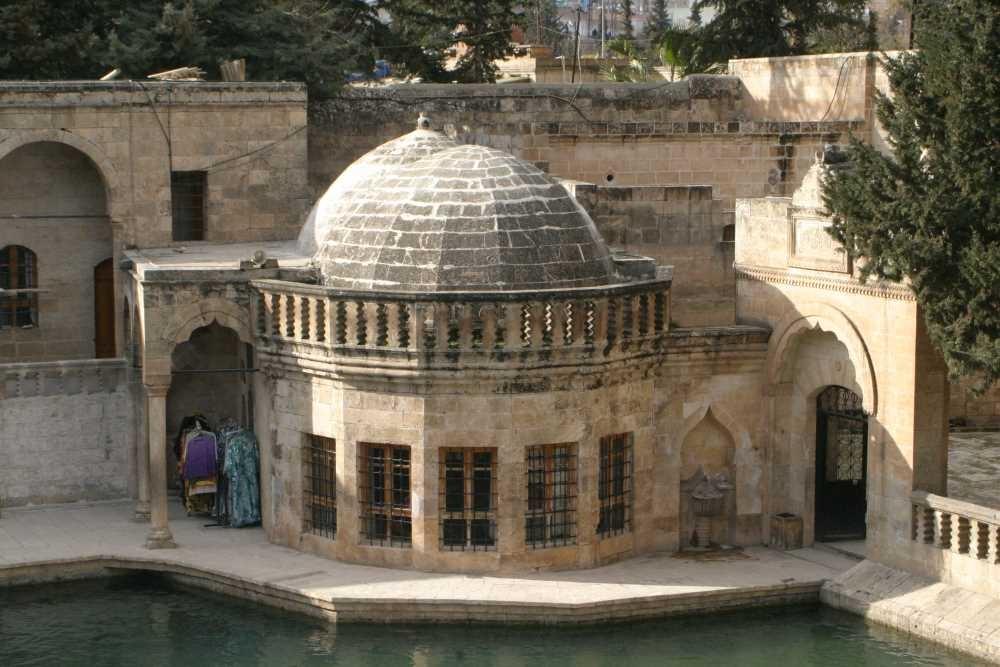
Halilü'r-Rahman Medresesi is a historical educational structure located in the city center of Şanlıurfa, on the western shore of Balıklıgöl. The medrese is one of the structures that embody the religious and architectural unity of the area surrounding Halilü'r-Rahman Lake, one of the city’s most sacred sites. This location has transformed the medrese into not only an educational institution but also a spiritual center of attraction. The medrese is situated within a significant cluster of buildings reflecting Şanlıurfa’s historical identity. Consequently, its spatial arrangement was planned in synchronization with other elements such as the lake, mosque, and tomb. The area where the medrese stands has historically housed religious structures serving various faiths. Today, this site remains an important stop within the framework of faith tourism, preserving religious, historical, and cultural continuity alongside the Halilü'r-Rahman Medresesi.
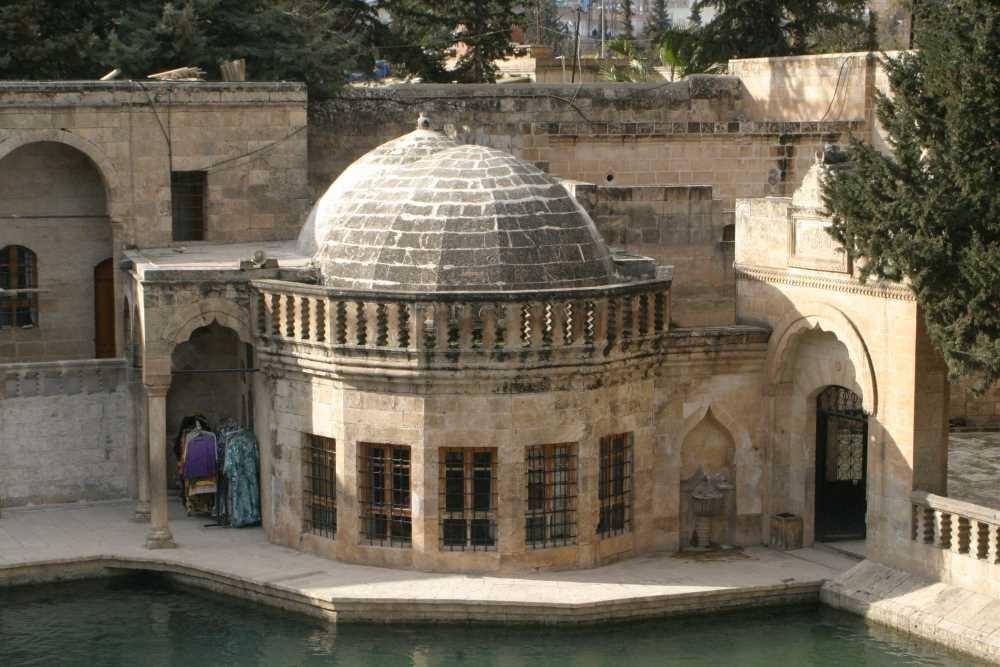
Halilü'r-Rahman Medresesi (Culture Portal)
Constructed in 1775, the medrese exhibits architectural features characteristic of the late Ottoman classical period. Its construction during this era reflects a synthesis of local influences and the classical Ottoman style evident in provincial Ottoman architecture. In 1871, during the reign of Sultan Abdülaziz, the structure underwent a comprehensive restoration led by Derviş Ali Paşa. This restoration not only preserved the building’s physical integrity but also reorganized its interior spaces to better serve educational functions. During the restoration, the surrounding area of the medrese was restructured, further emphasizing its relationship with the lake. Such structures held considerable importance within the Ottoman educational system. Medreses were not merely institutions for religious instruction but also centers contributing to societal enlightenment. In this context, the Halilü'r-Rahman Medresesi stands out as one of the institutions that sustained the scholarly traditions of its time.
The Halilü'r-Rahman Medresesi is L-shaped and constructed of finely cut stone. Its plan offers a closed and compact alternative to the open courtyard typology commonly found in classical Ottoman medreses. In this structure, cells and classrooms are arranged along the main axis, with window openings designed to allow natural light into the interior spaces. Arched transitions, symmetrical layout, and stone ornamentation are prominent architectural details. The interior volumes, covered by vaulted ceilings, are designed to adapt to the region’s hot and arid climate. The dershane section located along one side of the courtyard served both as the primary teaching space and as a venue for communal worship. The façade arrangements are relatively simple, yet the stone-carved window surrounds impart a rhythmic architectural quality. Situated on the lakeshore, the building integrates harmoniously with the natural landscape, offering a fine example of the relationship between local architecture and nature.
The site on which the medrese was built lies directly above the main water source feeding Halilü'r-Rahman Lake. This positioning imbues the structure with both symbolic and functional significance. In Islamic culture, water symbolizes purity, abundance, and divine power. Therefore, the medrese’s direct association with a water source underscores its role not only in education but also in spiritual purification. Moreover, its location beside the lake enabled students and instructors to carry out educational activities in a tranquil environment. The natural setting surrounding the lake has endowed the medrese with a more mystical character compared to other structures in the city center. Due to its proximity to water, the area’s architectural and social functions became distinct, and it began to be regarded by the local population as sacred. This relationship is a common feature of religious and educational structures built around holy water sources.
Since its construction, the Halilü'r-Rahman Medresesi has undergone various restoration efforts. The most comprehensive restoration took place in 1871, during which the building’s original fabric was preserved while structural reinforcements were introduced. However, in subsequent periods, the structure suffered damage due to natural factors and environmental conditions, necessitating partial restorations to maintain its stability. In the mid-20th century and at the beginning of the 21st century, local authorities collaborated with the Ministry of Culture and Tourism to carry out maintenance works, resulting in both physical and aesthetic renewal of the building. Today, the structure is protected under cultural heritage laws and remains open to visitors for tourism purposes. Its current condition indicates an ongoing need for regular maintenance and restoration. Given its relationship with other structures around Balıklıgöl and its significance within the context of a sacred area, the preservation of the medrese holds importance at both local and national levels.
The Halilü'r-Rahman Medresesi was constructed as a major center for religious education during the Ottoman period. Students resided in the cells of the medrese, while instruction in various branches of knowledge, primarily classical Islamic sciences, was delivered in the classrooms. The medrese also functioned as an educational institution that trained scholars from the region. In this capacity, it served both as a center of learning and as a spiritual guide for the community. Although the medrese no longer conducts active educational programs, it is frequently visited by both domestic and international tourists due to its historical and cultural heritage. The structure is an integral part of the religious complex surrounding Balıklıgöl and contributes significantly to Şanlıurfa’s spiritual identity and faith tourism. The high volume of visitors around the medrese enhances cultural interaction in the area and helps sustain traces of traditional educational practices in the present day.
"Halil Ür-Rahman Medresesi – Şanlıurfa." SosyalBilgiler.biz. Accessed July 24, 2025.
"Halil-ur Rahman Medresesi." TDMClinic Gezgin Rehberi. Accessed July 24, 2025.
"Halil-ür Rahman Medresesi." Urfakon. Accessed July 24, 2025.
Ministry of Culture and Tourism. "Halil Ür-Rahman Medresesi." Kültür Portalı. Accessed July 24, 2025.

Location | Western shore of Balıklıgöl Şanlıurfa Center | ||||||||
|---|---|---|---|---|---|---|---|---|---|
Year of Establishment | 1775 | ||||||||
Year of Repair | 1871 (Derviş Ali Paşa) | ||||||||
Plan Type | L-shaped plan, cut stone construction | ||||||||
Architectural Feature(s) | Barrel-vaulted ceilings dershane and cell arrangement arched openings | ||||||||
Water Relationship | Over the Balıklıgöl spring, sacred and functional use | ||||||||
Restoration Status | 19th century restoration and environmental arrangements in the 21st century | ||||||||
Function(s) | Ottoman period religious education center cultural tourism structure | ||||||||
No Discussion Added Yet
Start discussion for "Halilü'r-Rahman Medresesi" article
Foundation and Historical Development
Architectural Plan and Structural Features
Water and the Medrese’s Relationship with Water
Restoration Processes
Cultural and Educational Functions