


Bu içerik Türkçe olarak yazılmış olup yapay zeka ile otomatik olarak İngilizceye çevrilmiştir.
+2 Daha
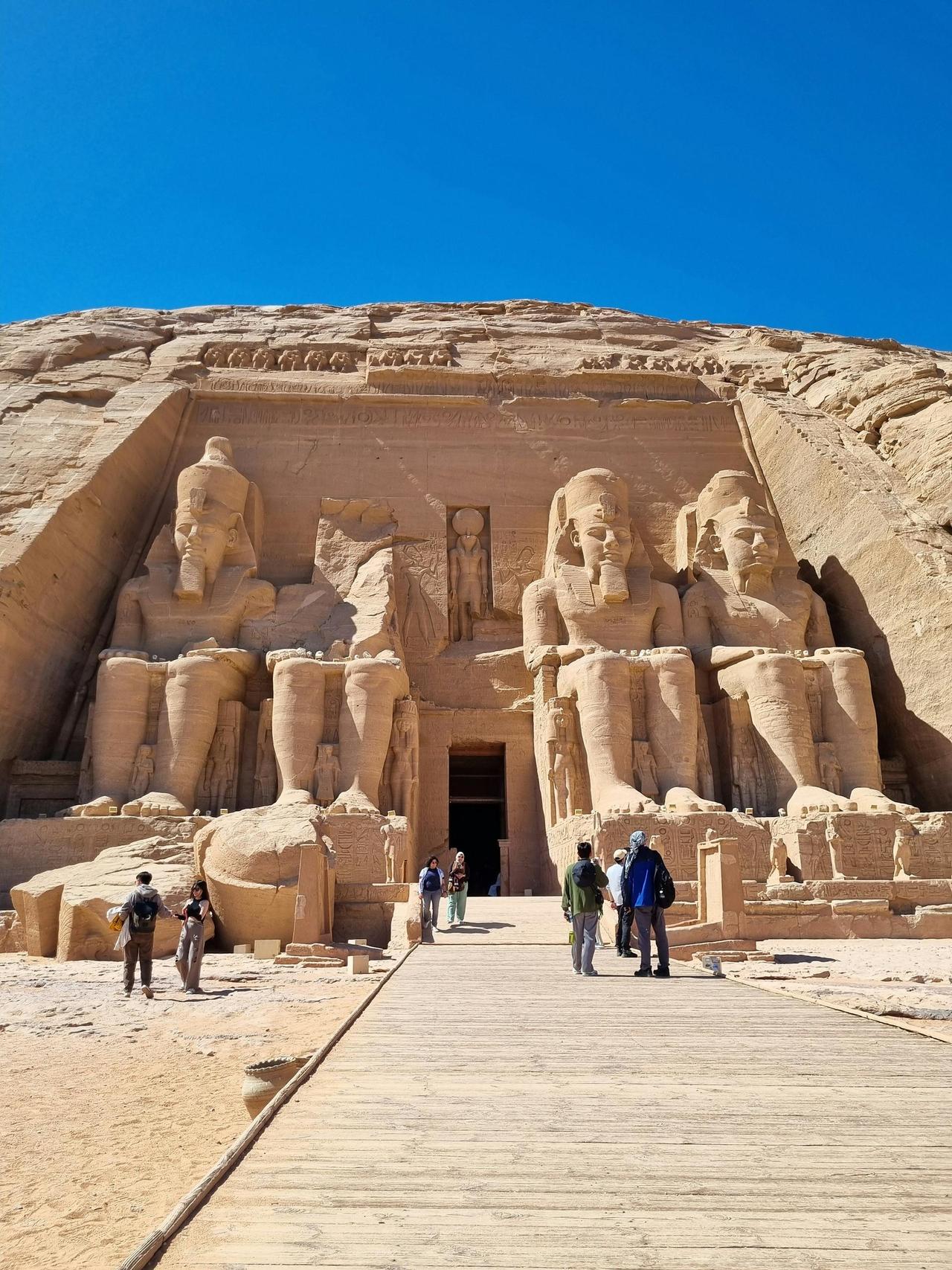
Location | Egypt Nubia region Aswan | ||||||||
|---|---|---|---|---|---|---|---|---|---|
Coordinate(s) | 22°20′N - 31°37′E | ||||||||
Current Status | relocated position On the shore of Lake Nasser | ||||||||
Great Temple | and Ptah Ra-Horakhty Amun Dedicated to Ramses II | ||||||||
Small Temple | Dedicated to the goddess Hathor and Queen Nefertari | ||||||||
Construction | 1264–1244 BCE | ||||||||
Period(s) | New Kingdom 19th Dynasty | ||||||||
Builder | Ramses II | ||||||||
Threat | Aswan Dam and Lake Nasser (1960s) | ||||||||
Relocation | Between 1964 and 1968 under the leadership of UNESCO | ||||||||
UNESCO Registration | 1979 | ||||||||
Abu Simbel is an archaeological complex consisting of two rock-cut temples located in the Nubia region of Upper Egypt, within the boundaries of Aswan Governorate. The temples were carved into the mountain during the reign of Ramses II of the 19th Dynasty. The complex comprises the Great Temple, dedicated to Ra-Horakhty, Amun, Ptah and the deified Ramses II, and the Small Temple, dedicated to Hathor and Ramses II’s chief wife Nefertari. Its current location is on the western shore of Lake Nasser, approximately 230 km southwest of Aswan. In 1968, the complex was relocated to a higher site to prevent it from being submerged by the reservoir waters of the dam.

Abu Simbel Temple (Flickr)
Construction of the complex began around 1264 BCE and continued for approximately 20 years, concluding around 1244 BCE. During this period, Egypt controlled the Nubian region. Ramses II commissioned these temples both for religious purposes and to symbolize Egyptian dominance over Nubia.
The Great Temple is renowned for its four colossal seated statues of Ramses II at the entrance. Each of the four statues on the façade stands approximately 20–21 meters tall; the head and torso of the leftmost statue likely collapsed during antiquity due to an earthquake. The interior iconography includes reliefs depicting the Battle of Kadesh.
The temple’s axis is aligned so that sunlight penetrates to the innermost sanctuary twice a year, on 22 February and 22 October. Observations conducted in 1966 after relocation confirmed that the statues of Amun, Ra-Horakhty and Ramses II were illuminated, while the statue of Ptah remained in shadow.

The Biannual Sunlight Phenomenon in the Temple (Anadolu Agency)
The Small Temple is located approximately 100 meters northeast of the Great Temple. It is dedicated to the goddess Hathor and Nefertari, wife of Ramses II. The façade features six colossal statues, each about 10 meters high: four representing Ramses II and two representing Nefertari. This arrangement is one of the rare examples in Egyptian art where a queen’s statues are depicted at the same scale as those of the pharaoh.
Over time, the temples became buried under sand. The Great Temple was rediscovered by European travelers in the early 19th century. In 1813, Swiss explorer Johann Ludwig Burckhardt identified the structure, and in 1817, Giovanni Battista Belzoni succeeded in clearing the temple’s entrance.
The construction of the Aswan High Dam in 1959 created Lake Nasser, threatening to submerge the temples. This prompted an international campaign to preserve the Nubian monuments. It was determined that prolonged exposure to water would compromise the structural integrity of the sandstone constructions.
Under UNESCO coordination, the Abu Simbel temples were cut into blocks between 1964 and 1968 and moved to a higher location. Their official reopening at the new site took place on 22 September 1968. According to UNESCO, the temples were relocated 64 meters higher and 180 meters inland. These efforts ensured their preservation in the new location.
Various alternative solutions were considered prior to relocation: leaving the temples in place within a protective pool filled with transparent water; lifting the entire mass using hydraulic jacks; or constructing a curved thin concrete dam for protection. Ultimately, the method of cutting into blocks and reassembling was adopted.
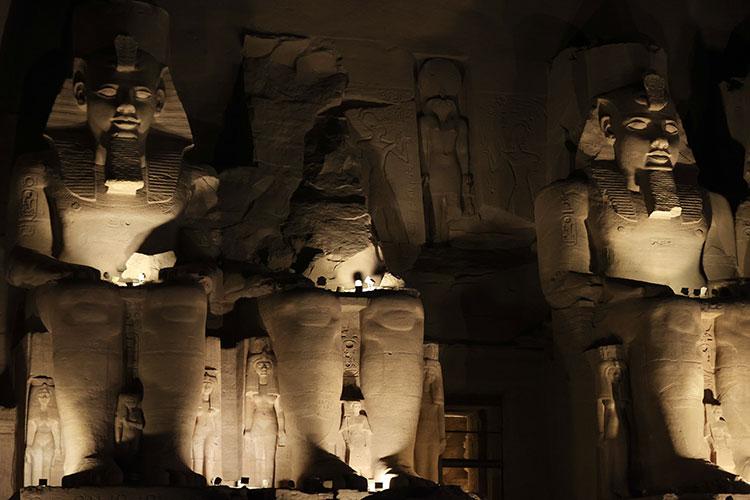
Abu Simbel Temple (Anadolu Agency)
The serial property titled “Nubian Monuments from Abu Simbel to Philae,” which includes Abu Simbel and Philae, consists of ten components and was inscribed on the UNESCO World Heritage List in 1979. The property represents architectural and cultural heritage spanning from the New Kingdom to the Roman period; some of the monuments were relocated between 1960 and 1980 as part of the UNESCO campaign.
According to UNESCO assessments, the physical texture and visual integrity of the relocated monuments have been preserved; their authenticity in form and design remains intact. The site is exposed to environmental factors such as wind, temperature fluctuations, precipitation, humidity, bird droppings, dust and tourism. Conservation is carried out under the framework of the Antiquities Law and related environmental and urban planning regulations; management plans are being progressively finalized.
Today, the Abu Simbel Temples are among Egypt’s most visited archaeological sites and continue to hold significant cultural and touristic value. The area is protected under the supervision of UNESCO and the Egyptian Supreme Council of Antiquities.
Anadolu Ajansı. “Binlerce Kişi O Anı Bekledi.” Accessed September 26, 2025. https://www.aa.com.tr/tr/dunya/binlerce-kisi-o-ani-bekledi/1070416
Anadolu Ajansı. “Mısır’da Firavun 2. Ramses’in Heykeline Güneş Vurdu.” Accessed September 26, 2025. https://www.aa.com.tr/tr/kultur/misirda-firavun-2-ramsesin-heykeline-gunes-vurdu/3370189
Egyptian Museum. "New Kingdom Monuments: Abu Simbel." Egyptian Museum. Accessed September 26, 2025. https://egyptianmuseum.org/explore/new-kingdom-monuments-abu-simbel
Madain Project. "Abu Simbel." Madain Project. Accessed September 26, 2025. https://madainproject.com/abu_simbel
Mark, Joshua J. “Abu Simbel.” World History Encyclopedia. Accessed September 26, 2025. https://www.worldhistory.org/trans/tr/1-287/abu-simbel/
Memphis University. “Abu Simbel.” University of Memphis. Accessed September 26, 2025. https://www.memphis.edu/egypt/resources/colortour/abusimbel-gtr2.php
Ministry of Tourism and Antiquities. “Abu Simbel.” Accessed September 26, 2025. https://egymonuments.gov.eg/archaeological-sites/abu-simbel/
Omar. “İnsanlar Kent Simgesi Görülecek Yer Çöl.” Pexels. Accessed September 26, 2025. https://www.pexels.com/tr-tr/fotograf/insanlar-kent-simgesi-gorulecek-yer-col-23030586/
UNESCO. “Abu Simbel, Nubia Monuments from Abu Simbel to Philae.” UNESCO World Heritage Centre. Accessed September 26, 2025. https://whc.unesco.org/en/list/88/
UNESCO. “Abu Simbel.” UNESCO World Heritage Centre Stories. Accessed September 26, 2025. https://whc.unesco.org/en/story-abu-simbel/
Üstün, Güldem. “Abu Simbel Photo by guldem.” Flickr. Accessed September 26, 2025. https://www.flickr.com/photos/guldem/26178486946

Location | Egypt Nubia region Aswan | ||||||||
|---|---|---|---|---|---|---|---|---|---|
Coordinate(s) | 22°20′N - 31°37′E | ||||||||
Current Status | relocated position On the shore of Lake Nasser | ||||||||
Great Temple | and Ptah Ra-Horakhty Amun Dedicated to Ramses II | ||||||||
Small Temple | Dedicated to the goddess Hathor and Queen Nefertari | ||||||||
Construction | 1264–1244 BCE | ||||||||
Period(s) | New Kingdom 19th Dynasty | ||||||||
Builder | Ramses II | ||||||||
Threat | Aswan Dam and Lake Nasser (1960s) | ||||||||
Relocation | Between 1964 and 1968 under the leadership of UNESCO | ||||||||
UNESCO Registration | 1979 | ||||||||
Henüz Tartışma Girilmemiştir
"Abu Simbel Temple" maddesi için tartışma başlatın
Foundation and Dating
Complex Composition
Great Temple
Sunlight Phenomenon
Small Temple
Documentation in the 19th Century
Relocation and Conservation Efforts
Aswan High Dam and the Threat
Relocation
Technical Details of the Relocation
UNESCO World Heritage Status
Integrity, Authenticity and Management
Current Status