

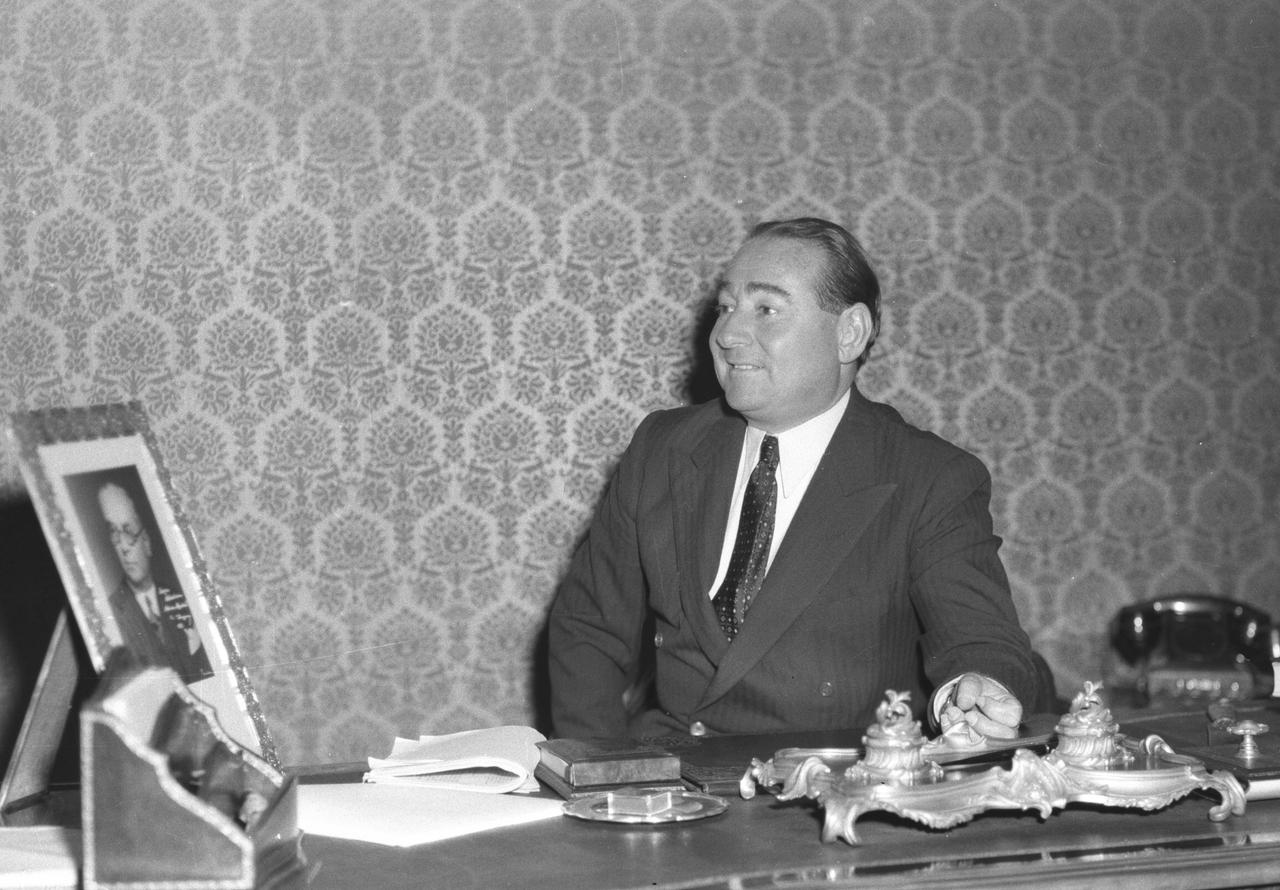

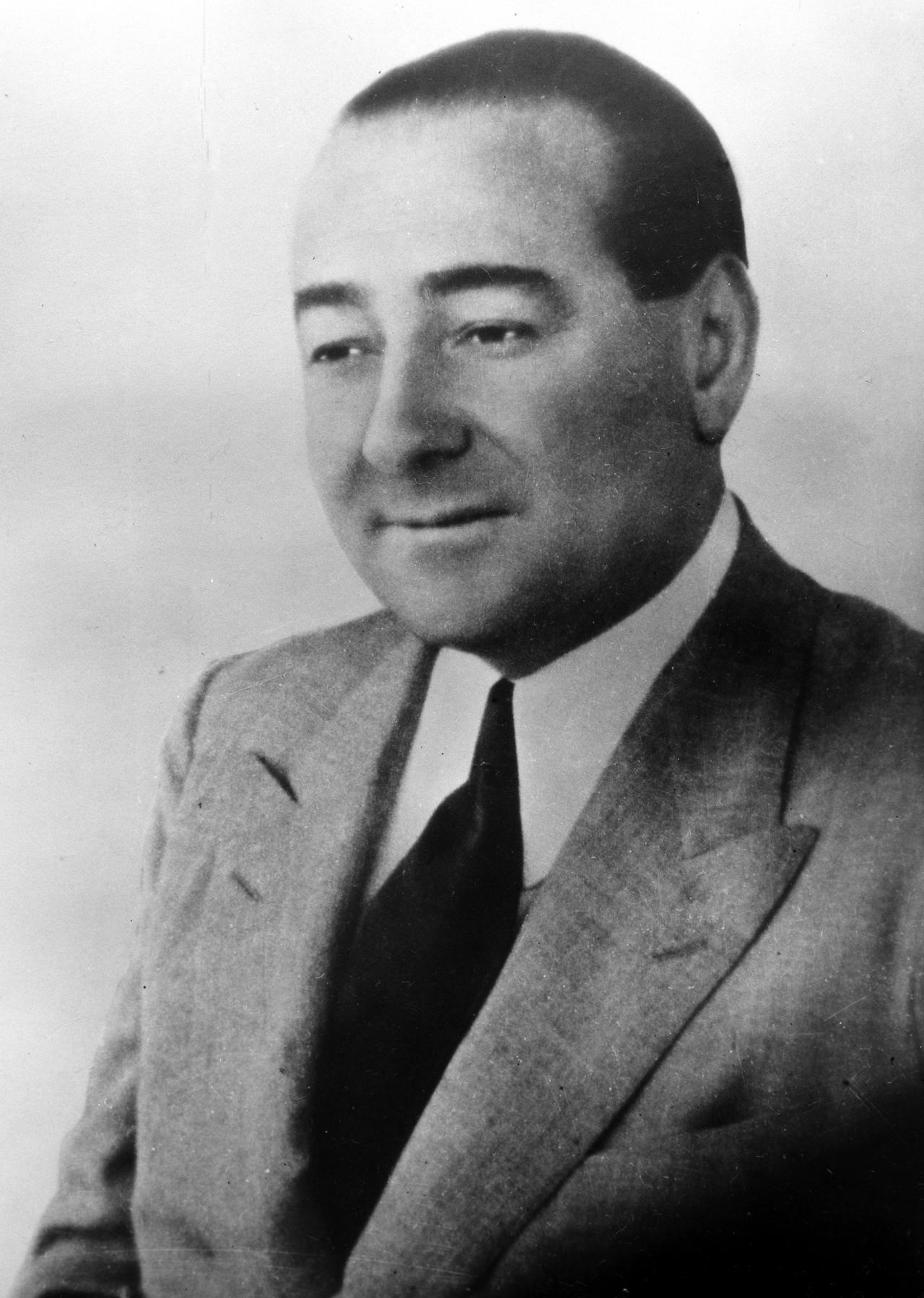
Adnan Menderes (AA)
Full Name | Ali Adnan Menderes | ||||||||
|---|---|---|---|---|---|---|---|---|---|
Birth | 1899 | ||||||||
Place of Birth | Aydın Sarayiçi Mahallesi | ||||||||
Father | İbrahim Ethem Bey | ||||||||
Mother | Tevhide Hanım | ||||||||
Spouse | Fatma Berrin Menderes | ||||||||
Marriage | 2 September 1928 | ||||||||
Children | Yüksel Mutlu Aydın | ||||||||
Profession | Politician Lawyer Farmer | ||||||||
Education | Ankara Faculty of Law | ||||||||
Farm | Çakırbeyli Farm | ||||||||
Entry into Politics | 1930 | ||||||||
First Political Party | Free Republican Party | ||||||||
First Political Office | SCF Aydın Provincial Presidency | ||||||||
Entry into the Grand National Assembly | 1931 | ||||||||
First Term as Member of Parliament | Member of Parliament from Aydın | ||||||||
CHP Membership as Member of Parliament | 1931–1945 | ||||||||
Democratic Party Office | Founding member Party Spokesperson | ||||||||
Start of Prime Ministership | 22 May 1950 | ||||||||
Term as Prime Minister | 1950–1960 | ||||||||
End of His Rule | 27 May 1960 military intervention | ||||||||
Place of Trial | Yassıada | ||||||||
Court | High Court of Justice | ||||||||
Death | 17 September 1961 | ||||||||
Place of Death | İmralı Island | ||||||||
Cause of Death | Execution | ||||||||
Adnan Menderes (1899–1961) was a Turkish politician, lawyer, and farmer who played a significant role in Türkiye's multi-party political life and served as prime minister from 1950 to 1960. Born in Aydın, Menderes performed military service during World War I and the National Struggle, and later engaged in agricultural activities on the Çakırbeyli Farm inherited from his family. In 1930, he entered active politics with the Free Republican Party, then joined the Republican People's Party and was elected as a deputy from Aydın in 1931, entering the Grand National Assembly of Türkiye. In 1945, he emerged as one of the leading figures of internal opposition and played an active role in the transition to a multi-party political system. Following the Democratic Party's victory in the general elections of 14 May 1950, Menderes was appointed prime minister on 22 May 1950 and remained a decisive figure in Türkiye's domestic and foreign policy for ten years. His government was overthrown by the 27 May 1960 coup, and he was tried by the High Court of Justice on Yassıada, sentenced to death, and executed on 17 September 1961 on İmralı Island.
Menderes's parents, İbrahim Ethem Bey and Tevhide Hanım, married in 1895. Their first child, Hatice Melike, was born in 1896, and their second child, Ali Adnan, was born in 1899.【1】 Ali Adnan was born in the summer of 1899 in the mansion of his uncle Hacı Ali Paşazade Sadık Bey in the Sarayiçi neighborhood of Aydın.【2】 Official records and population registers list his birth year as Rumî 1315 and Gregorian 1899. He was given the name "Ali" as a birth name, but in daily life he was known as "Adnan." His father, İbrahim Ethem Bey, was a state official belonging to the İzmirli Kâtipzadeler family, who had received legal education and served as a land registry clerk in Aydın. The Kâtipzadeler family's settlement in İzmir dates back to Elhac Mehmet Efendi, who moved to the city in 1762 to assume the role of ayan or mütesellim. İbrahim Ethem Bey's father, İsmail Bey, also served in public office and owned farmland. His mother, Tevhide Hanım (also recorded in some documents as Tevfika or Nevhide), belonged to the Hacı Ali Paşazadeler family. Tevhide Hanım's father, Hacı Ali Paşa, was a landowner with extensive agricultural lands in the Büyük Menderes and Küçük Menderes basins. According to some accounts, Hacı Ali Paşa's family origins trace back to Crimean Tatars who migrated via Dobruca and Eskişehir to Tire.
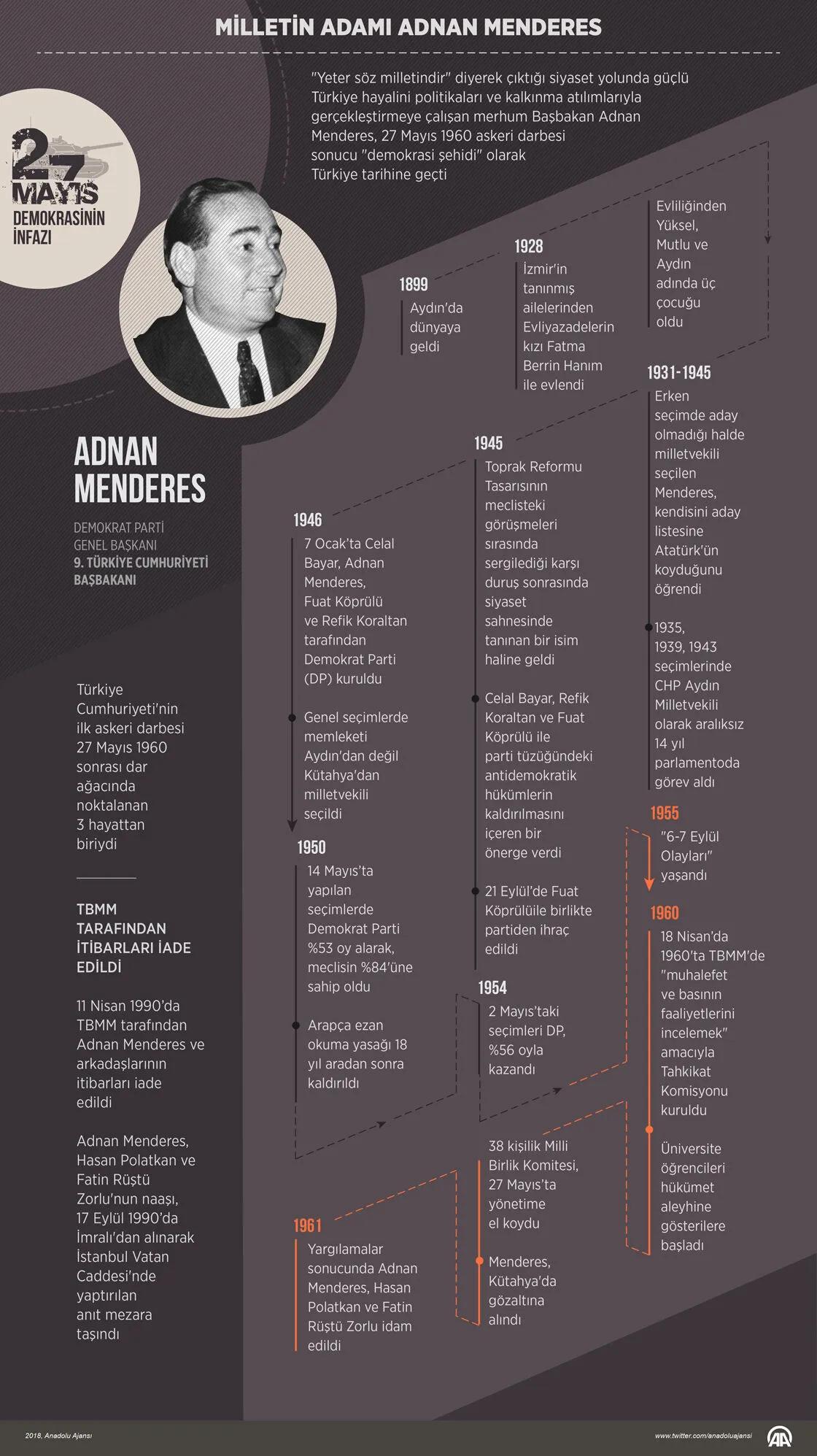
Adnan Menderes İnfografiği (Anadolu Ajansı)
Shortly after Ali Adnan's birth, Tevhide Hanım contracted tuberculosis. The family moved to İzmir for treatment, but Tevhide Hanım succumbed to the illness. After his wife's death, İbrahim Ethem Bey's condition worsened; he traveled to Istanbul for treatment and died of tuberculosis in a hotel room. Their first child, Hatice Melike, also died of tuberculosis at the age of six (some records say ten) in their home on Beyler Street in İzmir. Ali Adnan, having lost his mother, father, and older sister at a young age, became the sole surviving child of his family and was left orphaned and alone.【3】
After the deaths of family members, Ali Adnan's care and upbringing were taken over by his grandmother, Fatma Fitnat Hanım. Fatma Fitnat Hanım, daughter of Kâtipzade Mehmet Efendi and Safiye Hanım, was born in İzmir in 1853. Having no memory of his parents, Ali Adnan believed his grandmother to be his biological mother until the end of his elementary school years. Out of great concern to protect her grandson from tuberculosis, Fatma Fitnat Hanım showed exceptional care. After Dr. Şehri Bey of İzmir Gureba Hospital identified a tuberculosis risk, Fitnat Hanım moved her grandson to a well-ventilated, garden-equipped house in Karşıyaka. Due to his fragile constitution, Ali Adnan spent his childhood indoors in a protected environment rather than playing in the streets. To ensure his education was not interrupted, Fatma Fitnat Hanım hired private tutors at home to teach him reading and writing. His grandmother advised Ali Adnan never to abandon the Çakırbeyli Farm and ancestral lands inherited from his grandfather.【4】
During his military service, his grandmother Fatma Fitnat Hanım also came to Istanbul and settled at Şahin Paşa Hotel, but died there on 26 February 1918 due to tuberculosis. With his grandmother's death, Ali Adnan lost all of his first-degree relatives.【5】
From his early youth, Ali Adnan was deeply involved in sports. During his time in İzmir, he played football as a forward for Karşıyaka Sports Club and as a goalkeeper for Altay Sports Club. In addition to football, he engaged in swimming, horseback riding, sailing, and cycling. Ali Adnan spent his summers at the Çakırbeyli Farm and his winters in his home in İzmir Karşıyaka, where he was known for his social relationships and sporting activities.
On 2 September 1928, Ali Adnan married Fatma Berrin Hanım (born in 1905/1906), from the prominent İzmir Evliyazâdeler family. Fatma Berrin Hanım was the daughter of Mehmet İzzet Bey and Naciye Hanım. Their acquaintance was arranged through family friends and Ali Adnan's lawyer, Sadık Bey; their first meeting took place at the café of the Elhamra Cinema in İzmir. After their marriage, the couple settled at the Çakırbeyli Farm and spent winters in İzmir. They had three sons: Yüksel (1930), Mutlu (1937), and Aydın (1946).【6】
There is no official record of Ali Adnan's primary education; it is accepted that he learned reading and writing and completed elementary-level subjects through private tutors at home. He began formal secondary education in 1910 at the İzmir İttihat ve Terakki Mektebi's Rüştiye section. This school, founded by Enver Bey on Arapfırını Street in Beyler Sokağı, included primary, intermediate, and secondary levels. Among the distinguished educators on its staff were Şükrü (Saraçoğlu), Vasıf (Çınar), Baha (Tekant), Salih Zeki, İzzet, and İsmail Zühtü. Mathematics teacher Baha Tekant described Ali Adnan as a neat, diligent, sensitive, average student with strong speaking abilities.【7】
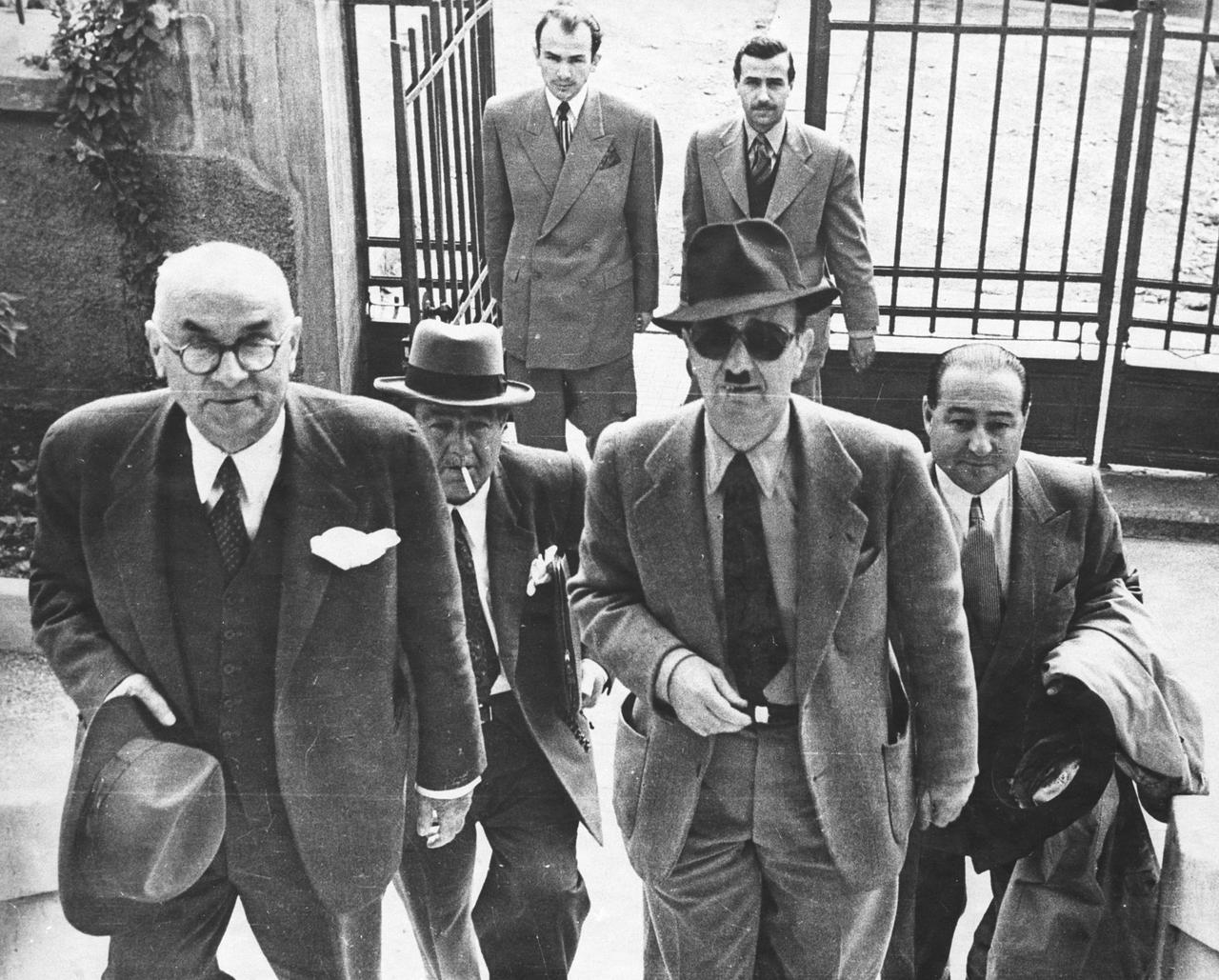
Celal Bayar (solda) ve Fuat Köprülü (sağda) ile Adnan Menderes (sağ arkada) - 16 Mayıs 1950 (Anadolu Ajansı)
Ali Adnan left the middle section of İttihat ve Terakki Mektebi before completing it to enroll in the American College in İzmir Kızılçullu to learn a foreign language. During his studies at the college, around 1913, he discovered that some missionary teachers in the administration were attempting to convert Muslim students to Christianity. In response, he and two classmates visited Mahmut Celal (Bayar) Bey, the İzmir Secretary of the İttihat ve Terakki Party, and provided the names and student numbers of the teachers and affected students, requesting state intervention. As a result of Celal Bayar's initiatives with the Ministry of Education and school administration, an official investigation was opened, and following media coverage, the implicated teachers were replaced.
In October 1916, under the Harbiye Nezareti's decision to conscript those born in 1315 (1899), Ali Adnan was called to military service, leaving his final year at the American College unfinished. On 16 December 1916 he was sent to the Erenköy Reserve Officer Training School (Yedek Subay Okulu) on the Anatolian side of Istanbul. Ali Adnan completed his officer candidate training with service number 20.737 and was promoted to the rank of Zabit Vekili (Second Lieutenant) on 15 December 1917.【8】
After receiving the rank of Zabit Vekili, he was deployed to the Syria-Palestine front under the command of Cemal Paşa. During the train journey to the front, he contracted tropical malaria at the Adana Pozantı station and was removed from the train, receiving treatment in a mobile hospital. Ali Adnan's body weight dropped to 40 kilograms; due to severe health issues, he could not be sent to the active front. Through the intervention of his relative, Nihat Paşa, commander of İzmir, he was reassigned to rear service at the İzmir 17th Corps (47th Division, 12th Regiment). On 10 October 1918, he took a one-month leave for health reasons, and on 30 October 1918, following the signing of the Armistice of Mudros, he was discharged from the army by the 17th Corps.【9】
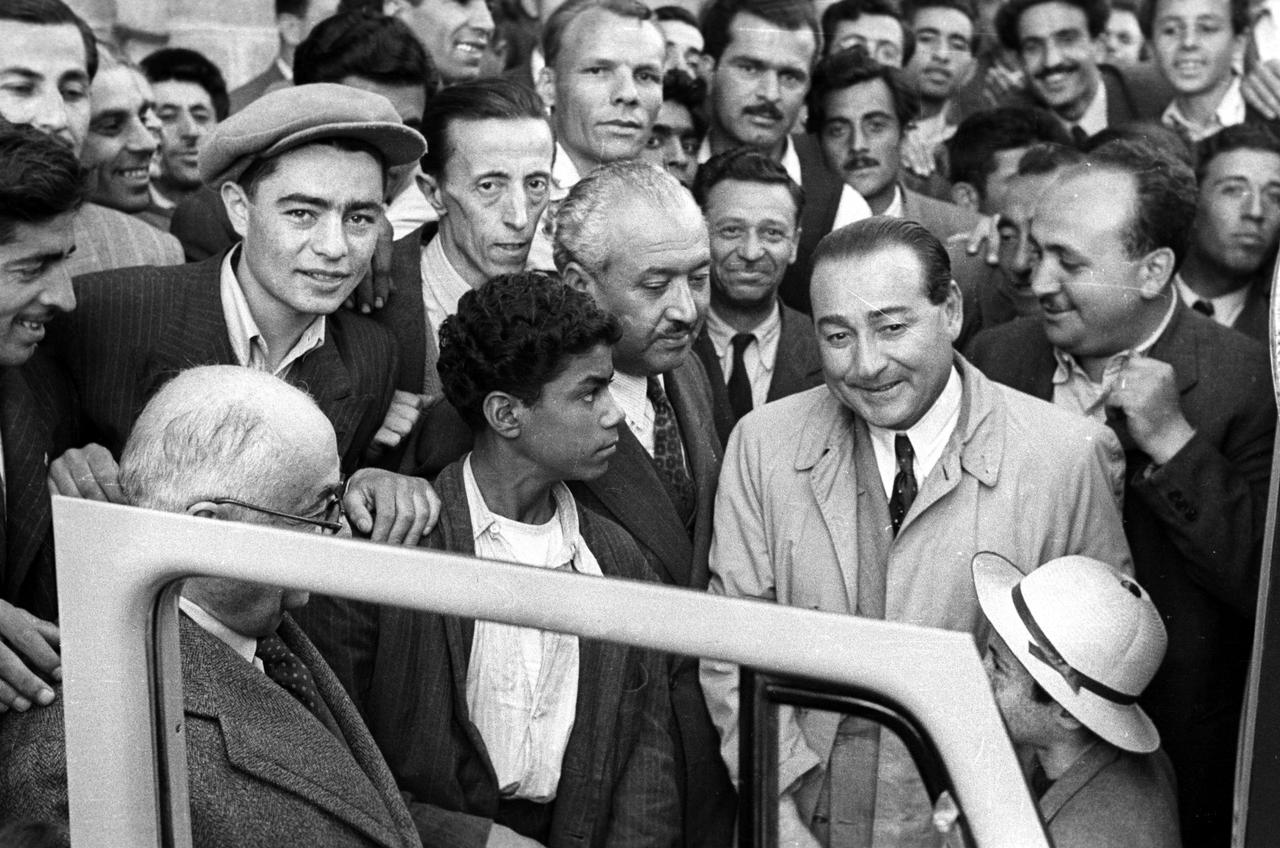
Seçimi kazandıkları anlaşıldıktan sonra Demokrat Parti Genel Başkanı Celal Bayar (solda), Ankara İl İdare Kurulu binasına geldi. Adnan Menderes (sağda), Osman Çiçekdağ (sağ 2) - 15 Mayıs 1950 (Anadolu Ajansı)
After the Armistice of Mudros, Ali Adnan returned to his hometown of Aydın and joined local resistance activities after Greek forces occupied Aydın on 27 May 1919. Under the leadership of Topçu Üsteğmen Selami (Helvacıoğlu) Bey, alongside his schoolmate Ethem (Menderes) Bey and close associates, he founded a National Forces detachment named "Ayyıldız Çetesi". Operating from the Çakırbeyli Farm, located in the Italian-occupied zone, this unit conducted raids against occupying forces, protected the local population, and coordinated with Colonel Şefik Bey, commander of the 57th Division. During the Turkish offensive launched on 28 June 1919, he participated with his detachment alongside militia units under the command of Binbaşı Hacı Şükrü Bey, the commander of Köprübaşı.【10】
Responding to a call from Ankara Government's Topçu Yarbay Osman Bey for regular military service, Ali Adnan was re-enlisted on 6 October 1920. He was initially assigned to the Aydın Cavalry Detachment, serving as a cavalry squadron commander in war zones such as Yenipazar and Baltaköy. He was then transferred to Koçarlı, serving under Binbaşı Besim Bey, and from 1 September 1921 to March 1922, he served as the Aydın Military Branch Administrative Officer. During this period, he organized and managed the safe transport of General Ali İhsan Sabis Paşa, returning from Malta exile, along the Söke-Koçarlı route to Ankara. Sabis Paşa noted in his memoirs Ali Adnan's youthful intelligence and dynamic military character.【11】
On 1 March 1922, Ali Adnan was appointed Commander's Aide for the Menderes Region; after the region was reorganized into the 74th Regiment, he continued as Regimental Aide. After the regiment was dissolved, he was assigned to the 12th Division's 35th Regiment, serving as Second Battalion Aide and Regimental Command Officer. Ali Adnan served in the 1st Regiment's 2nd Intelligence Branch and İzmir Censorship Branch and participated in the Great Offensive, engaging in combat with his units. After the victory, he was discharged on 1 August 1923. For his 2 years and 10 months of military service during the National Struggle, the Grand National Assembly awarded him the Red-Striped Independence Medal on 26 January 1931.【12】
After being elected as a deputy from Aydın in 1931 and entering the TBMM, Ali Adnan decided to complete his higher education due to the absence of a diploma. This decision was influenced by a recommendation from CHP General Secretary Recep Peker. Having been conscripted during his final year of high school due to World War I, Ali Adnan lacked a diploma. On 13 December 1932, he submitted a petition to the Ministry of National Education requesting recognition of his high school graduation. With the approval of the then Minister of National Education, Reşit Galip Bey, and under relevant legislation, he was deemed equivalent to a high school graduate and was admitted without examination to Ankara Law Faculty (Hukuk Mektebi) on 18 December 1932 with registration number 1795.【13】
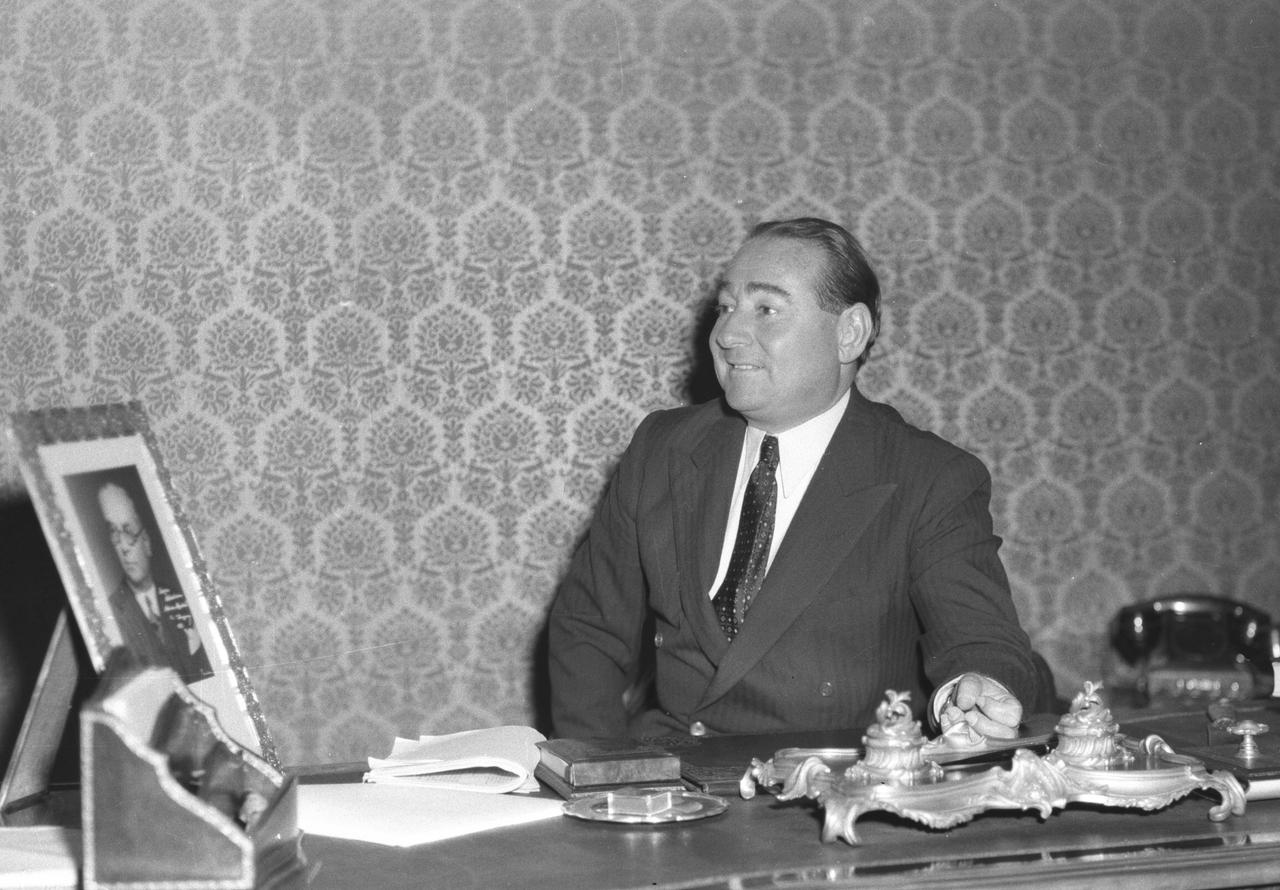
Adnan Menderes, makamında - 22 Mayıs 1950 (Anadolu Ajansı)
While continuing his duties as a deputy, Ali Adnan pursued his three-year daytime (non-residential) studies at Ankara Law Faculty. On his exam papers until the end of 1934, he used the name "Adnan Bey." In the 1934–1935 academic year, he graduated among a total of 137 graduates, 16 women and 121 men, and completed his education on 2 November 1935 with diploma number 791 as the seventh graduate of the faculty. His grades under the ten-point system were as follows: Forensic Medicine (9.5), Finance (10), Criminal Procedure (8.5), Public Law (10), International Law (9), Legal Procedure (10), Maritime Commerce (8), Civil Law (8), and Criminal Law taught by Baha Kantar (7.5).【14】
Following the Surname Law enacted in 1934, Ali Adnan first registered the surname "Ertekin," but from mid-1935 onward he began using the surname "Menderes." On 15 June 1937, he submitted a petition to the General Secretariat of the TBMM (Umumî Katibliğine) requesting that his official records and registers be corrected to reflect the surname "Menderes."【15】
The Çakırbeyli Farm passed by inheritance to the ten-year-old Ali Adnan Menderes in 1908 following the death of Hacı Ali Paşa, his maternal grandfather.【16】 The farm is located in the geographical area stretching from the western banks of the Çine Çayı toward the southern edge of the Menderes Valley, within the boundaries of Çakırbeyli village in the Koçarlı district of Aydın Province. Records and accounts regarding the total land area inherited from Hacı Ali Paşa vary between 35,000–40,000 dönüm, 40,000–60,000 dönüm, or over 50,000 dönüm.【17】 However, the flat, fertile, and irrigated lowland area between the Menderes River and the Çine Çayı covers approximately 3,500 to 4,000 dönüm. The remaining portions of the land are mountainous, shrub-covered, and pastureland.
The first legal dispute concerning the Çakırbeyli Farm during Ali Adnan Menderes's childhood occurred between 1908 and 1910. The villagers of Sobluca, a village attached to the Çakırbeyli Farm, filed a lawsuit claiming that the farm had encroached upon pastureland used for grazing their livestock. On 15 October 1908, the Aydın First Instance Court ruled that the disputed land was designated as pasture for the villagers, a decision later confirmed by the Provincial Administrative Council. However, the Governor of Aydın, Ahmet Muhtar Paşa, deployed gendarmerie units to prohibit villagers from entering the pasture. On 6 January and 10 March 1910, the Sobluca villagers petitioned the Ministry of Interior demanding enforcement of the court ruling. Despite a directive from the Ministry of Interior to the governor, the provincial administration opposed the ruling, citing Ali Adnan Bey's land deeds. At the time of this incident, Ali Adnan Menderes was a child aged 10–11.【18】
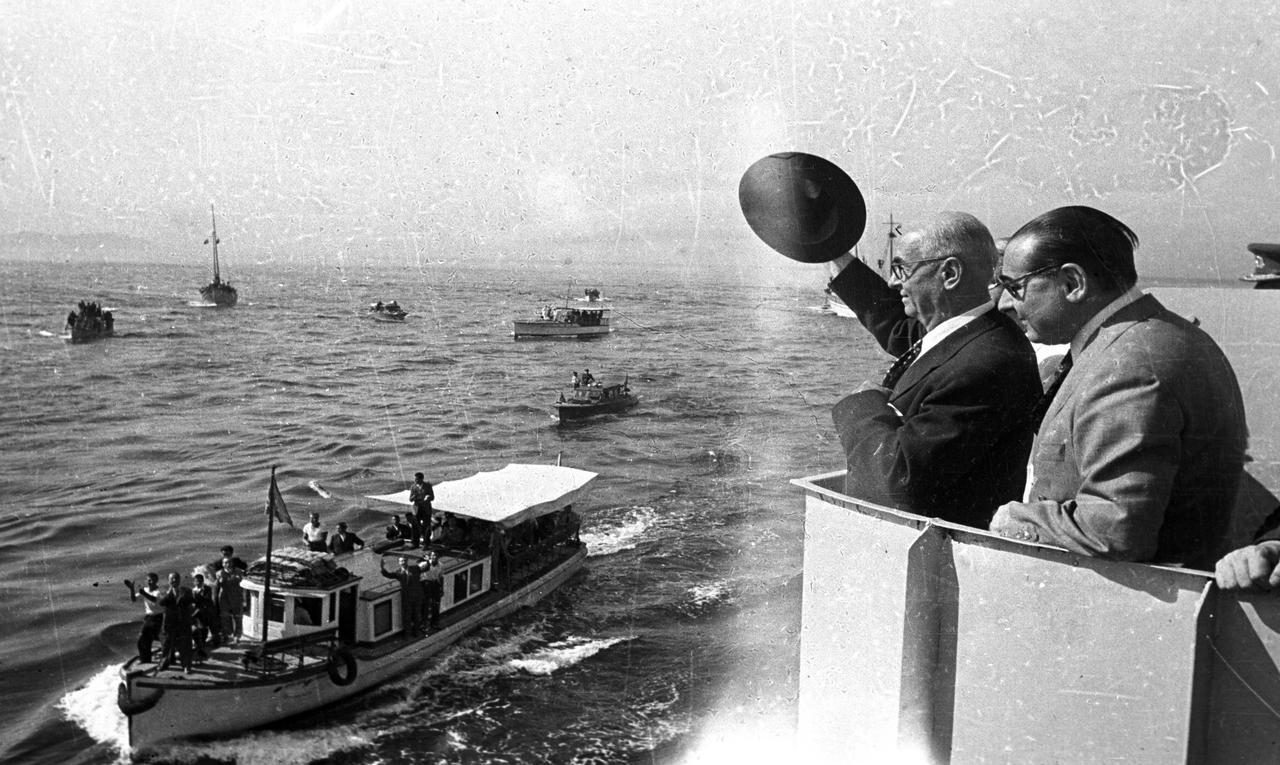
President Celal Bayar, Prime Minister Adnan Menderes (right), and the Governor of Gaziantep arrived in Istanbul from İzmir – 15 July 1950 (Anadolu Ajansı)
During his childhood and early youth, while his family resided in İzmir, the legal and administrative affairs of the Çakırbeyli Farm were managed by Lawyer Fevzi (Aker) Bey, and the farm's operations were overseen by Kâhya Tireli Mehmet Ağa. At the center of the farm stood a single-story, courtyard-style mansion known locally as "Kuleli," surrounded by stables. Over time, this original building fell into disrepair and was demolished; in its place, Adnan Menderes commissioned the construction of a new two-story farmhouse between 1952 and 1953.
After World War I, Ali Adnan Menderes returned to the Çakırbeyli Farm in May 1919 and again after his discharge from the National Struggle in 1922, assuming direct control of agricultural activities. His childhood friend Ethem (Menderes) Bey also moved into the farmhouse and participated in farm operations. Upon his return, Menderes's body weight had dropped to 40 kilograms due to successive bouts of toxic malaria, black fever, and liver inflammation, leaving him physically weakened.【19】
The farm's kâhya, Memişoğlu Mehmet Kâhya, played a guiding role in Menderes's integration into farming. Having lost his family elders and returning to the farm in his early twenties, the young Menderes appeared before the villagers in a weakened state due to illness. Kâhya Memişoğlu hung rifles, pistols, and sabers on the walls of Menderes's room in the mansion and ensured he wore boots and rode horses. Menderes later described Kâhya Memişoğlu as his "folk philosopher."【20】
Another kâhya serving at the Çakırbeyli Farm was Abdi Ağa. Known for his illiteracy and traditional Yörük attire and boots, Abdi Ağa remained with Menderes after his 1928 marriage and continued managing farm services. During his premiership, Menderes hosted his kâhya Abdi Ağa at his home in Ankara. Menderes personally joined workers in the fields, actively participating in planting, irrigation, and harvesting.
The most influential figure in Menderes's religious and social life during his farm years was Mehmet Emin Efendi, known as "Kara Hafız," born in 1877 in Evsekler village. A graduate of the Religious Sciences section of Istanbul Darülfünun, Kara Hafız taught children in Çakırbeyli and visited the farmhouse to engage in scholarly and religious discussions with Menderes. Menderes drew inspiration from Kara Hafız's teachings regarding devotion to the land and religious values. When deciding in the 1930s to distribute his land to villagers, he consulted Kara Hafız to determine which families had the greatest need for land.【21】
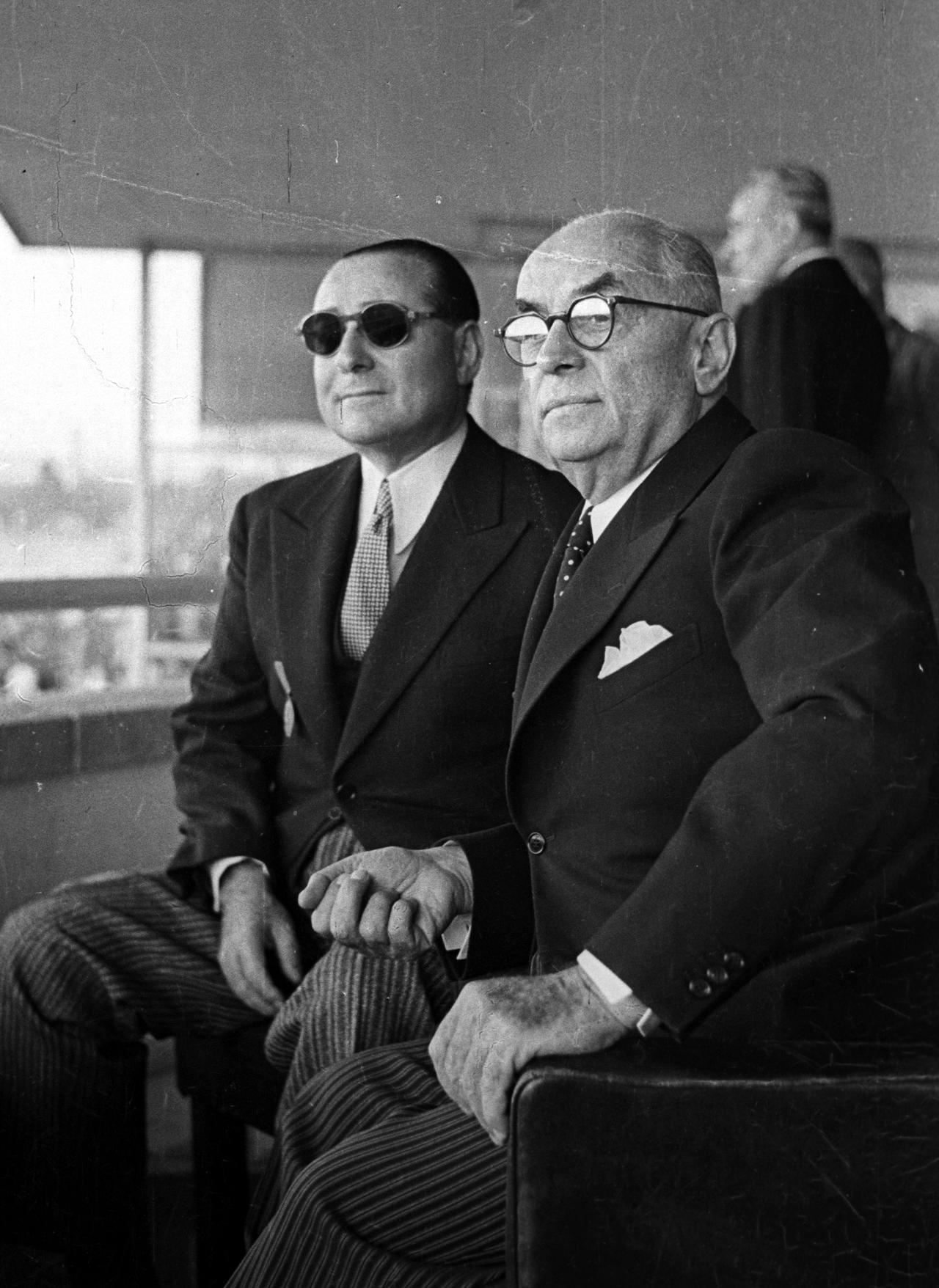
Cumhurbaşkanı Celal Bayar, Gazi koşusunu Başbakan Adnan Menderes ile birlikte izledi - 11 Haziran 1950 (Anadolu Ajansı)
After beginning farming at the Çakırbeyli Farm, Menderes implemented modern agricultural techniques on the fertile lowland areas. He prioritized cotton cultivation, which yielded high profits and was known as "white gold." To protect his cotton production from price fluctuations in the free market, he marketed it through the Aydın Agricultural Sales Cooperative. He promoted the use of high-yield cotton seed varieties developed at the Nazilli Cotton Improvement Station, increasing crop yields across his farm and region. He actively participated in agricultural trade through his membership in the Aydın Chamber of Commerce and his presidency of the Chamber of Agriculture.
Menderes transformed the Çakırbeyli Farm into a center for mechanization and modernization in agriculture. He purchased his first Turkish tractor from a factory in Ankara for 14,700 Turkish Liras and brought it to the Çakırbeyli Farm. The tractor's driver was Veli Yunus, a young villager. To demonstrate the tractor's power, Menderes invited cabinet ministers to the farm, kept their guards at a distance while plowing, and personally walked among the furrows to observe the tractor's performance and plowing depth. During the Marshall Plan period and afterward, he increased the number of tractors on the farm to enable villagers to benefit from agricultural machinery. He also distributed stored wheat and corn from the farm's silos to peasant families during periods of scarcity..【22】
After being elected as a deputy from Aydın in 1931 and relocating to Ankara, Ali Adnan Menderes found it difficult to personally manage the extensive lands of the Çakırbeyli Farm. He did not initiate legal action against villagers who illegally cultivated or converted unattended mountainous and lowland areas into olive groves or gardens. In 1932, using the "terk-i tapu" (land abandonment) method, he transferred 25,000 to 40,000 dönüm of his land无偿 or symbolically to villagers of Çakırbeyli, Koçarlı, Boğaziçi, Evsekler, and Cincin. He gave 500 dönüm to his schoolfriend Ethem Menderes and retained only the 3,500 dönüm of easily cultivable lowland for himself. His motivation in transferring land was to gain the affection and support of the villagers. Aydın Menderes reported that his father had distributed over 30,000 dönüm of land to villagers.【23】
The global economic crisis that began in 1929 negatively affected farmers and merchants in Türkiye, particularly in the Aegean Region, whose production was export-oriented. As prices of agricultural products fell and trade opportunities diminished, dissatisfaction with the ruling Republican People's Party's economic policies intensified. Under these economic crisis conditions, the Free Republican Party (FRP) was established on 12 August 1930 under the presidency of Ali Fethi (Okyar) Bey. FRP General President Fethi Bey embarked on a tour of the Aegean to organize the party and initially considered Şahinzade Fuad Bey, a former mayor, for the Aydın provincial leadership. However, due to negative press coverage and complaints, Fethi Bey decided to pursue a younger cadre. At the recommendation of Aydın Deputy Dr. Reşit Galip and Necip Ali (Küçüka) Bey, the candidacy of Ali Adnan Bey (Menderes)—owner of the Çakırbeyli Farm, president of the Aydın Chamber of Agriculture, and member of the Chamber of Commerce—was proposed for the Aydın provincial leadership.
Ali Adnan Menderes's wife, Fatma Berrin Hanım, opposed her husband's entry into active politics because her uncle Refik Bey's son-in-law, former İttihatçı Dr. Nazım Bey, had been executed in the İzmir Assassination Case. She sent him a telegram expressing her opposition. Nevertheless, Menderes, who directly suffered from the 1929 crisis as a producer farming and marketing his products at the Çakırbeyli Farm and was dissatisfied with the government's economic policies, found the FRP's liberal economic program appealing. At a meeting with Fethi Okyar on 5 September 1930, Adnan Menderes accepted Okyar's appeals for service to his homeland and formally established the FRP Aydın Provincial Organization on 9 September 1930, becoming its provincial president. Aydın became the fourth center of FRP organization nationwide. The provincial leadership board under Menderes included Ethem (Menderes), Dr. Mukadder, Yusuf Selahattin, Engineer Hıfzı, Şahinzade Osman Fuat (Erlaçin), Dr. Nafiz, and Osman Bey. Menderes played an active role not only in Aydın but also in organizing FRP branches in Denizli, Nazilli, and Muğla.【24】
Following the establishment of the Free Republican Party, Türkiye held its first multi-party municipal elections in September and October 1930. Political tensions arose between the ruling party, CHF, and the opposition, FRP. During the elections in Aydın, incidents of ballot-box tampering, voter intimidation, and irregularities disrupted the voting process, prompting an investigation. After review, the elections were re-conducted and completed on 26 October 1930; nationwide, the FRP won 31 of 502 mayoral positions. Of these 31, 10 were in İzmir and 8 were within the boundaries of Aydın Province under Adnan Menderes's leadership.【25】 Fethi Okyar brought the electoral irregularities to the TBMM agenda on 15 November 1930, and after debates in the Assembly, he chose not to confront the presidency and government. On 17 November 1930, he submitted a petition to the Ministry of Interior dissolving his party. On 18 November 1930, with the closure of its organizations, Menderes's position as FRP Aydın Provincial President ended.
After the dissolution of the FRP, the CHF Central Committee dispatched investigation teams to provinces to examine public grievances and recruit qualified individuals who had defected to the opposition. Under the leadership of Celal (Bayar) Bey, General Manager of İş Bankası, a four-member CHF team consisting of Mahmut Bey, the deputy from Siirt, Vasıf (Çınar) Bey, Ziya Bey, and Halit (Onaran) Bey, arrived in İzmir and Aydın.
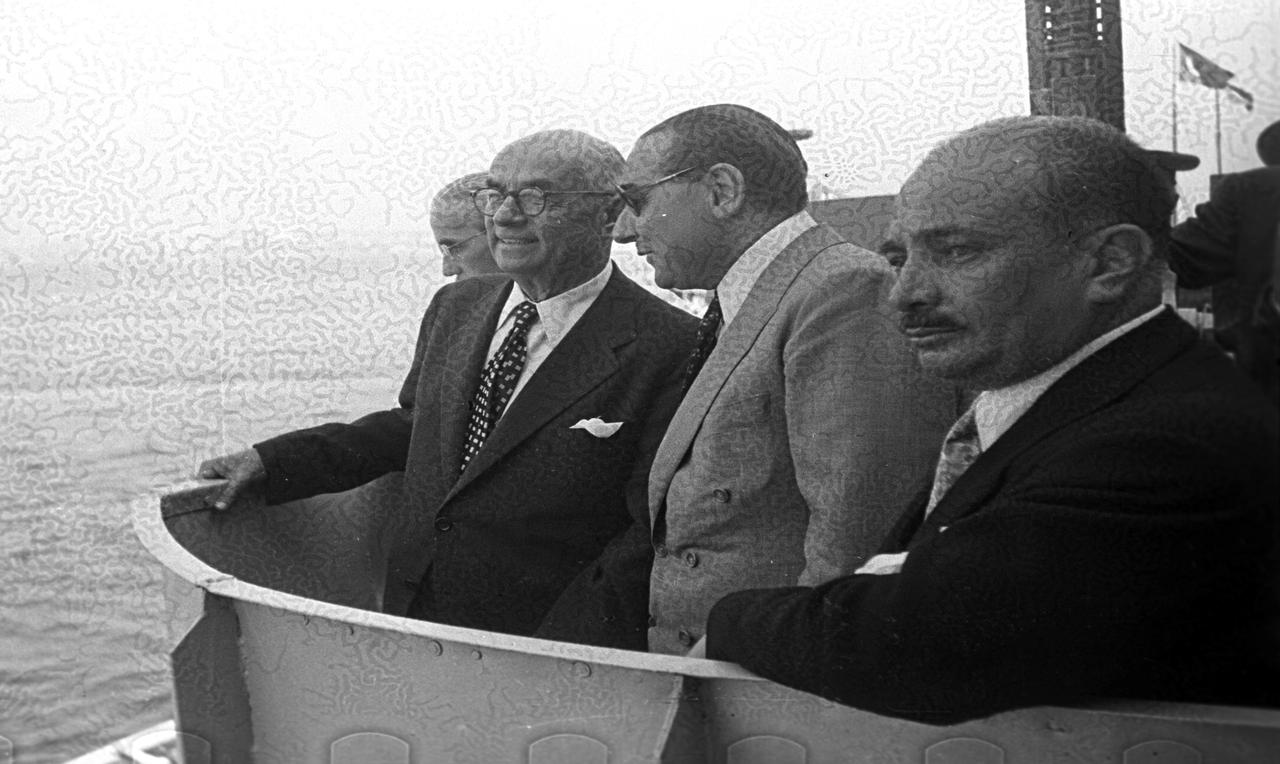
President Celal Bayar, Prime Minister Adnan Menderes, Istanbul Governor and Mayor Fahrettin Kerim Gökay, and the governor of Gaziantep arrived in Istanbul from İzmir (Anadolu Ajansı)
Vasıf Çınar, who had been Adnan Menderes's teacher at the İttihat ve Terakki İdadisi, described Menderes's abilities to Celal Bayar and proposed his recruitment into the CHF. Menderes avoided contact with the delegation for a week but, under the insistence of acquaintances he respected, agreed to meet with the delegation led by Celal Bayar. During the meeting, Menderes criticized financial matters, heavy taxation, deficiencies in cooperatives, and administrative shortcomings, and presented three conditions for joining the CHF: the reorganization of the party structure in Aydın under his leadership, the removal of party-appointed officials interfering in administration, and the correction of irregularities in the 1930 municipal elections. After the delegation led by Bayar accepted these conditions, Menderes and his associates joined the CHF, and Menderes was appointed as CHF Aydın Provincial President with broad authority.【26】
After the closure of the Free Republican Party, President Gazi Mustafa Kemal embarked on a national tour to assess public conditions. On Tuesday, 3 February 1931, at 15:00, he arrived in Aydın by train. Atatürk was received at the station by Aydın Governor Fevzi (Toker) Bey and Military Inspector Fahrettin (Altay) Paşa. After inspecting the Government House and Municipality, he proceeded to the political party building at around 16:00. Due to information suggesting that former FRP cadres had entered the CHF, Atatürk initially did not wish to visit the CHF provincial building, but under the insistence of Vasıf Çınar and others, he agreed to a brief five-minute visit. In the provincial building, CHF Aydın Provincial President Adnan Menderes, along with seven Provincial and seven District Administrative Council members, welcomed Atatürk. Initially, Atatürk refused even the offered cigarettes and coffee, but a direct conversation with Menderes on Aegean agriculture, cotton production, exports, industrialization, cooperatives, and credit facilities quickly deepened. The planned five-minute visit lasted four hours, during which Atatürk consumed four cups of coffee and smoked several cigarettes.【27】
After the visit, Atatürk assessed Menderes to CHP General Secretary Recep Peker as: "A promising young man, but he cannot work with our party-appointed officials." The next day, on his return to Denizli, Atatürk requested that Menderes prepare a detailed report on Turkish Hearth organizations, agriculture, and cooperatives to be delivered to him.【28】
Following Atatürk's tour and a decision by the CHP General Assembly on 5 March 1931, new elections for the TBMM were scheduled. Although nearly 6,000 candidates applied to the CHP Central Committee, there was no formal nomination application from Menderes. Atatürk's positive impression of Menderes during his visit to Aydın, Celal Bayar's favorable reports, and the initiative of Dr. Tevfik Rüştü Aras, Minister of Foreign Affairs and husband of Menderes's aunt, led to Menderes being personally included on the CHP Aydın deputy candidate list by Atatürk's direct order.【29】 Menderes learned of his nomination the next morning from friends and newspaper reports.【30】 In the 1931 general elections conducted under a two-tier system, he was elected as a deputy for Aydın in the IV. Term of the Grand National Assembly and moved to Ankara to begin his duties as a deputy.
Adnan Menderes entered the Assembly in 1931 as a deputy from Aydın in the IV. Term and was continuously re-elected by majority vote in the 1935, 1939, and 1943 general elections, serving as a CHP Aydın deputy for a total of 14 years across the IV., V., VI., and VII. Terms. His first parliamentary role was on the Petition Commission (İstida Encümeni), which reviewed citizens' complaints, requests, and petitions. Later, he served as a member and rapporteur (mazbata muharriri) on the Finance and Agriculture commissions, gaining authority to audit ministries' budgets and internal organizational structures.
While serving as a deputy, to address his educational deficiencies, he was admitted without examination to Ankara Law Faculty on 18 December 1932 with registration number 1795. After three years of daytime student studies, he graduated on 2 November 1935 with diploma number 791 as the seventh graduate of the faculty.
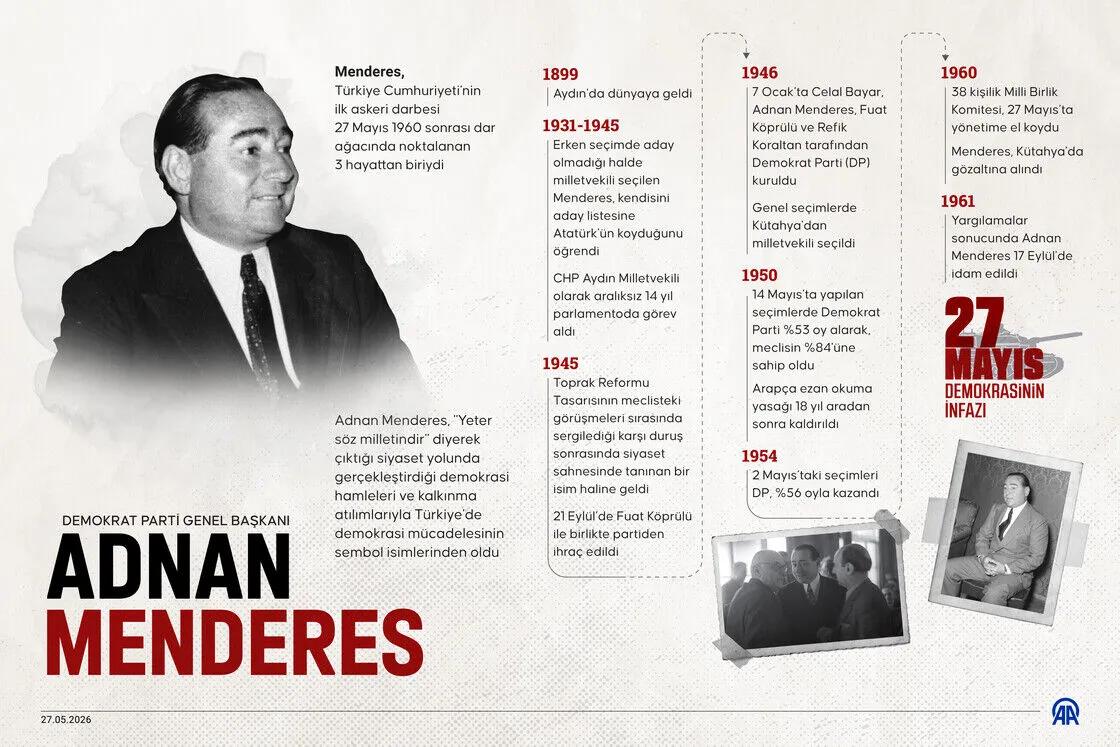
Adnan Menderes İnfografiği (Anadolu Ajansı)
In addition to his parliamentary duties, Menderes participated in regional and cultural activities. In 1932, he personally established the Aydın Halkevi and delivered a speech at its opening emphasizing the importance of halkevleri in social advancement. He also assumed responsibilities in sports administration, becoming General Secretary of the Turkish Sports Organization in 1936 and its Vice President in 1937. This role ended on 29 June 1938 when Law No. 3530 established the General Directorate of Physical Education, transferring autonomous sports structures to state institutions. He regularly attended CHP congresses and served as Secretary of the Regulations Commission at the Fifth Great Congress of the CHP from 29 May to 3 June 1939.【31】
In the early years of his parliamentary membership, Adnan Menderes maintained a quiet demeanor. He first spoke from the podium in his second year as a deputy, on 4 December 1933, regarding a bill on penalties for customs officials who abused their duties and accepted bribes and kickbacks. Menderes argued that bribery and kickbacks were not limited to the customs service and proposed expanding the penalty to cover all public officials. In his speech on 8 April 1935, he evaluated a decision by the Petition Commission concerning Kemal, the former director of Bozdoğan Mine, who had been dismissed, explaining that the penalty only restricted him from his current position and that the Ministry of Finance could reassign him to another administrative role. On 29 June 1938, speaking as Vice President of the Turkish Sports Organization during debates on the Physical Education Law, he clarified uncertainties regarding student participation in sports clubs.【32】
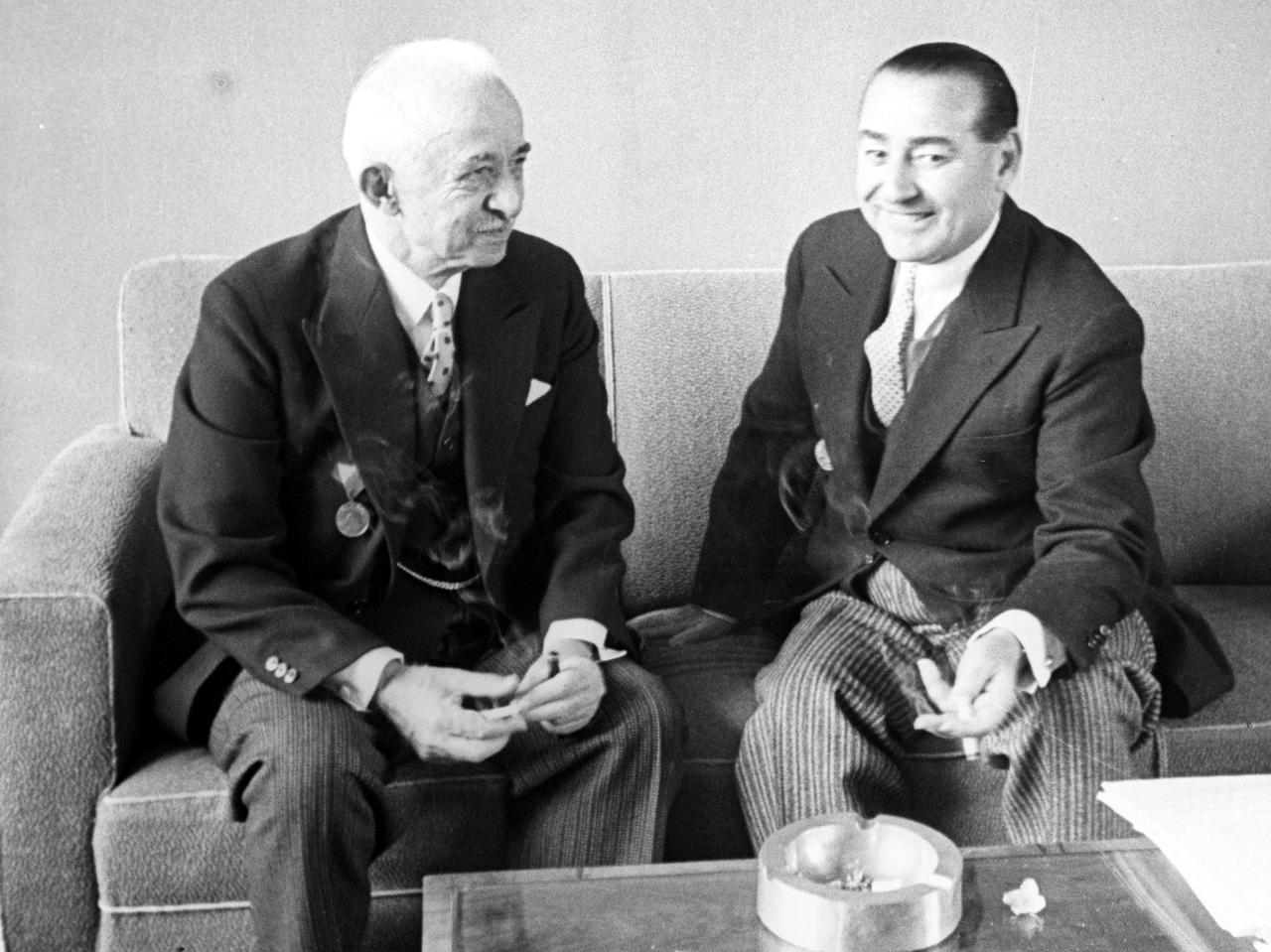
Adnan Menderes ve İsmet İnönü, 19 Mayıs Gençlik ve Spor Bayramı törenleri öncesi stadyumda sohbet etti.
During İsmet İnönü's presidency, Menderes's critical interventions on the podium increased. His speech on 29 May 1939 on the Ministry of Agriculture's budget was the first clear public criticism of the government's agricultural policies. He argued that the Ministry's 7 million lira budget was insufficient to develop national agriculture, that agricultural institutions failed to fulfill their expected duties, that mechanization in agriculture was essential, that customs duties on tractor imports should be abolished, and he presented concrete data on the seed crisis at the Nazilli Cotton Improvement Station. On 30 May 1941, he spoke on the budget of the General Directorate of Physical Education, and on 18–25 June 1941, he addressed the bill on the Protection of Agricultural Products. On 18 June 1943, during debates on the Travel Allowance Decree, he emphasized that per-kilometer travel allowances for inspectors were inadequate under wartime conditions, and on 6 December 1943, he presented his views on an additional bill to the Land Products Tax Law.【33】
Adnan Menderes's longest and most comprehensive field role within the CHP was as a Party Inspector. After graduating from Ankara Law Faculty in 1935, he was appointed by the CHP General Secretariat as inspector for a region covering Konya, Antalya, and İçel (Mersin). In the provinces he visited, Menderes examined party records, accounts, municipalities, halkevleri, and the level of implementation of reforms, preparing detailed inspection reports.
During İnönü's presidency, Menderes was appointed to the Afyon Regional Inspectorship on 7 July 1939, responsible for inspecting the provinces of Afyon, Eskişehir, and Kütahya. He intermittently visited this region along the railway line between 1939 and 1940.
Adnan Menderes was appointed rapporteur for the 32-member Joint Committee established to examine the Farmer Land Distribution Law (FLDL) bill, presented to the TBMM on 17 January 1945. During the three-month committee work, when Prime Minister Şükrü Saracoğlu intervened to amend Article 17 of the bill, mandating the expropriation of private lands exceeding 500 dönüm cultivated by their owners, Menderes protested this interference, resigned from his rapporteurship, and appended a dissenting note to the report.
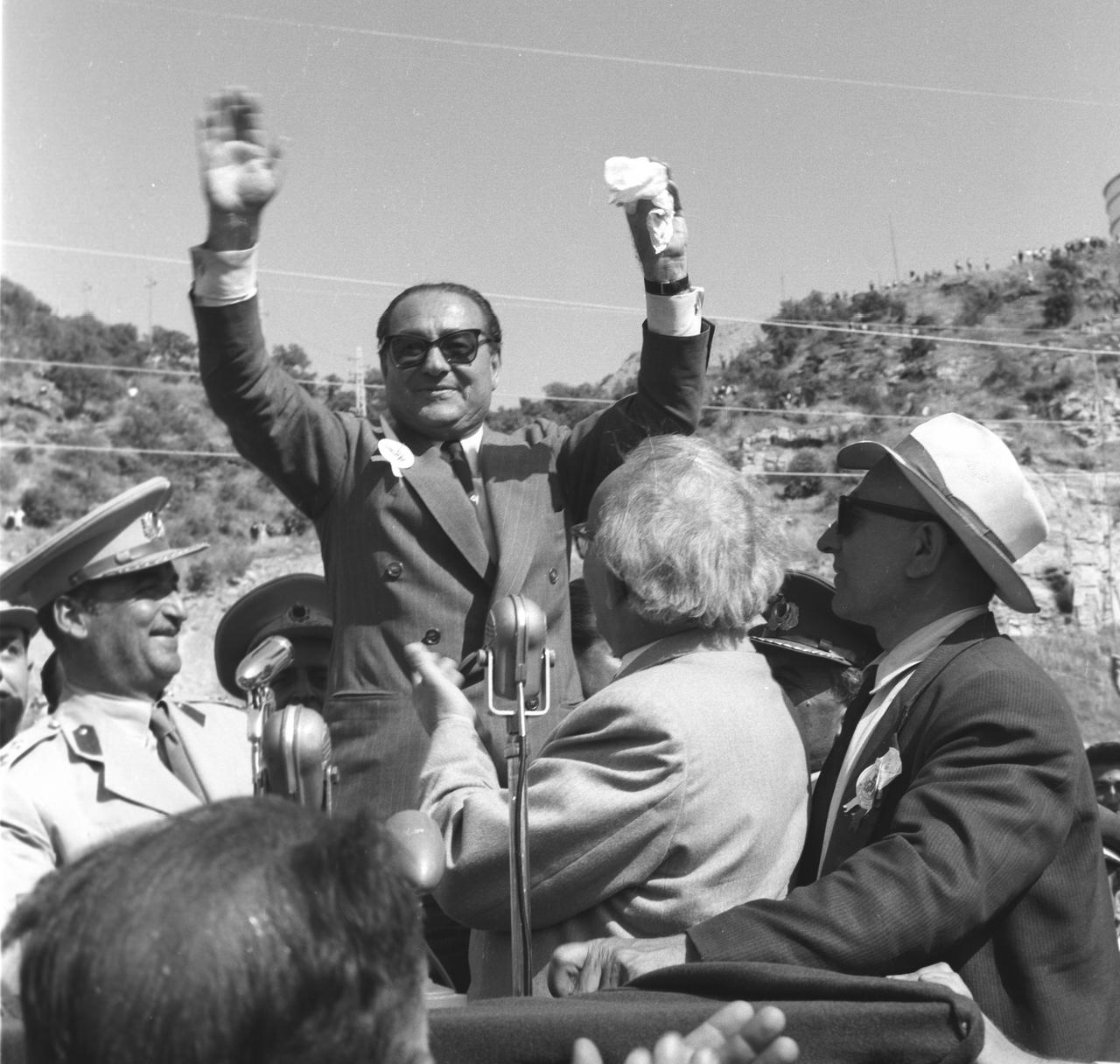
Adnan Menderes, Ege gezisinde (Anadolu Ajansı)
During the parliamentary debates in May and June 1945, Menderes conducted a systematic opposition to the bill.【41】 In his speeches from the podium, he noted that only 15% of arable land in Türkiye was cultivated, arguing that instead of expropriating private lands to settle landless peasants, unused state lands should be opened for production. He stated that dividing land into small 3–5 dönüm plots would reduce productivity and efficiency and destroy property security; he compared the bill's concept of "farmer households" to Nazi Germany's National Socialist land law, the Erbhof Law. Menderes advocated for large-scale, technologically advanced, mechanized, and cooperative-based agricultural reform. He abstained from voting on the FLDL, which was approved by majority vote on 11 June 1945.【43】
While the FLDL debates continued, during the May 1945 budget discussions, Menderes opposed the government's economic policies. From the parliamentary podium, he criticized the increase in state debt from half a billion liras in 1939 to 1.5 billion liras, the expansion of money supply, and inflationary pressures, and voted "no" in the budget vote on 29 May 1945.
Following the Allied victory in World War II and Türkiye's participation as a founding member in the United Nations San Francisco Conference, steps to strengthen the democratic system gained prominence on the agenda. President İsmet İnönü's declaration on 19 May 1945, during the Youth and Sports Day speech, that democracy would become more dominant in political life provided a morale-boosting turning point for parliamentary opposition. A dissident group, openly opposing government policies by voting "no" on the Farmer Land Distribution Law and the 1945 Budget Law, initiated a joint movement to demand reforms in statutes and laws.
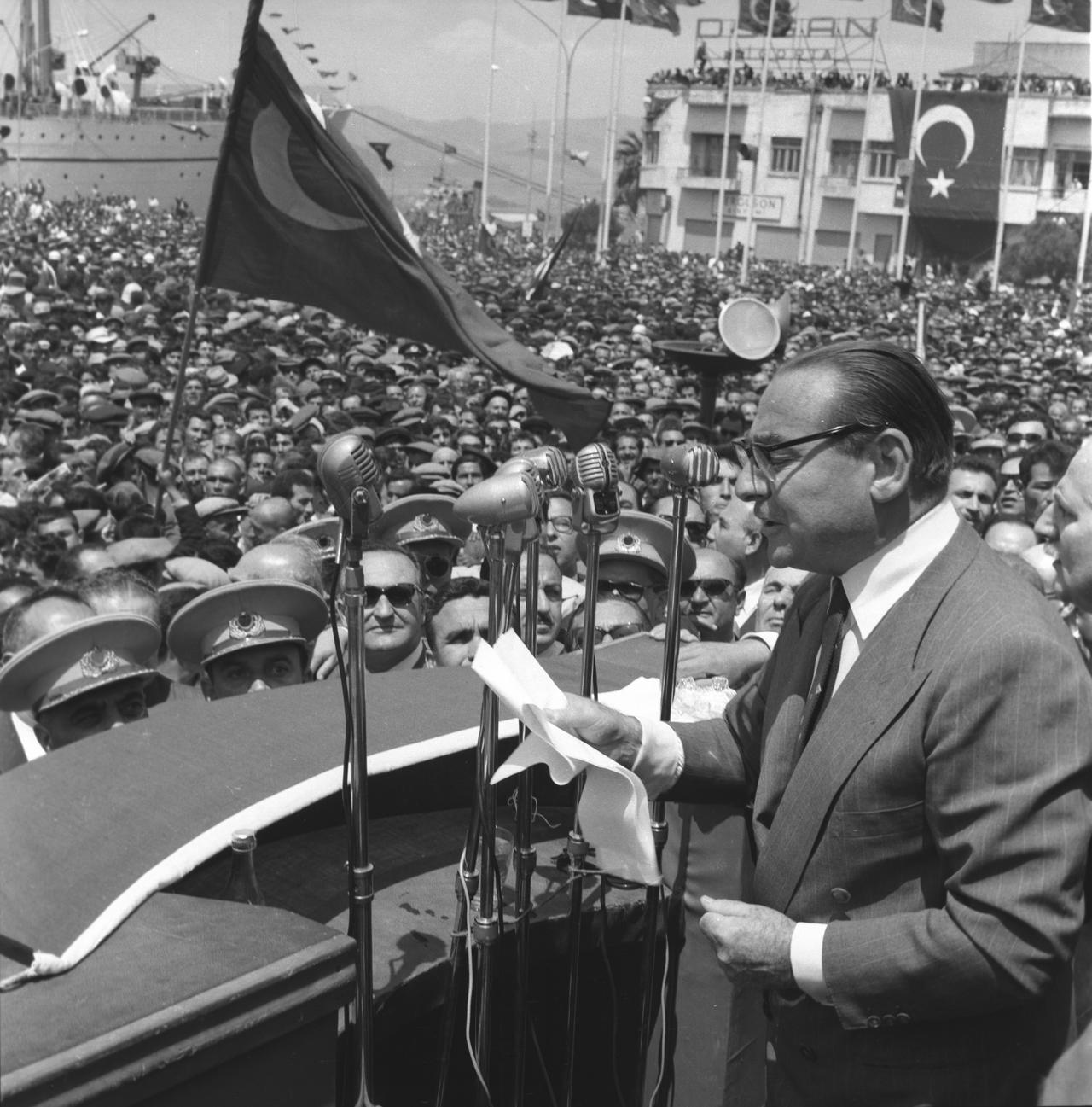
Adnan Menderes, Ege gezisinde halka hitap etti (Anadolu Ajansı)
On 7 June 1945, İzmir Deputy Celal Bayar, Aydın Deputy Adnan Menderes, Kars Deputy M. Fuad Köprülü, and İçel Deputy Refik Koraltan submitted a proposal to the CHP Parliamentary Group Presidency known as the "Four-Point Petition." The idea originated with Refik Koraltan, and the draft text was written by Fuad Köprülü.【44】 Initially, former Foreign Minister Hikmet Bayur also participated in the group, but he withdrew his signature during the signing phase.
The text of the Four-Point Petition emphasized that democracy was the fundamental principle of the Republic of Türkiye and the CHP, referencing the democratic spirit of the 1921 Teşkilat-ı Esasiye Law and the 1924 Constitution and Atatürk's goal of achieving full democracy. The three-page petition requested the acceptance of three key proposals from the CHP General Assembly:
The petitioners requested that this proposal be discussed in an open session of the party group and referred to a committee for examination.
After the Four-Point Petition was submitted to the parliamentary group, high-level meetings chaired by President İsmet İnönü at Çankaya decided to reject the petition. On Tuesday, 12 June 1945, the CHP Parliamentary Group, chaired by Acting Speaker Kâzım Özalp, held a closed-door meeting instead of the petitioners' request for an open session. During the seven-hour uninterrupted group discussions, the petitioners were harshly criticized for undermining party discipline and creating division.
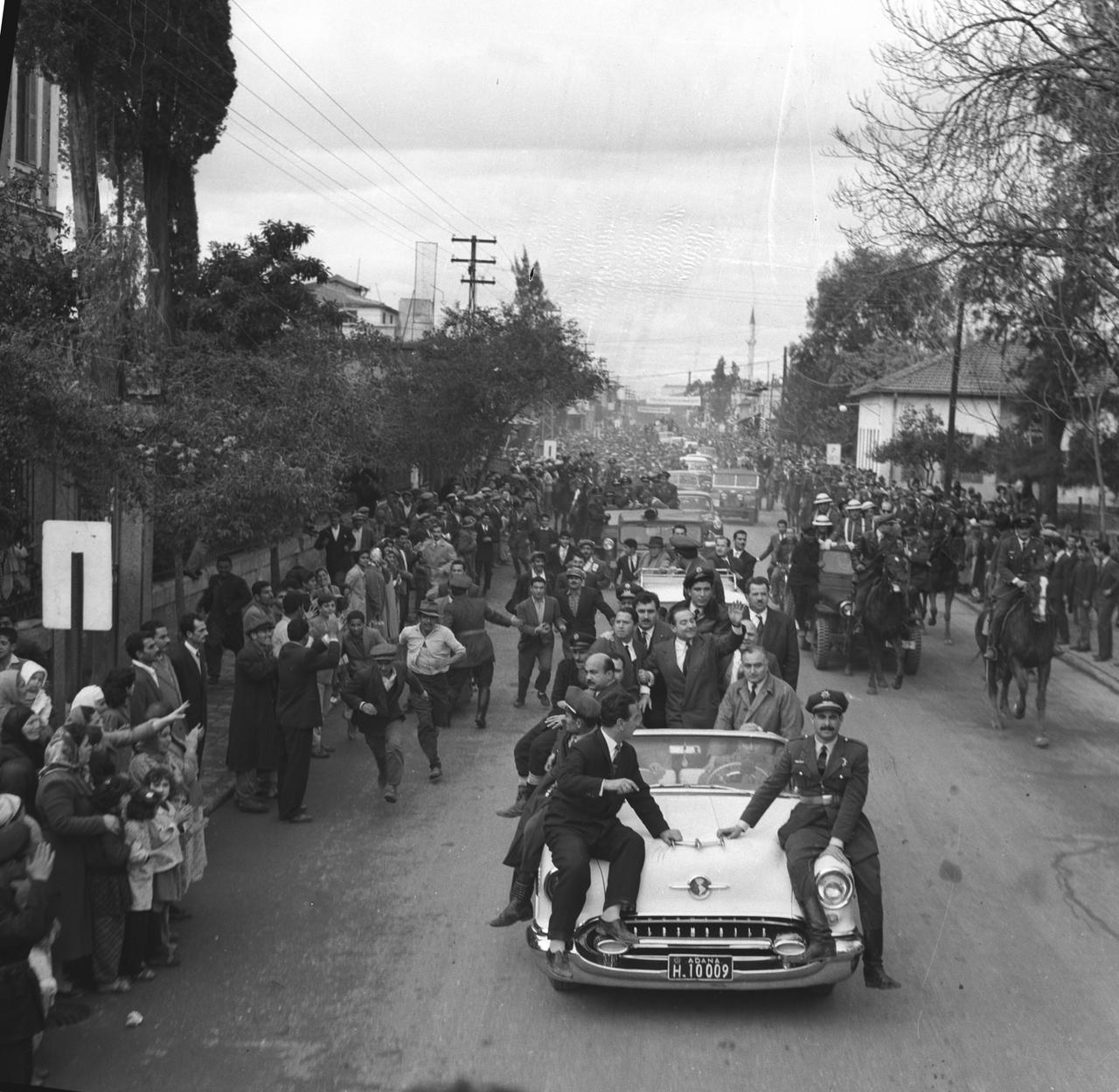
Adnan Menderes's visit to Adana (Anadolu Ajansı)
Refik Koraltan spoke first on behalf of the petitioners, followed by Adnan Menderes, who defended himself against the criticisms. Celal Bayar described Menderes as: "During these negotiations, I recognized another strong side of Adnan Menderes. He did not tire under attacks, did not lose his composure, and deflated the glittering balloons of demagogic statements with a single sentence." 【46】
When Fuad Köprülü rose to withdraw the petition during the discussions, Celal Bayar intervened, sat him down, and declared: "We are not people who withdraw petitions we have given." 【47】
At the end of the session, Prime Minister Şükrü Saraçoğlu rose to the podium and stated that no democratic reform was needed in the regime or party, as the party already rested on democratic principles, and requested the petition's withdrawal. When the petitioners refused to withdraw it, Saraçoğlu instructed the deputies present to vote against it. In the vote, the Four-Point Petition was rejected unanimously by all members of the CHP group except the four signatories (Bayar, Menderes, Köprülü, Koraltan). The official CHP communiqué publicly announced that the petition was rejected because constitutional amendments belonged to the general assembly and party statute changes to the party congress.
After the group's rejection of the Four-Point Petition, tensions within the parliament escalated, and opposition views were transferred to the public through the press. In the semi-official CHP newspaper Ulus, chief columnist Falih Rıfkı Atay defended single-party rule and criticized the petitioners in articles titled "Sunday Talk," "A Ridiculous Blackmail," and "A Criticism of Criticisms." Fuad Köprülü responded to Atay in the newspaper Vatan, edited by Ahmet Emin Yalman, with articles titled "Let Us Speak Openly!" and "The Hypocrite's Candle," criticizing the repression in parliament.【48】
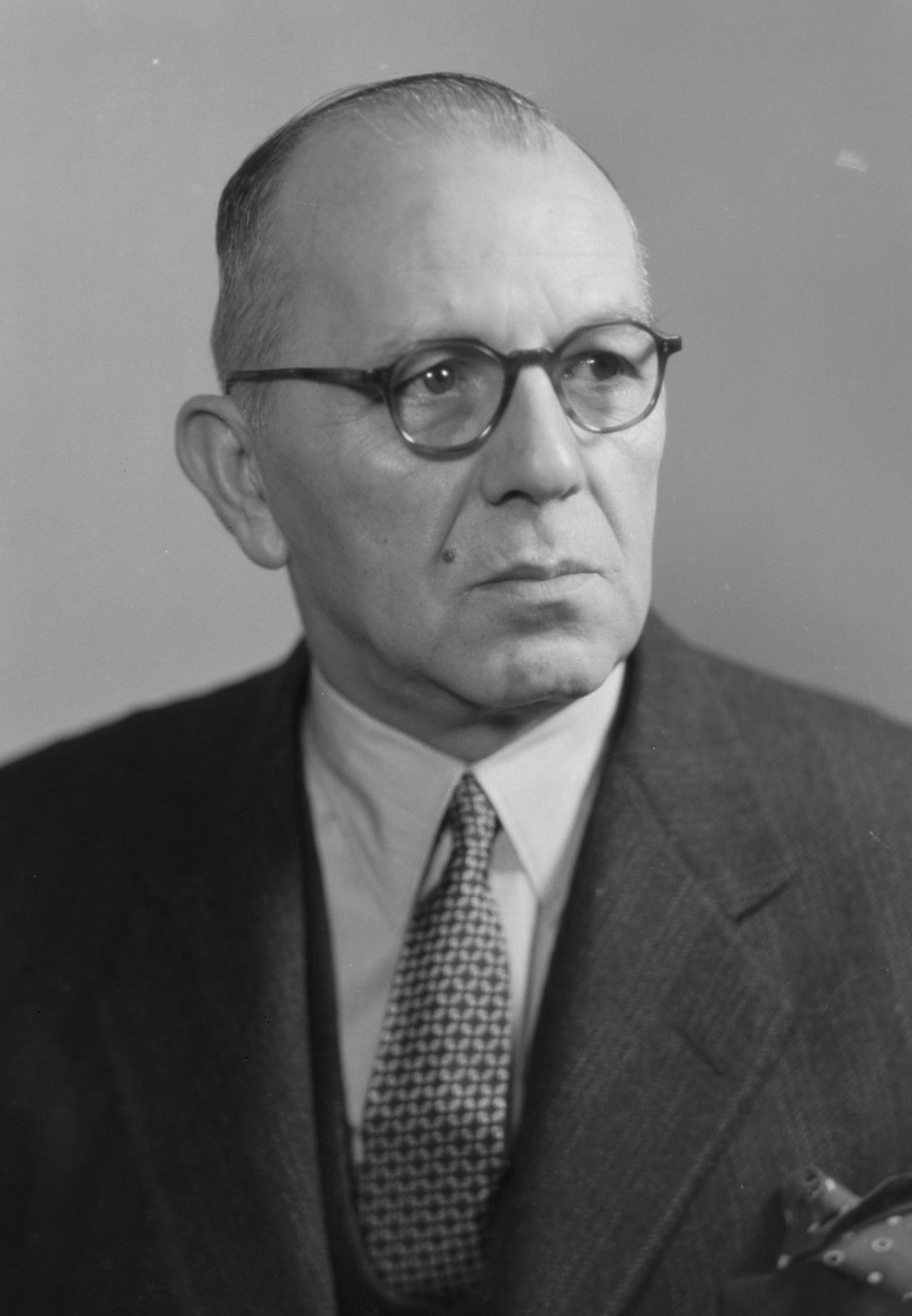
Şükrü Saraçoğlu (Anadolu Ajansı)
To quell the intense polemics in the press, Prime Minister Şükrü Saraçoğlu held a press conference on 5 September 1945 at the Ankara Anadolu Club. In his statement, Saraçoğlu affirmed that the government had taken democratic steps and criticized the harsh debates in the press.
In response to Prime Minister Saraçoğlu's statement, Adnan Menderes published his first two newspaper articles on 13 and 14 September 1945 in the Vatan column "Ideas and Criticisms," titled "The Prime Minister's Statement." In his article, Menderes criticized the Prime Minister's statements on democratization, arguing that democracy was not merely about press freedom or individual security, but fundamentally depended on citizens' political rights and freedoms and free elections based on free will.【49】
Due to Menderes and Köprülü writing articles against the government and party in the opposition newspaper Vatan, the CHP General Administrative Council met on 6 September 1945 and decided to open a disciplinary investigation against the two deputies. CHP Acting General Secretary Nafi Kansu sent letters to Adnan Menderes on 6 September and to Fuad Köprülü on 11 September, requesting an explanation of their actions and written defenses.【50】
In his written defense submitted to the CHP General Secretariat on 13 September 1945, Adnan Menderes stated that he had not violated party statutes or programs and that his conduct as a deputy was in the best interests of the country and the party. Menderes stated that his writings in Vatan and his speeches in parliament were based on the fundamental freedoms outlined in the Four-Point Petition. Fuad Köprülü also noted in his defense that he had been compelled to defend himself against the slander in Ulus and that his views were not contrary to party principles.【51】
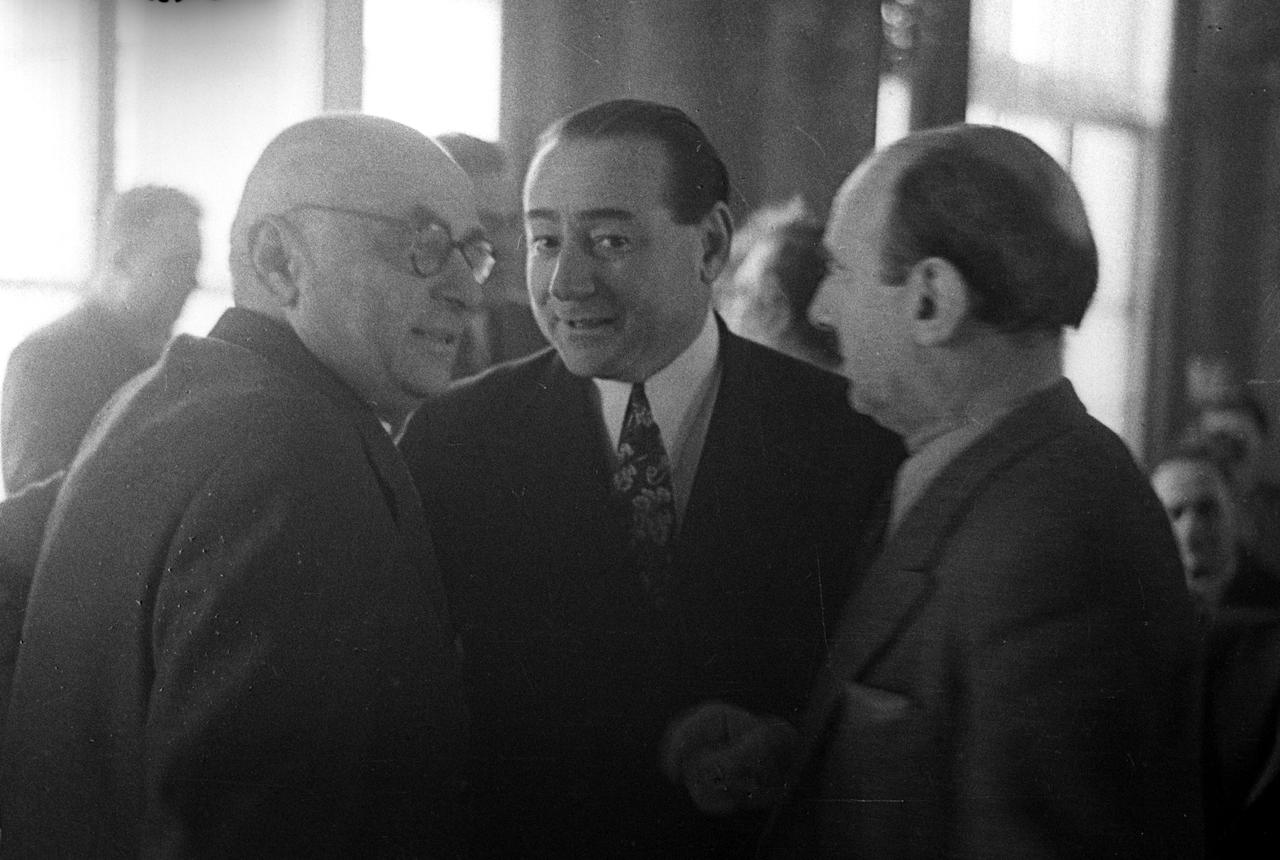
President Celal Bayar (left), Prime Minister Adnan Menderes (center), and Foreign Minister Fuat Köprülü (right), in Kayseri (Anadolu Ajansı)
The CHP General Administrative Council found Menderes and Köprülü's defenses inadequate on 19 September 1945, determined that both had conducted a systematic political struggle in parliament, the group, and the press since the Four-Point Petition, created division within the party, and violated Articles 147, 148, and 149 of the party statute, and referred the case to the Party Court with a request for expulsion.
On Friday, 21 September 1945, at 17:00, the CHP Party Court, chaired by Prime Minister and Acting Party President Şükrü Saraçoğlu, reviewed the documents and concluded that the actions and activities of Aydın Deputy Adnan Menderes and Kars Deputy Fuad Köprülü were contrary to the CHP's actions and activities. The Court, under Articles 147, 148, and 149 of the Statute, decided by unanimous vote to expel Adnan Menderes and Fuad Köprülü from the CHP (terminate their membership). The expulsion decision was announced on radio that same evening and on the front pages of newspapers the next day. After the expulsion decision, Menderes told journalists that his struggle for freedom and democracy would continue regardless of whether it was inside or outside the party.【52】
In protest against the expulsion of Menderes and Köprülü, the other signatories of the Four-Point Petition also severed ties with the CHP. İzmir Deputy Celal Bayar submitted a petition to the TBMM Presidency on 26 September 1945, resigning from his deputyship on 28 September 1945, and formally left the CHP on 3 December 1945.【53】 The fourth signatory of the Four-Point Petition, İçel Deputy Refik Koraltan, was expelled from the CHP on 19 December (some records state 27 November) 1945, citing his criticisms of the treatment of his colleagues. Thus, the cadre known as the "Four" completely left the CHP.
With the completion of their departure from the CHP, efforts to establish a new political party accelerated. Celal Bayar, Adnan Menderes, Fuad Köprülü, and Refik Koraltan held regular meetings, mostly at Adnan Menderes's home in Ankara and in the apartment of Antalya Deputy Cemal Tunca, to prepare the party's statute and program. After President İsmet İnönü's 1 November 1945 opening speech of the Assembly, in which he stated the need for an opposition party in parliament, and after his agreement with Celal Bayar at Çankaya, stipulating loyalty to the regime, revolutions, and foreign policy principles, a legal process was initiated.
In preparing the party statute and program, Adnan Menderes sought to translate the demands of peasants, artisans, and merchants into statute articles in accordance with liberal principles. After completing the statute work, on Monday, 7 January 1946, Refik Koraltan, on behalf of the founders, submitted a petition for establishment to the Ministry of Interior, delivering it to Interior Minister Hilmi Uran, and the Democratic Party (DP) was officially established.【54】 The party's headquarters was designated as an apartment in Ankara Yenişehir Sümer Street owned by Cemal Tunca.【55】
At the first press conference held at the party headquarters on the evening of 7 January 1946, Celal Bayar announced the party's program, consisting of 85 articles, to the public. During the meeting, when a journalist asked, "Is your party right or left?", Celal Bayar replied: "Our party is democratic." Sitting beside him, Adnan Menderes completed this statement by saying: "You define the position of the People's Party; let us define our own position accordingly."【57】 Menderes made the following assessment regarding the founding of the party:
"Today, the Democratic Party has been officially established. A completely new chapter is opening in Turkish political life. This date will be an unforgettable milestone for future generations. The dominance of the single-party-single-leader system will not only break out of the narrow confines of our state life but will also allow our nation to freely enjoy the vast horizons of democracy, which it has long yearned for. Our country needs development and economic growth. Democracy and development will be the two fundamental philosophies of the Democratic Party. I hope that this party, of which I am the founder, will continue indefinitely in our political life. My most sincere wish is that future leaders of this party will always keep the '1946 spirit' alive and alert in their memories."【58】
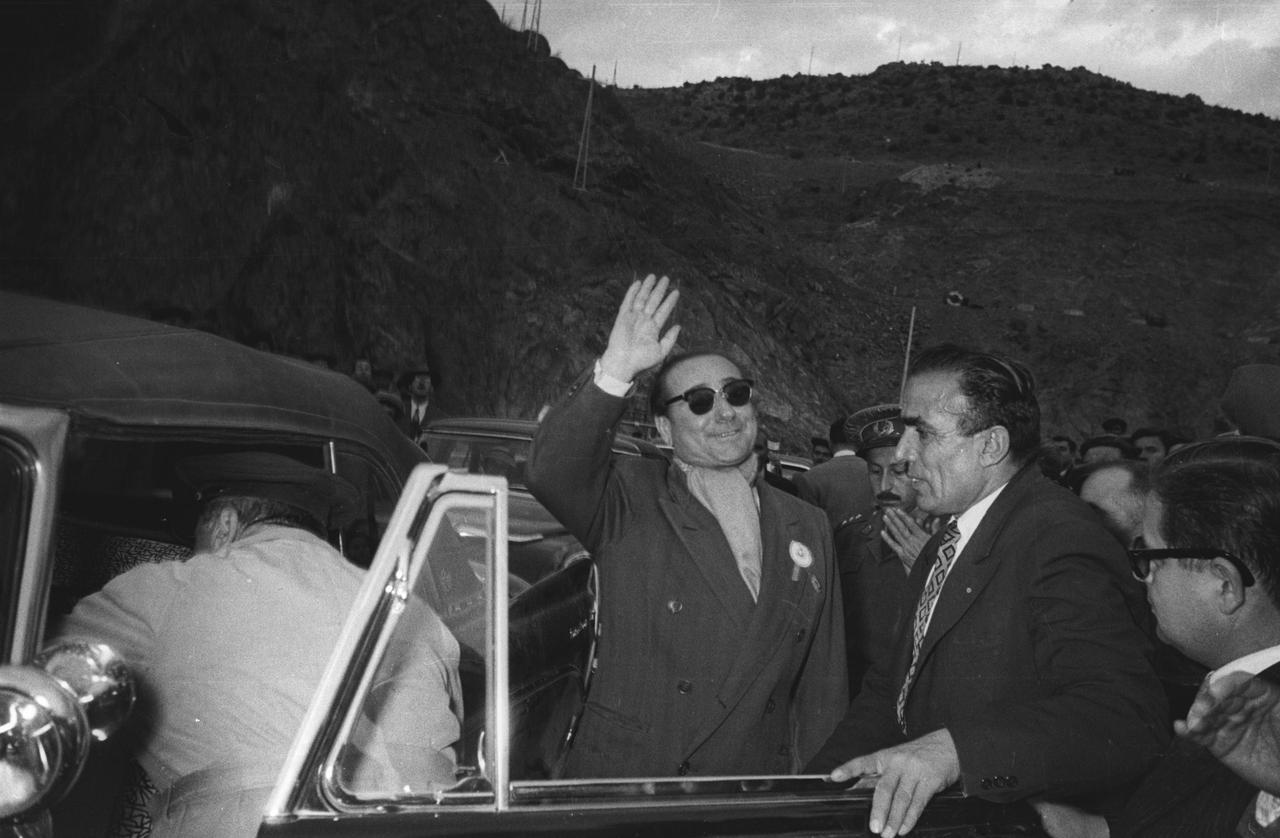
Başbakan Adnan Menderes, Sarıyar Barajı Hidroelektrik santralinin açılış törenine katıldı (Anadolu Ajansı)
At the founding committee meeting on 8 January 1946, Celal Bayar was elected General President by unanimous vote. In a secret ballot, Adnan Menderes, Fuad Köprülü, Refik Koraltan, and Cemal Tunca were elected to the General Administrative Council, and Adnan Menderes was appointed Party Spokesperson.
The Democratic Party's 85-article program included adherence to Atatürk's principles, liberal and pluralistic democratic understanding, parliamentary oversight, judicial independence, a single-tier election system based on secret ballot and open counting, reduction of bureaucratic burdens on the state, encouragement of private enterprise, granting workers the right to strike, and protection of religious and conscience freedoms. The Democratic Party quickly became known in public and the press by the symbol "Demir Kırat"; upon the founders' request, the TBMM allocated the first group room for the opposition.
Immediately after the official establishment of the Democratic Party on 7 January 1946, the founding group initiated organizational activities. The Republican People's Party parliamentary group met on 26 April 1946 and decided to prioritize local elections, announcing this decision via official notice. The DP administration viewed the early elections as an unfair competitive maneuver and decided not to participate in the municipal elections held in May 1946. On 31 March 194
AdnanMenderes Üniversitesi. "Adnan Menderes Kimdir ?" Accessed September 14, 2026.https://www.adu.edu.tr/tr/adnan-menderes-kimdir
Akdeniz, Sedat. “Adnan Menderes Dönemi Türkiye-Suriye İlişkileri (1950–1960).” Master's thesis, Kahramanmaraş Sütçü İmam Üniversitesi, Institute of Social Sciences, Department of History, 2019. Accessed September 14, 2026.https://tez.yok.gov.tr/UlusalTezMerkezi/TezGoster?key=T1mWGp9MngYYkCSgiJvtVmT1mD0dc56PflIOOTSZenmdwDP4IAxKi3efpR_UtCoi
Anadolu Ajansı. “9'uncu Türkiye Cumhuriyeti Başbakanı Adnan Menderes.” Accessed September 14, 2026.https://www.aa.com.tr/tr/info/infografik/52081
Anadolu Ajansı. “Milletin adamı Adnan Menderes.” Accessed September 14, 2026.https://www.aa.com.tr/tr/info/infografik/10137
Artar, Rukiye. “Adnan Menderese Yazılan Vatandaş Mektupları.” Master's thesis, Fırat Üniversitesi, Sosyal Bilimler Enstitüsü, Tarih Ana Bilim Dalı, 2015. Accessed September 14, 2026.https://tez.yok.gov.tr/UlusalTezMerkezi/TezGoster?key=WBc656i315e2eV6-EZV1omGXwk3X6frrCHrR_Kp3Kl56CTdQ2pjinwqxWlQ1WSjU
Aslan, Düzgün. “Adnan Menderes’in Konuşma ve Demeçlerinde Tarihin Siyasal Bir Araç Olarak Kullanımı (1950–1960).” Master's thesis,Uşak Üniversitesi, Graduate School of Education, 2020. Accessed September 14, 2026.https://tez.yok.gov.tr/UlusalTezMerkezi/TezGoster?key=9MiDp3x86xrwjpi5-14w-WIs9sCqmxP21azp3r0b9UgBy-DIT3JSHVkLGeiPUJWo
Aydemir, Şevket Süreyya. Menderes’in Dramı? İstanbul: Remzi Kitabevi, 1993.
Bayar, Celal. Başvekilim Adnan Menderes. İstanbul: Baha Matbaası, 1969.
Can, Osman. “Adnan Menderes Dönemi Türk Dış Politikası ve Türkiye-Ortadoğu İlişkileri.” Master's thesis, Van Yüzüncü Yıl Üniversitesi, Institute of Social Sciences, Department of International Political Economy, 2026. Accessed September 14, 2026.https://tez.yok.gov.tr/UlusalTezMerkezi/TezGoster?key=5T1_CZ5-UGb9QCmoURec4J-CV-aWKSLWCeVErrD0tDlUEhdqcAuUts1pXiLdF2s7
Demir, Şerif. 2012. “Adnan Menderes ve 6/7 Eylül Olayları”. Recent Period Turkish Studies, no. 12: 37-63. Accessed September 14, 2026.
Demir, Şerif. “Türk Tarihi Tarihinde Adnan Menderes (1930–1960).” PhD thesis,Marmara Üniversitesi, Institute of Turkish Studies, Department of Turkish History, Department of Republican History, 2009. Accessed September 14, 2026.
Duman, Seçil. “Adnan Menderes Dönemi Gazete İncelemesi: Cumhuriyet Gazetesi Örneği.” Master's thesis,Marmara Üniversitesi, Institute of Turkish Studies, Department of Atatürk's Principles and History of Revolution, 2018. Accessed September 14, 2026.https://avesis.marmara.edu.tr/yonetilen-tez/65972040-3828-49ec-b54c-bf65ca7bba32/adnan-menderes-donemi-gazete-incelemesi-cumhuriyet-gazetesi-ornegi
Durmuş, Sevilay. 2024. “Toprak Beyi Olarak Adnan Menderes ve Çakırbeyli Çiftliğinde Etkilendiği İsimler”. Anasay, no. 27: 220–232. Accessed September 14, 2026.
Durmuş, Sevilay. “Halk Kültüründe ve Halk Belleğinde Adnan Menderes.” Master's thesis, Aydın AdnanMenderes Üniversitesi, Institute of Social Sciences, Department of Turkish Language and Literature, 2023. Accessed September 14, 2026.
Duğalı, Elif Destan. “Adnan Menderes Döneminde Türkiye’nin Balkan Devletleri ile İlişkileri (1950–1960).” Master's thesis, Bandırma Onyedi Eylül Üniversitesi, Institute of Social Sciences, Department of History, 2024. Accessed September 14, 2026.https://tez.yok.gov.tr/UlusalTezMerkezi/TezGoster?key=E_eEUHQic_C-LvhxNQn1W5BATeNfOxDEVGeoCHxTwj3P7iiRZVhb9apwY4-qv_rR
Ergun, A. Yavuz. CHP'li Menderes (1931–1945). İstanbul: Boyut Yayıncılık, 2017.
Ergun, Abdullah Yavuz. “Tek Parti Dönemi Milletvekili Olarak Adnan Menderes (1931–1945).” Master's thesis, Dokuz Eylül University, Institute of Social Sciences, Department of History, Republic of Turkey History Program, 2016. Accessed September 14, 2026.
Gök, Hacı Veli. 2024. “İslamcı Basında Adnan Menderes İmajı (1950-1954)”. Cihannüma Tarih ve Coğrafya Araştırmaları Dergisi 10, no. 1: 105-142. Accessed September 14, 2026.
Göktürk Çetinkaya, Selma. 2020. “Adnan Menderes’in Siyasal Karakteri ve 27 Mayıs”. Journal of Universal History Studies 3 (Prof. Dr. Mustafa Keskin Special Issue): 112–130. Accessed September 14, 2026.
Gönültaş, Emre, and Sami Zariç. 2025. “Türkiye’de Muhafazakâr Siyasetin Kökleri: Demokrat Parti ve Adnan Menderes’in Muhafazakâr Siyaseti”. Uluslararası Yönetim Akademisi Dergisi 8, no. 2: 448–456. Accessed September 14, 2026.https://dergipark.org.tr/tr/pub/mana/article/1622142?issue_id=93131
Güneş, Müslime. 2012. “Adnan Menderes ve Halkevleri”. Çağdaş Türkiye Tarihi Araştırmaları Dergisi 12, no. 25: 141-155. Accessed September 14, 2026.
Irmak, Özge. “Adnan Menderes’in Yurt Dışı Gezileri.” Master's thesis,İstanbul Üniversitesi, Institute of Atatürk's Principles and History of Revolution, Department of Atatürk's Principles and History of Revolution, 2009. Accessed September 14, 2026.https://tez.yok.gov.tr/UlusalTezMerkezi/TezGoster?key=UPP_Zu9isEmWGFXFCBYasY5LhkXWyIiT8WJC_nKO9xf9-rTGzLdilPHLBLPt813A
Karagöz, İkra Nur. “Adnan Menderes’in Atatürkçülük Anlayışı.” Master's thesis, Bilecik ŞeyhEdebali Üniversitesi, Graduate School of Education, Department of Political Science and Public Administration, Public Administration Program, 2025. Accessed September 14, 2026.https://tez.yok.gov.tr/UlusalTezMerkezi/TezGoster?key=CtwiQkYvArAb95Ufpfs_vlrkBzn7yQvf3zcOuUVxQKRYucblt-I7LmFfL8RJHHjp
Konca, Ömer Faruk. “Adnan Menderes’in Siyasal Yaşamı ve Kişiliği.” Master's thesis, Dokuz Eylül Üniversitesi, Atatürk İlkeleri ve İnkılâp Tarihi Enstitüsü, Atatürk İlkeleri ve İnkılâp Tarihi Anabilim Dalı, Atatürk İlkeleri ve İnkılâp Tarihi Programı, 2011. Accessed September 14, 2026.https://avesis.deu.edu.tr/yonetilen-tez/76803a88-1ab3-40fb-9fd9-889d19424a86/adnan-menderesin-siyasal-yasami-ve-kisiligi
Kımış, Recep. “Adnan Menderes’in Seçim Konuşmaları (1954–1957).” Master's thesis, Niğde ÖmerHalisdemir Üniversitesi, Institute of Social Sciences, Department of History, 2022. Accessed September 14, 2026.
Kırmıt, Ömer Faruk. 2021. “Necip Fazıl Kısakürek’in Adnan Menderes ile Olan İlişkileri”. Mukaddime 12, no. 2: 347–379. Accessed September 14, 2026.
Kıyanç, Sinan. 2020. “Adnan Menderes, Fatin Rüştü Zorlu ve Hasan Polatkan’a İadeiitibar Süreci”. Bilecik Şeyh Edebali Üniversitesi Sosyal Bilimler Dergisi 5, no. 1: 140–162. Accessed September 14, 2026.
Sertkaya, İbrahim. Demokrasi Yolunda Bir Hayat: Adnan Menderes. İstanbul: Yağmur Yayınları, 2008.
Sitembölükbaşı, Şaban. “MENDERES, Adnan.” TDV İslâm Ansiklopedisi. Accessed September 14, 2026.https://islamansiklopedisi.org.tr/menderes-adnan
TBMM Kütüphanesi Open Access System. "Adnan Menderes, Celal Bayar, Refik Koraltan ve Demokrat Parti milletvekillerine ait resimler [Fotoğraf Albümü]." Accessed September 14, 2026.https://acikerisim.tbmm.gov.tr/items/e13d095d-1516-45fd-bb25-28edc246481a
TRT Arşiv. "Adnan Menderes." Accessed September 14, 2026.https://www.youtube.com/watch?v=jaVi0wXkSQc
TRT Haber. "Adnan Menderes Demokrasinin İdamı Yassıada'dan Yaslıada'ya." Accessed September 14, 2026.https://interaktif.trthaber.com/2018/menderes/
Tamak, Hatice. “İsmet İnönü ve Adnan Menderes Dönemi Dil veTarih Ana (1938–1960).” Master's thesis, Kırşehir Ahi Evran Üniversitesi, Institute of Social Sciences, Department of History, 2019. Accessed September 14, 2026.https://openaccess.ahievran.edu.tr/items/3b92c433-27de-4ab2-95d1-4758db0b85b4
Tuna, Hatice Burçin. “27 Mayıs İhtilali ve Adnan Menderes'in İdam Süreci.” Master's thesis, Muğla SıtkıKoçman Üniversitesi, Institute of Social Sciences, Department of Public Administration, 2019. Accessed September 14, 2026.https://tez.yok.gov.tr/UlusalTezMerkezi/TezGoster?key=vjszP7PzV0HebcjFEvDfwC5XS72o2r0RjSxm9vu7A6Uod3QFZWRy-hsyimVyT-Y7
Tuncer, Hüner. Menderes'in Dış Politikası: Batı'nın Güdümündeki Türkiye. İstanbul: Kaynak Yayınları, 2013.
Turfan, Halenur. “Türk Siyasetinde Celal Bayar-Adnan Menderes İlişkisi.” Master's thesis,Atatürk Üniversitesi, Institute of Turkic Studies, Department of History, Department of Turkish Republic History, 2024. Accessed September 14, 2026.https://tez.yok.gov.tr/UlusalTezMerkezi/TezGoster?key=htlyhJG97gjBTPjAeWRhPq58SpqVf6ylLmWA9CZFYaO4i0g6IOrM7Z3C_8-6zbHu
Türkiye Cumhuriyeti Millî Savunma Bakanlığı. "Adnan MENDERES." Accessed September 14, 2026.https://www.msb.gov.tr/Bakanlar/Detay/482ab288-387a-427c-aad5-5d4ec2836b10
Uzman, Nasrullah. 2017. “Adnan Menderes ve M. Fuad Köprülü’nün Cumhuriyet Halk Partisi’nden ihraçları”. Tarih Araştırmaları Dergisi 36, no. 62: 205-228. Accessed September 14, 2026.
Yıldız, Murat. “Türkiye’de Liberal Siyaset ve Adnan Menderes.” Master's thesis,Harran Üniversitesi, Institute of Social Sciences, Department of Public Administration, 2020. Accessed September 14, 2026.http://acikerisim.harran.edu.tr:8080/jspui/bitstream/11513/2347/1/616254.pdf
Yıldız, Turan. “Demokrasi Hayatımızda Adnan Menderes.” Master's thesis, Kahramanmaraş Sütçüİmam Üniversitesi, Institute of Social Sciences, Department of History, 2013. Accessed September 14, 2026.https://tez.yok.gov.tr/UlusalTezMerkezi/TezGoster?key=vVNzTGHHhjH-u3WMToxQ-lujyE8_qBSVjK54UaQ9voPf3HvmTOj-M-8ZfmC1_zk4
Çelik, Mustafa Edip, and Sedat Akdeniz. 2025. “Bir Seçim Kampanyasının Anatomisi: Adnan Menderes ve 1957 Seçimleri”. BELLEK Uluslararası Tarih ve Kültür Araştırmaları Dergisi 7, no. 2: 143-185. Accessed September 14, 2026.
Çetin, Gizem. “Adnan Menderes Döneminde Türkiye’nin Ortadoğu Politikası (1950–1960).” Master's thesis,Akdeniz Üniversitesi, Institute of Social Sciences, 2022. Accessed September 14, 2026.https://tez.yok.gov.tr/UlusalTezMerkezi/TezGoster?key=sELqxhTlFGAjsbjOuuiyCBVxv8nNjYmzgjSOP4lsY5fGn--jGdgM3ZBUQ3Np9usu
Ünlü, Naim Yavuz. “Demokrat Parti’nin Kurucularından Celâl Bayar ve Adnan Menderes’in Liderlikleri: İç Siyasi Olaylar Üzerinden Bir Analiz.” Master's thesis, Ankara Hacı Bayram Veli Üniversitesi, Lisansüstü Eğitim Enstitüsü, 2020. Accessed September 14, 2026.
İnan, Süleyman. “Adnan Menderes (1899-1961)” Atatürk Ansiklopedisi. Accessed September 14, 2026.https://ataturkansiklopedisi.gov.tr/detay/102/Adnan-Menderes-(1899-1961)
İnan, Süleyman. “Muhalefette Adnan Menderes (1945–1950).” PhD thesis, Süleyman Demirel University, Institute of Social Sciences, Department of History, 2002. Accessed September 14, 2026.https://www.academia.edu/3394575/Muhalefette_Adnan_Menderes_1945_1950
[1]
Rukiye Artar, “Adnan Menderese Yazılan Vatandaş Mektupları” (yüksek lisans tezi, Fırat Üniversitesi, Sosyal Bilimler Enstitüsü, Tarih Ana Bilim Dalı, 2015), sayfa no.1
[2]
Yavuz Ergun, A. *CHP'li Menderes (1931–1945)* (İstanbul: Boyut Yayıncılık, 2017), p. 19.
[3]
Turan Yıldız, “Demokrasi Hayatımızda Adnan Menderes” (yüksek lisans tezi, Kahramanmaraş Sütçü İmam Üniversitesi, Sosyal Bilimler Enstitüsü, Tarih Ana Bilim Dalı, 2013), sayfa no.11.
[4]
Sevilay Durmuş, “Halk Kültüründe ve Halk Belleğinde Adnan Menderes” (yüksek lisans tezi, Aydın Adnan Menderes Üniversitesi, Sosyal Bilimler Enstitüsü, Türk Dili ve Edebiyatı Ana Bilim Dalı, 2023), sayfa no. 40.
[5]
Yıldız, “Demokrasi Hayatımızda Adnan Menderes,” sayfa no. 11.
[6]
Rukiye Artar, “Adnan Menderese Yazılan Vatandaş Mektupları” (yüksek lisans tezi, Fırat Üniversitesi, Sosyal Bilimler Enstitüsü, Tarih Ana Bilim Dalı, 2015), sayfa no. 4.
[7]
Halenur Turfan, “Türk Siyasetinde Celal Bayar-Adnan Menderes İlişkisi” (yüksek lisans tezi, Atatürk Üniversitesi, Türkiyat Araştırmaları Enstitüsü, Tarih Ana Bilim Dalı, Türkiye Cumhuriyeti Tarihi Bilim Dalı, 2024), sayfa no.38.
[8]
Ergun, *CHP'li Menderes*, p. 19.
[9]
Yıldız, “Demokrasi Hayatımızda Adnan Menderes,” sayfa no. 12.
[10]
Artar, “Adnan Menderese Yazılan Vatandaş Mektupları,” sayfa no. 3.
[11]
Yıldız, “Demokrasi Hayatımızda Adnan Menderes,” sayfa no. 12.
[12]
Artar, “Adnan Menderese Yazılan Vatandaş Mektupları,” sayfa no. 3.
[13]
Ergun, *CHP'li Menderes*, p. 43.
[14]
Süleyman İnan, “Muhalefette Adnan Menderes (1945–1950)” (doktora tezi, Süleyman Demirel Üniversitesi, Sosyal Bilimler Enstitüsü, Tarih Anabilim Dalı, 2002), sayfa no. 20-23.
[15]
Durmuş, “Halk Kültüründe ve Halk Belleğinde Adnan Menderes,” sayfa no. 246.
[16]
Durmuş, “Halk Kültüründe ve Halk Belleğinde Adnan Menderes,” sayfa no. 39.
[17]
İnan, “Muhalefette Adnan Menderes,” sayfa no. 14.
[18]
Ergun, *CHP'li Menderes*, p. 23.
[19]
İnan, “Muhalefette Adnan Menderes,” sayfa no. 14.
[20]
Durmuş, “Halk Kültüründe ve Halk Belleğinde Adnan Menderes,” sayfa no. 50-51.
[21]
Sevilay Durmuş, “Toprak Beyi Olarak Adnan Menderes ve Çakırbeyli Çiftliğinde Etkilendiği İsimler,” Anasay, no. 27 (2024): sayfa no.226, erişim: 14 Eylül 2026. https://dergipark.org.tr/tr/pub/anasay/article/1413663
[22]
Durmuş, “Halk Kültüründe ve Halk Belleğinde Adnan Menderes,” sayfa no. 108.
[23]
Durmuş, “Halk Kültüründe ve Halk Belleğinde Adnan Menderes,” sayfa no. 160.
[24]
İnan, “Muhalefette Adnan Menderes,” sayfa no. 27-29.
[25]
Yıldız, “Demokrasi Hayatımızda Adnan Menderes,” sayfa no. 14.
[26]
Ergun, *CHP'li Menderes*, p. 33.
[27]
Abdullah Yavuz Ergun, “Tek Parti Dönemi Milletvekili Olarak Adnan Menderes (1931–1945)” (yüksek lisans tezi, Dokuz Eylül Üniversitesi, Sosyal Bilimler Enstitüsü, Tarih Anabilim Dalı, Türkiye Cumhuriyeti Tarihi Programı, 2016), sayfa no. 17-18.
[28]
Durmuş, “Halk Kültüründe ve Halk Belleğinde Adnan Menderes,” sayfa no. 61.
[29]
Ergun, *CHP'li Menderes*, p. 40.
[30]
Durmuş, “Halk Kültüründe ve Halk Belleğinde Adnan Menderes,” sayfa no. 62.
[31]
Turfan, “Türk Siyasetinde Celal Bayar-Adnan Menderes İlişkisi,” sayfa no. 55-56.
[32]
Ergun, *CHP'li Menderes*, pp. 61–62.
[33]
Ergun, *CHP'li Menderes*, pp. 151–153.
[34]
Ergun, *CHP'li Menderes*, pp. 70-71.
[35]
Ergun. *CHP'li Menderes*, pp. 96–98.
[36]
Ergun, *CHP'li Menderes*, pp. 105–106.
[37]
Ergun. *CHP'li Menderes*, pp. 123–125.
[38]
Ergun, *CHP'li Menderes*, p. 134.
[39]
Ergun, *CHP'li Menderes*, p. 129.
[40]
Ergun, *CHP'li Menderes*, pp. 119–120.
[41]
Durmuş, “Halk Kültüründe ve Halk Belleğinde Adnan Menderes,” sayfa no. 158.
[43]
Turfan, “Türk Siyasetinde Celal Bayar-Adnan Menderes İlişkisi,” sayfa no.62-63.
[44]
Nasrullah Uzman, “Adnan Menderes ve M. Fuad Köprülü’nün Cumhuriyet Halk Partisi’nden İhraçları,” Tarih Araştırmaları Dergisi 36, no. 62 (2017): sayfa no. 208, erişim tarihi: 14 eylül 2026, https://dergipark.org.tr/tr/pub/tariharastirmalari/article/602993
[45]
Uzman, “Adnan Menderes ve M. Fuad Köprülü’nün Cumhuriyet Halk Partisi’nden İhraçları,” sayfa no.209.
[46]
Celal Bayar, Başvekilim Adnan Menderes (İstanbul: Baha Matbaası, 1969), sayfa no. 19.
[47]
Bayar, Başvekilim Adnan Menderes, sayfa no. 19.
[48]
Düzgün Aslan, “Adnan Menderes’in Konuşma ve Demeçlerinde Tarihin Siyasal Bir Araç Olarak Kullanımı (1950–1960)” (yüksek lisans tezi, Uşak Üniversitesi, Lisansüstü Eğitim Enstitüsü, 2020), sayfa no.88-89.
[49]
İnan, “Muhalefette Adnan Menderes,” sayfa no. 94-95.
[50]
Uzman, “Adnan Menderes ve M. Fuad Köprülü’nün Cumhuriyet Halk Partisi’nden İhraçları,” sayfa no. 217-218.
[51]
Uzman, “Adnan Menderes ve M. Fuad Köprülü’nün Cumhuriyet Halk Partisi’nden İhraçları,” sayfa no. 218.
[52]
İnan, “Muhalefette Adnan Menderes,” sayfa no. 98-99.
[53]
Yıldız, “Demokrasi Hayatımızda Adnan Menderes,” sayfa no. 27.
[54]
Sedat Akdeniz, “Adnan Menderes Dönemi Türkiye-Suriye İlişkileri (1950–1960)” (yüksek lisans tezi, Kahramanmaraş Sütçü İmam Üniversitesi, Sosyal Bilimler Enstitüsü, Tarih Ana Bilim Dalı, 2019), sayfa no,56.
[55]
Durmuş, “Halk Kültüründe ve Halk Belleğinde Adnan Menderes,” sayfa no.72.
[57]
Artar, “Adnan Menderese Yazılan Vatandaş Mektupları,” sayfa no.18.
[58]
Artar, “Adnan Menderese Yazılan Vatandaş Mektupları,” sayfa no.18.


Adnan Menderes (AA)
Full Name | Ali Adnan Menderes | ||||||||
|---|---|---|---|---|---|---|---|---|---|
Birth | 1899 | ||||||||
Place of Birth | Aydın Sarayiçi Mahallesi | ||||||||
Father | İbrahim Ethem Bey | ||||||||
Mother | Tevhide Hanım | ||||||||
Spouse | Fatma Berrin Menderes | ||||||||
Marriage | 2 September 1928 | ||||||||
Children | Yüksel Mutlu Aydın | ||||||||
Profession | Politician Lawyer Farmer | ||||||||
Education | Ankara Faculty of Law | ||||||||
Farm | Çakırbeyli Farm | ||||||||
Entry into Politics | 1930 | ||||||||
First Political Party | Free Republican Party | ||||||||
First Political Office | SCF Aydın Provincial Presidency | ||||||||
Entry into the Grand National Assembly | 1931 | ||||||||
First Term as Member of Parliament | Member of Parliament from Aydın | ||||||||
CHP Membership as Member of Parliament | 1931–1945 | ||||||||
Democratic Party Office | Founding member Party Spokesperson | ||||||||
Start of Prime Ministership | 22 May 1950 | ||||||||
Term as Prime Minister | 1950–1960 | ||||||||
End of His Rule | 27 May 1960 military intervention | ||||||||
Place of Trial | Yassıada | ||||||||
Court | High Court of Justice | ||||||||
Death | 17 September 1961 | ||||||||
Place of Death | İmralı Island | ||||||||
Cause of Death | Execution | ||||||||
Henüz Tartışma Girilmemiştir
"Adnan Menderes" maddesi için tartışma başlatın
Family, Childhood, and Early Youth
Education and Military Service
Çakırbeyli Farm Years and Agricultural Activities
Entry into Politics: Free Republican Party and Republican People's Party Period
Founding of the Free Republican Party and Organization in Aydın
1930 Municipal Elections and Party Dissolution
Process and Conditions for Joining the Republican People's Party
Mustafa Kemal Atatürk's Visit to Aydın (3 February 1931)
1931 General Elections and Entry into the Grand National Assembly
CHP Deputy Years and Parliamentary Activities (1931–1945)
TBMM Terms, Committee Roles, and Social Activities
Speeches on the Parliamentary Podium (Atatürk and İnönü Periods)
CHP Party Inspector Roles and Inspection Reports (1935–1940)
The Farmer Land Distribution Law and 1945 Budget Discussions
The Four-Point Petition and the Founding of the Democratic Party
Preparation and Content of the Four-Point Petition (7 June 1945)
CHP Parliamentary Group Meeting and Rejection of the Petition (12 June 1945)
Opposition Through the Press and the Menderes-Saraçoğlu Debate
Disciplinary Investigation and Expulsion from the CHP (21 September 1945)
Expulsion of Refik Koraltan and Resignation of Celal Bayar
Founding Efforts, Program, and Announcement of the Democratic Party (7 January 1946)
Opposition Years and Transition to Multi-Party Life (1946–1950)
Organization of the Democratic Party and Adnan Menderes's Role as Party Spokesperson (1946)