


Bu içerik Türkçe olarak yazılmış olup yapay zeka ile otomatik olarak İngilizceye çevrilmiştir.
+1 Daha
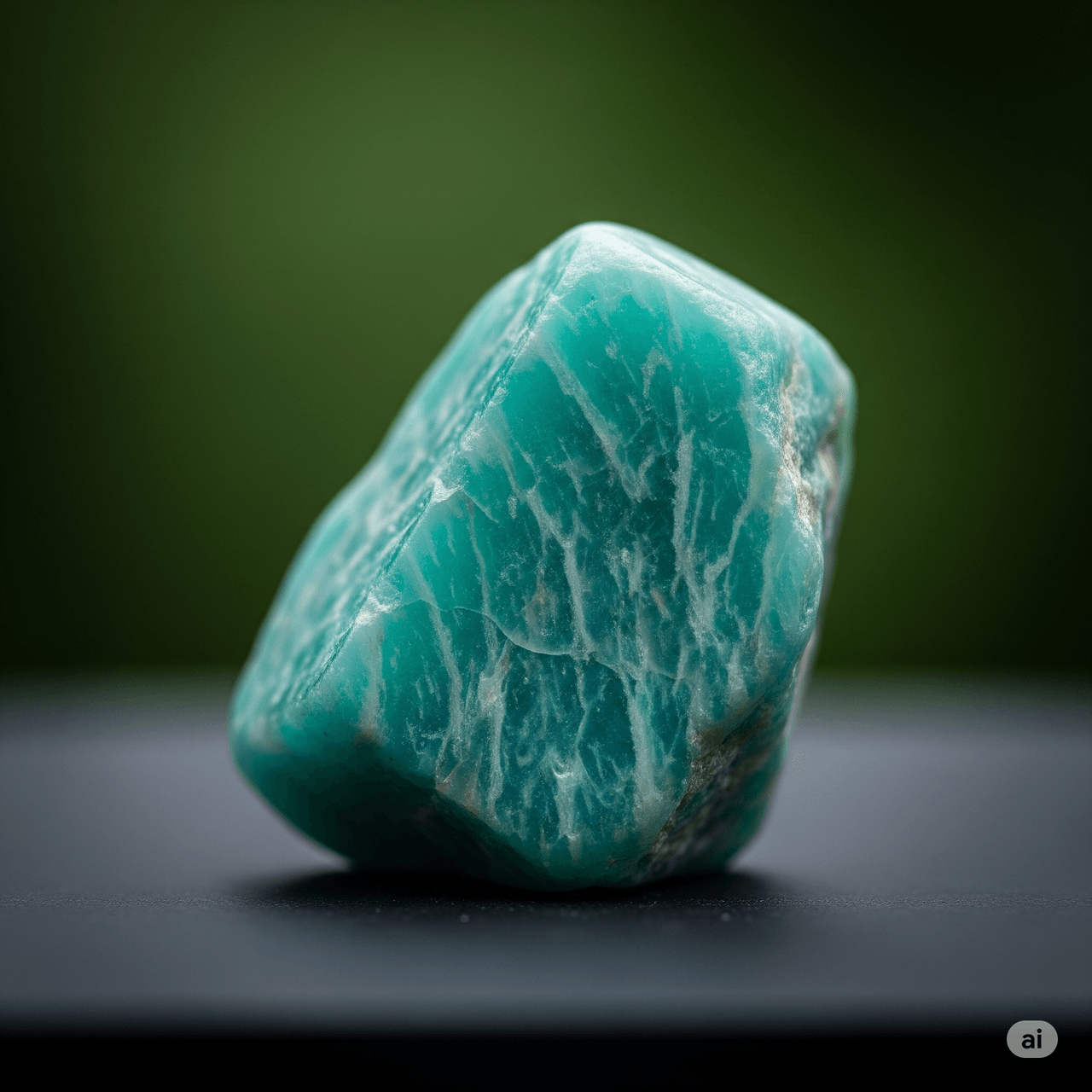
Amazonite is a mineral belonging to the feldspar group and is particularly noted for its greenish-blue tones. Amazonite has the chemical formula KAlSi₃O₈ and is a variety of microcline feldspar. Trace elements within its crystal structure, especially lead and iron, are responsible for its characteristic coloration.
Amazonite typically forms in granitic rocks known as pegmatites, where the slow cooling of the magma allows crystals to grow large enough to be visible to the naked eye. The physical and optical properties of amazonite are among the fundamental subjects of research in mineralogy and also hold significant industrial importance.
Amazonite is a feldspar mineral that crystallizes in the triclinic crystal system. Its fundamental chemical formula is KAlSi₃O₈, forming a crystal lattice through ionic bonding between potassium, aluminum, and silicon ions. Trace elements such as lead and iron within this crystal lattice are the primary cause of amazonite’s distinctive greenish-blue color.
Color variations arise from structural and chemical substitutions specific to the mineral. Partial replacement of potassium ions by other elements such as sodium or calcium can induce strain within the crystal structure, resulting in differences in color tone. This phenomenon is one of the key parameters used in mineralogy to distinguish amazonite from other minerals.

Amazonite Stone (Generated by Artificial Intelligence)
The crystal lattice of amazonite consists of cations and anions bonded by ionic bonds. This bonding structure renders the mineral both durable and optically translucent. Detailed crystal parameters of amazonite can be determined through X-ray diffraction (XRD) studies. Additionally, scanning electron microscopy (SEM) enables analysis of the distribution of constituent elements and the microfracture structure of the mineral. These analytical methods play a crucial role in understanding the geochemical and physical properties of amazonite. Within mineralogy, the structural characteristics of amazonite are classified by comparison with other feldspar types.
Amazonite exhibits birefringence, an optical property in which light travels at different speeds along different axes within the mineral, producing a double-image effect. Its refractive index ranges between 1.52 and 1.53, contributing to its bright, translucent appearance. Amazonite does not display fluorescence under ultraviolet light, a feature that aids in its differentiation from similar minerals. Light transmittance and brilliance are key properties supporting its use in jewelry.
Physically, amazonite has a hardness of 6 to 6.5 on the Mohs scale, indicating moderate durability and suitability for everyday use. Its density ranges from 2.56 to 2.58 g/cm³. Its fracture can be conchoidal or irregular; due to its tabular structure, it displays perfect cleavage in two directions, characteristic of the mineral. These cleavage properties facilitate the cutting and shaping of the stone. The structural durability of amazonite is one of the main reasons it is preferred for the production of jewelry and decorative items.
Amazonite forms in granitic pegmatite veins. Pegmatites originate from the slow cooling and crystallization of granitic magma. In this environment, amazonite crystals typically develop in large sizes and high purity. Major amazonite deposits are found in the Ural Mountains of Russia, Brazil, the United States (particularly in the states of Colorado and Virginia), and Madagascar. Specimens from these regions are in high demand on international markets due to their color quality and crystal size.

Geological Formation of Amazonite (Generated by Artificial Intelligence)
Geochimically, the presence of amazonite provides insights into the conditions of pegmatite formation. The ratios of potassium and aluminum are important parameters in the mineralogical classification of pegmatites. The economic value of amazonite is linked to its aesthetic appearance, workability, and large crystal dimensions. Its use in jewelry and decorative applications enhances its commercial value.

Henüz Tartışma Girilmemiştir
"Amazonite Stone" maddesi için tartışma başlatın
Crystal Structure and Chemical Properties
Optical and Physical Properties
Geological Formation and Economic Importance