


Bu içerik Türkçe olarak yazılmış olup yapay zeka ile otomatik olarak İngilizceye çevrilmiştir.
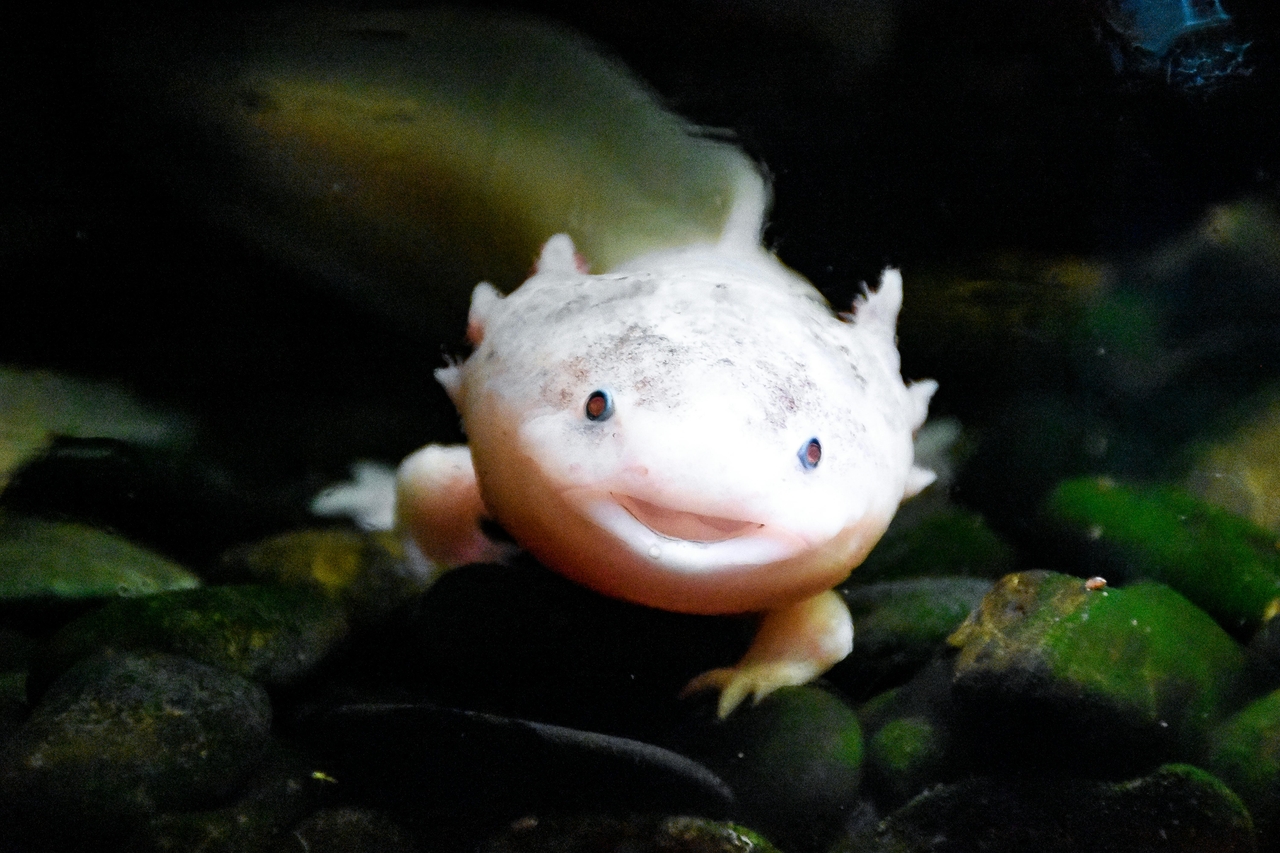
Axolotl (Ambystoma mexicanum) is a unique amphibian species belonging to the order Caudata (salamanders) and the family Ambystomatidae, endemic to Mexico. Known as “walking fish” or “water monster,” axolotls are among the rare organisms that remain in their larval stage throughout their entire lives. The species is classified as Critically Endangered.

Axolotl (Unsplash)
Axolotls are known for retaining larval characteristics even as adults. This condition is called neoteny. They continue to live in aquatic environments and breathe through external gills. These external gills appear as feathery projections on either side of the head and are distinguished by their reddish color. Their average length ranges from 15 to 25 cm, though some individuals can grow up to 30 cm. Their bodies are flattened, with long, fin-like tails.
Axolotls can also breathe using lungs and exchange oxygen through their skin. Their bodies are elongated, with a dorsal fin extending from the back to the tip of the tail, paddle-like tails, and fringed limbs. These structures provide them with strong swimming ability. In their natural habitat, their coloration is typically brown or gray; however, in laboratory settings, genetic variations have produced albino, leucistic (white with pink eyes), and golden forms.
Another morphologically distinctive feature is the permanent upward tilt of their mouths, which gives axolotls a constant “smiling” expression. In addition, their large eyes are exposed directly without eyelids. They capture prey by creating a sudden vacuum motion, making their hunting strategy highly effective.
The natural habitat of axolotls consists of the lakes surrounding Mexico City’s capital: Xochimilco, Chalco, and Chapultepec. These areas have been severely degraded due to pollution, invasive species (particularly tilapia and carp), and habitat loss. Lake Chalco has largely dried up, while Xochimilco survives only as a canal system. Lake Chapultepec is an artificial, concrete-lined lake where released axolotls have bred.
In their natural environment, axolotls are carnivorous and occupy the upper levels of the food chain. Their primary food sources include small fish, crustaceans, mollusks, insect larvae, and various invertebrates. In particular, within the Xochimilco ecosystem, they compete for food with invasive species such as tilapia and carp, disrupting their natural feeding patterns and reducing survival rates. They capture prey by suction, enabling them to rapidly and suddenly seize their targets.
Axolotls reproduce in aquatic environments, typically within a temperature range of 14–20 °C. Breeding usually begins in spring. Males perform a “courtship dance” by vibrating their tails and lower bodies to attract females. They then deposit spermatophores (sperm capsules) on the substrate. Females take up these spermatophores through their cloaca to achieve internal fertilization.
Females lay between 100 and 1,000 eggs on plant surfaces or rocky structures. The eggs hatch after approximately two weeks, and the larvae begin swimming freely. The young receive no parental care and must survive independently from birth.

Axolotls Swimming in Water (Unsplash)
The axolotl (Ambystoma mexicanum) is classified as Critically Endangered by the International Union for Conservation of Nature (IUCN). A population decline of over 80% has been observed over the last three generations (approximately 16.5 years). In the 1990s, thousands of axolotls could be found per cubic meter in Xochimilco’s canals; by 2013, surveys detected only a few individuals.
Main threats include habitat loss, urban expansion, agricultural and domestic pollution, excessive proliferation of invasive species such as tilapia and carp, and illegal pet trade. Additionally, axolotls persist in isolated populations due to the extensive drying and contamination of their habitats in Xochimilco and Chalco.
Various local and international efforts are underway to conserve this species. The Mexican government and researchers have established axolotl refuges on artificial islands called “chinampas,” which are integrated with traditional agricultural practices in Xochimilco. These structures provide safe habitats for axolotls and improve water quality, contributing to habitat restoration. Initial observations show significant improvements in water quality and increased body weight among individuals within these refuges.
The most remarkable feature of axolotls is their regenerative capacity. They can fully regenerate lost organs including the heart, spinal cord, brain tissue, eyes, jaws, and even limbs. Due to this ability, axolotls are used as model organisms in research on stem cells, tissue engineering, and organ repair.
Scientists are studying axolotls to identify the molecular mechanisms and signaling pathways involved in regeneration. In particular, experimental systems such as the “Accessory Limb Model” are used to determine which signals trigger regenerative responses at injury sites. These studies provide valuable insights into how regenerative capacity might be activated in humans.
In addition, the axolotl’s large genome (approximately 32 billion base pairs) and powerful DNA repair mechanisms make it a valuable subject in cancer research and genetic engineering.

Henüz Tartışma Girilmemiştir
"Axolotl (Ambystoma mexicanum)" maddesi için tartışma başlatın
Morphological Features and Neotenic Lifestyle
Habitat
Diet and Reproduction
Conservation Status
Role in Scientific Research