

Bu içerik Türkçe olarak yazılmış olup yapay zeka ile otomatik olarak İngilizceye çevrilmiştir.
+2 Daha
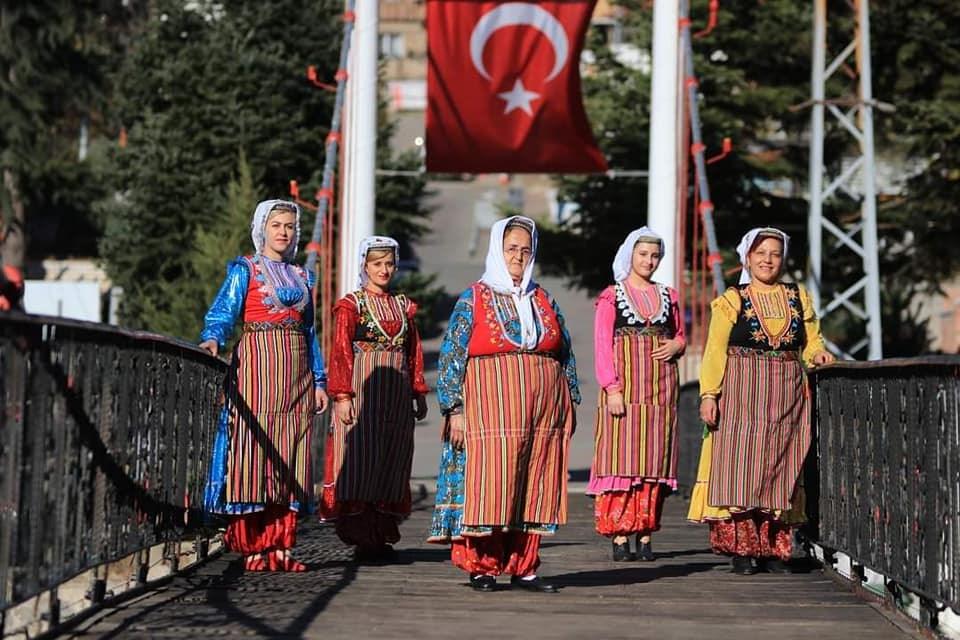
Azdavay Regional Clothing consists of traditional garments worn for centuries by women in the Azdavay district of Kastamonu Province, both in daily life and on special occasions. These garments are not merely aesthetic expressions; they constitute a cultural whole that reflects social identity, belief systems, and local craft traditions.
Registered as a geographical indication under Law No. 6769 on Industrial Property by the Turkish Patent and Trademark Office.

Azdavay Regional Clothing (Azdavay Subdistrict Office)
A headpiece made of etamin fabric and decorated with needlework embroidery. Circular and triangular etamin pieces are used in its construction. Married women fasten the takke with a patterned tülbent called “çökü”, while unmarried women use a fabric casing known as “peyik”. These headpieces serve not only decorative purposes but also convey information about a person’s civil status. The decorations on the takke include small triangular muska motifs and dotted square göz motifs, which in folk belief carry protective significance and are used to ward off the evil eye. The takke is completed with beaded tassels and braided cords, then stiffened with sugar water and dried to preserve its shape.
A cord made of glass beads that passes under the chin to prevent the takke from slipping. It is threaded either in front of or behind the ears and tied at the top of the head. It is also known locally as “çene boncuğu” or “imik bağı”.
A regional garment that extends from the waist to the ankles and covers the legs. The upper section is sewn from cotton fabric (pazen or basma), while the lower section is made from patterned synthetic fabric. Elastic bands are attached at the waist and ankles. The stitching structure and measurements are tailored to the wearer’s body. The crotch area is sewn in three sections to ensure ease of movement.

Azdavay Regional Clothing (Azdavay Subgovernorship)
Entaris reach from the waist to just below the knees, with a straight front panel and a ruffled back panel known as “sayvanlı”. Decorations are applied using sutaşı fabric of various colors along the neckline, sleeves, and hem. The fabric is synthetic and finished with buttoned or snap-fastened cuffs. Additional fabric pieces called “kuyma” are added to the sleeves to define their shape.
A traditional vest made of synthetic fabric, lined and cut short, with an open front extending down to below the chest. The sleeve openings are decorated using a printing technique called “kıvratma”, and tassels are attached at the shoulders. The vest is embellished with beaded crochet work, etamin embroidery, and ready-made appliqués. These decorations are chosen to contrast with the fabric and are typically mounted using hand stitching.
A traditional woven band worn around the waist, serving both aesthetic and functional purposes. Rectangular woven fabrics with fringed edges are produced in three sections and joined together using the “çatma” technique to form a square shape. The kuşak is wrapped so that its back portion hangs down in a triangular shape and is secured to the waist with a thin, long woven strip called “şerit”. Motifs such as the mirror cap and menük (patterned thread) are defining elements of kuşak weaving.

Azdavay Regional Clothing (AA)
A narrow weaving, 1–1.3 cm wide and 3–4 m long, used to secure the kuşak. Made from orlon yarn, it is produced using stretched warp threads and the use of wooden sticks. The patterns feature small square shapes; red and yellow dominate the color palette.
A protective textile piece, 30–40 cm wide and 110–150 cm long, woven with stripes and fastened over the dress. It is woven using the bezayağı technique, with white cotton warp threads and colorful orlon weft threads. A belt is sewn along the upper edge to secure it around the waist.

Image from the Production Process (AA)

Image from the Production Process (AA)
The production of Azdavay Regional Clothing is permitted only within the geographical boundaries of Azdavay district in Kastamonu Province. Due to its association with the region’s reputation and its reliance on skilled local techniques, production must remain confined to this area.
Monitoring is conducted at least once annually under the coordination of the Azdavay Municipality, with participation from the Azdavay District Governorate, Azdavay Community Education Center Directorate, and relevant experts. Additional inspections may be carried out at any time upon complaint. During monitoring, compliance with production methods and the correct use of the geographical indication mark are verified.

Henüz Tartışma Girilmemiştir
"Azdavay Regional Clothing" maddesi için tartışma başlatın
Garment Components and Cultural Functions
Takke
Çene İpi
Paça (Şalvar)
Entari
Delme (Yelek)
Kuşak
Şerit Dokuma
Ön Bezi
Production Techniques
Geographical Boundary and Monitoring Process