


Bu içerik Türkçe olarak yazılmış olup yapay zeka ile otomatik olarak İngilizceye çevrilmiştir.
+2 Daha
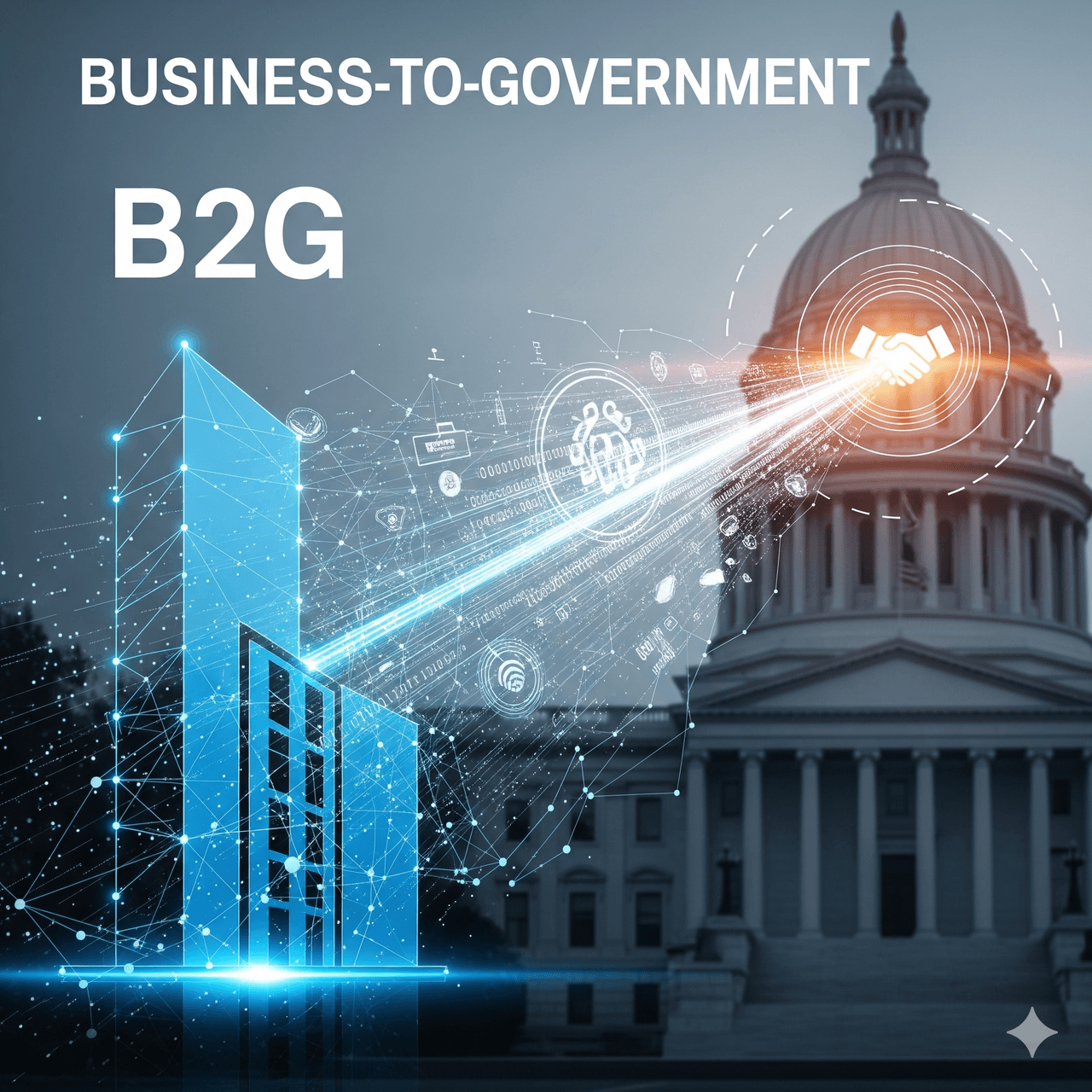
B2G Business to Government (Yapay Zeka ile Oluşturulmuştur.)
B2G (Business to Government) is a market type in which government institutions, ministries, and departments purchase products or services to meet the state’s needs within a legally defined framework of rules and procedures. Consumers in the B2G market use products not to satisfy personal needs or engage in commercial circulation, but to fulfill the state’s functions.
Significance of relations between public institutions and the business sector: Government procurement and the economic relationships within this domain hold importance for many sectors. The state and private companies interact within institutional structures where they jointly formulate and implement commercial policies.
The role of B2G in the digitalization of public services: The primary objective of the B2G market is to fulfill the state’s needs and functions. Within this scope, procurement of high-technology products and technologies enables businesses to meet these requirements. The B2G market plays a role in securing the technological infrastructure necessary for modernizing public services and resolving state functions through the private sector.
Contributions to the economy and public administration: Demand in the B2G market is derived not from individual consumer preferences but from state priorities and government spending programs. This market adds a significant volume of consumption to the economy by constituting a substantial portion of a country’s total market demand—for example, more than 10% of total demand in Russia. The state’s procurement of technology and products provides an incentive for supplier enterprises, encouraging them to enhance their product promotion and sales efforts and supporting innovation management initiatives. Furthermore, public administration is enabled to ensure the provision of necessary goods and services through budgetary institutions that meet societal needs.
Purchasing processes in the B2G market are formalized through legislative constraints and follow a multi-stage, hierarchical structure distinct from subjective evaluations. Procurements are conducted under legally established rules and procedures. The key purchasing criterion is the objective suitability of product features to the buyer’s requirements at a reasonable price. Demand in the B2G market is derived from state programs and is directly tied to the state’s spending priorities. Through its procurement of technology and high-tech products, the state supports and incentivizes businesses to operate in this field. Additionally, since B2G encompasses the supply of goods and services for resolving state functions, the design, operation, and maintenance of e-government systems and public portals require information and communication technology (ICT) services and products that are also part of B2G business models.
In the B2G market, interaction patterns differ from those in other market types. Due to intense competition, businesses must focus on rational sales approaches that emphasize the objective suitability of their product features to institutional requirements. Tender processes are formalized through legislative constraints and involve multi-stage, hierarchical procedures. Products must possess the required features and be offered at a justifiable price. Moreover, the consumer’s motivation in the B2G market is rational-personal; although decisions are based on resolving institutional tasks, the personal motivations of responsible individuals also play a role.
The intensity of innovation in the B2G market is generally assessed as medium or low. However, the state’s demand for high-tech products and technologies necessitates increased efforts by supplier enterprises in innovation management. Automation and digital transformation form the foundation of products and services procured to deliver public services and resolve state functions. These systems are part of public institutions’ digitalization needs and are included among the services and solutions supplied through the B2G market. The management of legally formalized procurement processes by institutions necessitates the adoption and procurement of such digital tools. Data privacy and security regulations in B2G relationships are integral components of the legal and regulatory framework. The state’s need to manage large-scale and sensitive data drives the procurement of cloud technologies, cybersecurity software, and services from the B2G market.
All procurement activities in the B2G market are formalized through legislative constraints and conducted under legally established rules and procedures. Since procurement processes aim to enable public institutions to fulfill state functions, legal regulations ensuring data privacy and security are of particular importance, especially in procurements involving sensitive information. The formalization of the procurement decision process, based on criteria such as rationality and objective suitability, is part of a legal framework designed to ensure transparency and accountability.
B2G procurement processes have a multi-stage, hierarchical structure. This formalized structure can lead to bureaucratic and slow decision-making. The formalization of procurement through legal constraints and the requirement for full compliance with rules and procedures constitute a complexity factor in the B2G market. Suppliers must be fully familiar with tender laws and all related regulations. Competition exists in the government procurement market. Businesses face the obligation to offer not only products that meet institutional requirements but also a reasonable price. Additionally, the potential for corruption risk arising from the personal motivations of decision-makers represents an ethical and operational risk.

B2G Business to Government (Yapay Zeka ile Oluşturulmuştur.)
Henüz Tartışma Girilmemiştir
"B2G (Business to Government)" maddesi için tartışma başlatın
Importance and Objectives of B2G
B2G Business Models and Applications
B2G Marketing and Sales Processes
The Role of Technology in B2G
Legal and Regulatory Framework in B2G
Challenges and Risks in B2G