



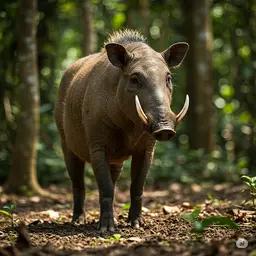
Babirusa (Babyrousa babyrussa) is a mammal species belonging to the family Suidae, endemic to Sulawesi Island of Indonesia and its surrounding islands. This genus is particularly notable for the upward-curving tusks seen in males. Babirusas inhabit tropical rainforests and are usually found alone or in small groups. The species faces threats such as habitat loss and hunting, and conservation efforts are in place to support its survival.
Babirusas are medium-sized mammals. In males, the most distinctive feature is the upper canines that grow upward, piercing through the skin and curving backward over the head. In females, these tusks are much smaller or may be absent altogether. Their bodies are generally hairless, with thick and elastic skin.
Babirusas live in the tropical rainforests of Sulawesi and neighboring islands. They prefer moist areas with dense vegetation and are often found near water sources. Their feeding habits are omnivorous; they consume fruits, leaves, roots, and small invertebrates.
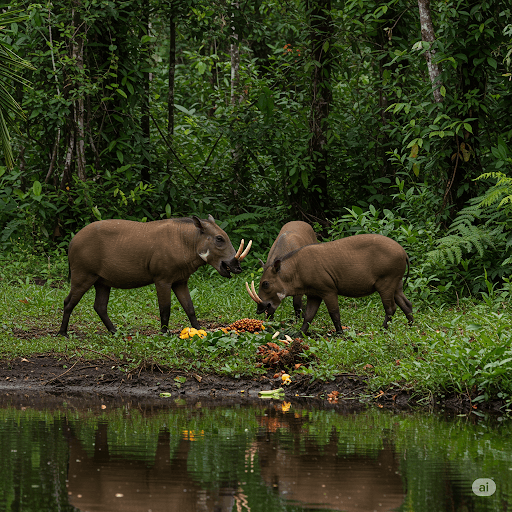
Babirusas in the Tropical Forest (Generated by Artificial Intelligence)
Babirusas are generally solitary but may occasionally form small groups. Males compete for access to females during the mating season, often using their tusks in these encounters. Their daily activities peak during morning and evening hours, and they follow established paths between resting and feeding areas.
Babirusas face threats from habitat loss, hunting, and human activities. The conversion of forests into agricultural and residential land reduces their natural habitats. Additionally, they are hunted for their meat and tusks. The International Union for Conservation of Nature (IUCN) classifies babirusas as "Endangered." Conservation efforts focus on habitat protection and regulation of hunting.
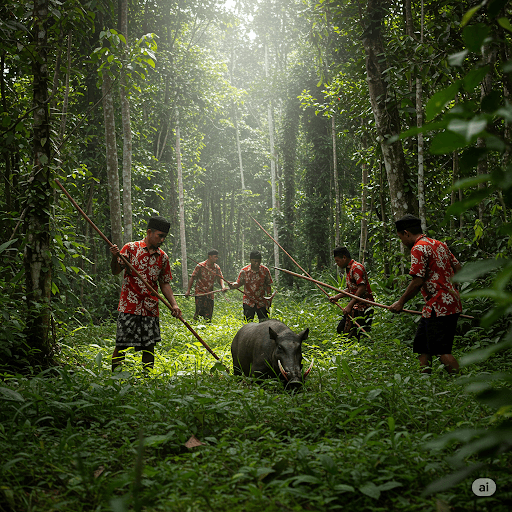
Babirusa Hunters (Generated by Artificial Intelligence)
Babirusas are hunted by local communities for their meat and tusks. In some regions, their tusks are used as ornaments or in traditional artifacts. However, with increasing conservation awareness and legal regulations, efforts to protect the species have intensified. Ecotourism and environmental education programs also contribute to the conservation of babirusas.
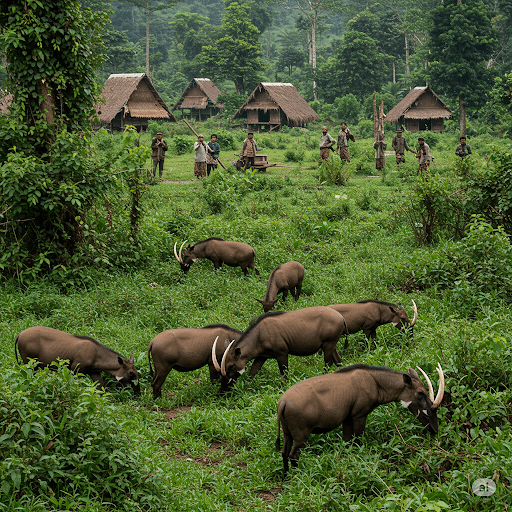
Humans and Babirusas (Created by Artificial Intelligence)
Asian Wild Cattle Specialist Group. (2013). Strategy and Action Plan for Conservation of Babirusa (Babyrousa spp.) 2013–2022. https://www.asianwildcattle.org/uploads/1/2/1/8/121825577/strategy_and_action_plan_for_babirusa_conservation_2013-2022_english.pdf
Jati, A. S., Broto, B. W., Dri, G. F., Latifiana, K., Fraver, S., Rejeki, I. S., Bustang, N., & Mortelliti, A. (2024b). Conserving large mammals on small islands: A case study on one of the world’s most understudied pigs, the Togean islands babirusa. Biodiversity and Conservation, 33(3), 1207–1223. https://doi.org/10.1007/s10531-024-02800-5
Patry, M., Leus, K., & Macdonald, A. A. (1995). Group structure and behaviour of babirusa (Babyrousa babyrussa) in northern Sulawesi. Australian Journal of Zoology, 43(6), 643–655. https://www.researchgate.net/publication/248902170_Group_Structure_and_Behaviour_of_Babirusa_Babyrousa_Babyrussa_in_Northern_Sulawesi

Henüz Tartışma Girilmemiştir
"Babirusa (Babyrousa babyrussa)" maddesi için tartışma başlatın
Morphology and Physical Characteristics
Ecology and Habitat
Behavior and Social Structure
Conservation Status and Threats
Human Interaction and Cultural Significance
Bu madde yapay zeka desteği ile üretilmiştir.