

Back to the Future (Film Series)
Genre | Adventure Comedy Science Fiction | ||||||||
|---|---|---|---|---|---|---|---|---|---|
Director(s) | Robert Zemeckis | ||||||||
Screenplay(s) | Bob Gale Robert Zemeckis | ||||||||
Producer(s) | Neil Canton Bob Gale | ||||||||
Total Budget | ~99 million USD | ||||||||
Total Box Office Revenue | ~970 million USD | ||||||||
Films | Back to the Future Part III (1990) Back to the Future Part II (1989) Back to the Future (1985) | ||||||||
Back to the Future is a science fiction-comedy film series directed by Robert Zemeckis, co-written by Bob Gale, and distributed by Universal Pictures. The trilogy's producers include Steven Spielberg, Bob Gale, Neil Canton, Kathleen Kennedy, and Frank Marshall.

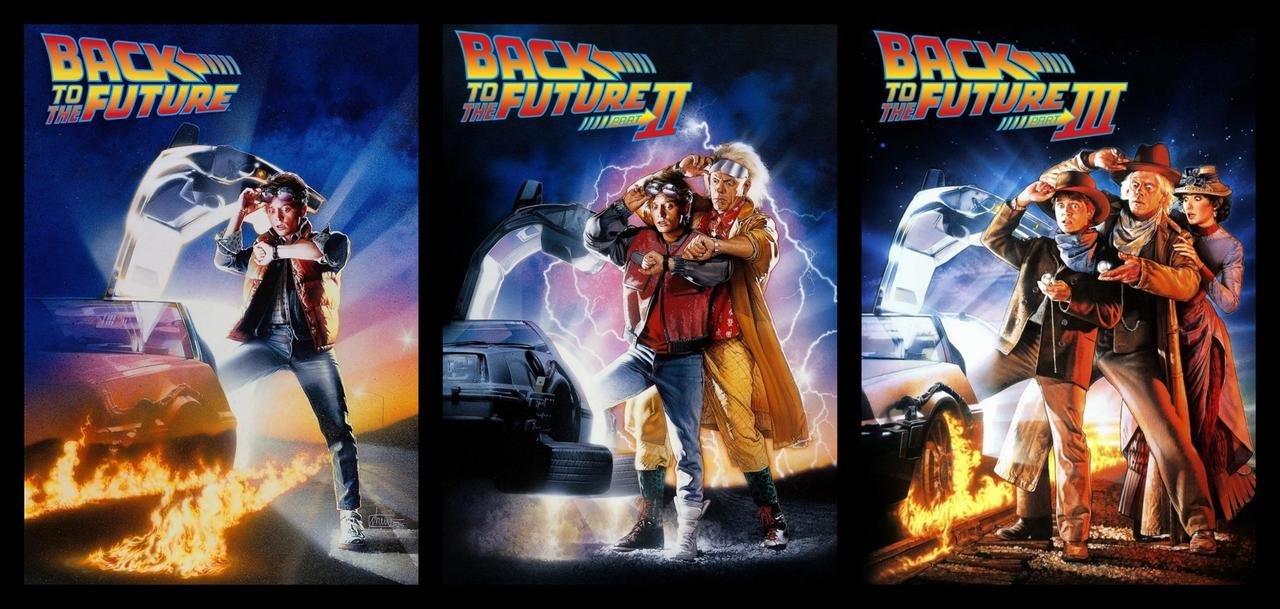
(Back to the Future movie poster - Film Art Gallery)
The series follows the friendship and time-travel adventures of high school student Marty McFly (Michael J. Fox) and the eccentric scientist Dr. Emmett "Doc" Brown (Christopher Lloyd). Time travel is made possible by a device called the "flux capacitor," invented by Doc Brown and integrated into a modified DeLorean DMC-12. Throughout the trilogy, the characters unintentionally alter the past or future, causing significant disruptions in the timeline, which they must then correct.
The first film premiered on July 3, 1985, achieving great commercial and critical success. Following its box office triumph, production for sequels began. The second film was released on November 22, 1989, and the third on May 25, 1990.
Regarded as one of the most significant time-travel-themed films in cinema history, the series is known for its blend of science fiction and comedy.
The concept for the series was conceived in 1980 by Robert Zemeckis and Bob Gale. The screenplay focused on time travel but avoided a narrative requiring extensive historical knowledge. Initially, multiple studios rejected the script.
At the beginning of his career, Zemeckis worked with Steven Spielberg, directing films such as I Wanna Hold Your Hand (1978) and Used Cars (1980). Since these films did not achieve commercial success, Zemeckis was hesitant to seek Spielberg’s backing again. However, after Romancing the Stone (1984) became a hit, Zemeckis secured Universal Pictures' investment in the project.
Initially, Eric Stoltz was cast as Marty McFly, and filming proceeded for five weeks. However, Zemeckis and Gale felt Stoltz failed to capture the character’s comedic essence and decided to replace him. They then cast Michael J. Fox, who, despite his demanding schedule on the TV series Family Ties, joined the film, working on the show during the day and filming at night. The first Back to the Future film premiered in 1985, becoming a major box office success, leading to the development of sequels.
The first film was released on July 3, 1985. Marty McFly is accidentally sent to 1955 using Doc Brown’s time machine, where he encounters his parents as teenagers. Due to an unintentional mistake, Marty's mother falls in love with him instead of his father, jeopardizing his own existence. With the help of a younger Doc Brown, Marty struggles to correct the timeline and return to 1985.

(An image from Back to the Future (1985), Marty McFly and Dr. Emmett Brown - Back To the Future Official Website)
The second film, continuing directly from the first, premiered on November 22, 1989. Marty and Doc travel to 2015 to fix an issue in the future but inadvertently alter the timeline. Biff Tannen uses a sports almanac from the future to manipulate 1985 for his personal gain, creating a dystopian reality. To restore the original timeline, Marty and Doc must return to 1955, intertwining with the events of the first film.

(An image from Back to the Future 2, Biff Tannen and friends - Back To the Future Official Website)
The final installment debuted on May 25, 1990. Doc Brown becomes stranded in 1885 and starts a new life in the Wild West. Marty learns that Doc is destined to be killed by outlaw Buford "Mad Dog" Tannen, prompting him to travel back to 1885 to save his friend. The film explores Doc Brown’s romantic relationship with teacher Clara Clayton, Marty’s survival in the Old West, and their efforts to reactivate the time machine. The series concludes with Doc and Marty returning to their respective timelines.

(Still from Back to the Future 3, Marty McFly and Dr. Emmett Brown - Back To the Future Official Website)
The trilogy explores cause-and-effect relationships and the butterfly effect, emphasizing how minor alterations in the past can lead to significant changes in the future.
The films examine the potential of scientific discoveries and the responsibilities that come with them. While Doc Brown’s time machine is a groundbreaking invention, it also serves as a tool with serious consequences.
A recurring theme in the series is the idea that individuals can shape their own destinies. The characters learn that events are not necessarily predetermined, and their choices impact their futures.
Marty frequently interacts with his family’s past, directly influencing their lives. His encounters with his parents as teenagers and his attempts to restore the timeline form a crucial aspect of the series.
The series' visual effects were produced by Industrial Light & Magic (ILM). Advanced techniques were employed, particularly for hoverboard sequences and scenes depicting Biff Tannen at various ages.
The DeLorean DMC-12 was extensively modified for its role as the time machine. The flux capacitor, depicted as the key to time travel, was an integral part of its design. The "Mr. Fusion" energy reactor on the DeLorean was modeled after a real Krups coffee grinder. Time travel sequences featured a combination of light bursts and special effects.

(DeLorean DMC-12 vehicle used as a time machine - Back To the Future Official Website)
Key locations used in the series include:
The Back to the Future trilogy is regarded as one of the important influential works in the sci-fi and comedy genres, leaving a lasting imprint on popular culture. The DeLorean DMC-12, used as the time machine, became an iconic cinematic vehicle. The hoverboard featured in Back to the Future Part II inspired real-world attempts to develop similar technology.
The series received numerous accolades and nominations:
Amazon Prime Video. "Back to the Future." Prime Video, 2025. Accessed February 19, 2025. https://www.primevideo.com/-/tr/detail/Gelece%C4%9Fe-D%C3%B6n%C3%BC%C5%9F/0TRBK6WYC48DACF77EK9MDRBTJ
American Film Institute (AFI). "Back to the Future – AFI Movie Club." AFI, 2025. Accessed February 19, 2025. https://www.afi.com/news/back-to-the-future-afi-movie-club/
Back to the Future Official Website. "Back to the Future News." 2025. Accessed February 19, 2025. https://www.backtothefuture.com/news
IMDb. "Back to the Future (1985)." IMDb, 2025. Accessed February 19, 2025. https://www.imdb.com/title/tt0088763/
MUBI. "Back to the Future." MUBI, 2025. Accessed February 19, 2025. https://mubi.com/tr/tr/films/back-to-the-future
The American Society of Cinematographers (ASC). "Back to the Future: Wheels on Fire." The ASC, 2025. Accessed February 19, 2025. https://theasc.com/articles/back-to-the-future-wheels-on-fire

Back to the Future (Film Series)
Genre | Adventure Comedy Science Fiction | ||||||||
|---|---|---|---|---|---|---|---|---|---|
Director(s) | Robert Zemeckis | ||||||||
Screenplay(s) | Bob Gale Robert Zemeckis | ||||||||
Producer(s) | Neil Canton Bob Gale | ||||||||
Total Budget | ~99 million USD | ||||||||
Total Box Office Revenue | ~970 million USD | ||||||||
Films | Back to the Future Part III (1990) Back to the Future Part II (1989) Back to the Future (1985) | ||||||||
Henüz Tartışma Girilmemiştir
"Back to the Future (Film Series)" maddesi için tartışma başlatın
Production and Development
The Films in the Series
Back to the Future (1985)
Back to the Future Part II (1989)
Back to the Future Part III (1990)
Themes and Concepts
Time Travel and Temporal Paradoxes
Technology and Science
Self-Determination
Family and Generational Relationships
Production and Filming
Special Effects and Cinematic Techniques
Filming Locations
Cultural Impact and Legacy
Awards and Achievements
Bu madde yapay zeka desteği ile üretilmiştir.