
+1 Daha

Baskil (District)
Province(s) | Elazığ | ||||||||
|---|---|---|---|---|---|---|---|---|---|
Population | 13.443 | ||||||||
Elevation(s) | 1.200 meters | ||||||||
District Governor | Muhammed Enes ÇIKRIK | ||||||||
Mayor(s) | Tuncer TURUS | ||||||||
Surface Area | 1.195 km² | ||||||||
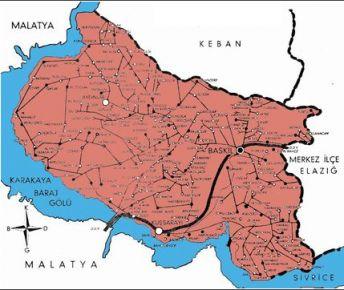
Baskil is a district in the Eastern Anatolia Region of Türkiye, affiliated with the province of Elazığ. It is located approximately 38 kilometers from the city center of Elazığ. The district is accessible by both road and railway. Situated along the banks of the Euphrates River, Baskil spans a 118-kilometer shoreline around the Karakaya Dam Lake. The district is bordered by Keban to the north, the districts of Kale, Pütürge, and Battalgazi in Malatya Province to the south, Yazıhan and Arguvan to the west, the city center of Elazığ to the east, and Sivrice to the southeast. Notable mountains in the district include Piran, Hasan, Karga, Bulutlu, and Muşar. According to 2024 data from TÜİK (Turkish Statistical Institute), its population is 13,443.
The history of Baskil dates back to the Neolithic Age. Excavations and surface surveys in the region have revealed traces of settlement dating to the Paleolithic and Mesolithic periods. Archaeological mounds such as Caferhöyük, Değirmentepe, İmikuşağı, and Köşkerbaba have yielded artifacts from the Neolithic, Chalcolithic, Bronze, Iron Ages, as well as from the Hellenistic, Roman, Byzantine, and Ottoman periods. During the Hittite era, the area referred to as "Işuwa," which included Harput and its surroundings, also covered Baskil. The region held strategic importance during the Urartian, Roman, and Byzantine periods and came under Islamic rule in the 7th century. After the Battle of Manzikert in 1071, the area came under Turkish control and was governed by various Turkic-Islamic states such as the Çubukoğulları, Artukids, Seljuks, Dulkadirids, Akkoyunlus, and Safavids.
During the Ottoman period, the region was administratively divided into various subdistricts under the sanjaks of Harput and Malatya. In 1926, under the administrative organization of the Republic of Türkiye, it gained district status under the name Baskil. The district's name derives from the “Baskil tribe,” a subgroup of the Herdi tribe. The former village of Baskil (now called Eskibaskil) was the first settlement of the district.

Mar Ahron Monastery (Baskil Municipality)
The Baskil Basin is a pull-apart depression formed around Hasan Mountain. Located on a plateau with an average elevation of 1200–1250 meters, the district features small and large streams flowing into the Euphrates River, forming alluvial plains. Kadıköy and İmikuşağı are among the prominent examples of these plains. Settlements close to the river have historically enjoyed advantages in agriculture and transportation.
Baskil’s economy is primarily based on agriculture. Approximately 90% of the agricultural land is used for dry farming and 10% for irrigated farming. Wheat and barley are the main crops in dry farming, while sugar beet, vegetables, and melons/watermelons are common in irrigated fields. Tomatoes, peppers, and green beans are especially widespread in riverside villages and the Baskil Plain. Although vegetables are generally grown in open fields, greenhouse cultivation is also developing. Forest and shrubland areas constitute about 6.6% of the land area.
Baskil is one of the regions in Türkiye where the highest quality apricots are grown. The apricots cultivated in the fertile lands around the Karakaya Dam are rich in sugar and minerals. Apricot farming is conducted on 7,760 hectares of dedicated orchards. Over 70% of the production is processed as dried apricots and sold in the Malatya markets, while the rest is packaged by the Baskil Apricot Union Cooperative. The most commonly grown varieties are Hacıhaliloğlu and Kabaaşı.

Baskil Apricot (Baskil Municipality)
Animal husbandry in Baskil mainly involves raising sheep and goats. Sheep are primarily raised in villages of the Aydınlar subdistrict, while goats are more commonly found in mountainous villages such as Söğütdere and Konalga. Although the number of cattle is low, hybrid and culture breeds of cows are raised. Many agricultural lands were submerged due to the artificial lake formed by the Karakaya Dam, which led the local population to turn to fishing. Fishing activities are conducted through cooperatives established around the dam area.
Baskil has historically held strategic importance on the east-west route. Today, while road access is limited, railway transportation remains significant.
Established as a district in 1926, Baskil currently consists of the central subdistrict and two others named Kuşsarayı (İzolu) and Aydınlar (Muşar). There are 62 villages affiliated with the district. According to 2024 TÜİK data, the population is 13,443.
Arslantaş, Mehmet. “Minstrels and Minstrel-Style Turkish Folk Poetry in the Folk Culture of the Baskil Region.” Türkbilig – Journal of Turkology Research 21 (2011): 1–20. Accessed July 1, 2025. https://dergipark.org.tr/tr/download/article-file/147897.
Baskil Municipality. “Baskil Map.” Official Website of Baskil Municipality. Accessed July 1, 2025. https://www.baskil.bel.tr/sayfa/baskil-haritasi.html.
Baskil Municipality. “Culture and Tourism.” Official Website of Baskil Municipality. Accessed July 1, 2025. https://www.baskil.bel.tr/sayfa/kultur-ve-turizm.html.
Baskil Municipality. “Economy.” Official Website of Baskil Municipality. Accessed July 1, 2025. https://www.baskil.bel.tr/sayfa/ekonomi.html.
Baskil Municipality. “General Images.” Official Website of Baskil Municipality. Accessed July 1, 2025. https://www.baskil.bel.tr/foto/genel.html.
Baskil Municipality. “Geography.” Official Website of Baskil Municipality. Accessed July 1, 2025. https://www.baskil.bel.tr/sayfa/cografyasi.html.
Baskil Municipality. “Our History.” Official Website of Baskil Municipality. Accessed July 1, 2025. https://www.baskil.bel.tr/sayfa/tarihcemiz.html.
Republic of Türkiye, Baskil District Governorship. “Local Administrations.” Official Website of Baskil District Governorship. Accessed July 1, 2025. http://www.baskil.gov.tr/mahalli-idareler.
Turkish Statistical Institute (TURKSTAT). "Address-Based Population Registration System Results, 2024." Bulletin No. 53783. Accessed July 1, 2025. https://data.tuik.gov.tr/Bulten/Index?p=Adrese-Dayali-Nufus-Kayit-Sistemi-Sonuclari-2024-53783
Baskil (District)
Province(s) | Elazığ | ||||||||
|---|---|---|---|---|---|---|---|---|---|
Population | 13.443 | ||||||||
Elevation(s) | 1.200 meters | ||||||||
District Governor | Muhammed Enes ÇIKRIK | ||||||||
Mayor(s) | Tuncer TURUS | ||||||||
Surface Area | 1.195 km² | ||||||||
Henüz Tartışma Girilmemiştir
"Baskil (District)" maddesi için tartışma başlatın
History
Geography and Geomorphology
Economy and Agriculture
Baskil Apricots
Livestock and Fishing
Historical and Cultural Assets
Transportation and Infrastructure
Administration and Population
Bu madde yapay zeka desteği ile üretilmiştir.